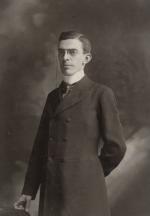
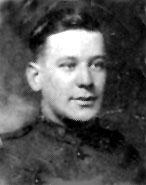
George Wesley Pedlow (1874-1947)

On August 8, 1874, George Wesley Pedlow was born in Manistee, Michigan. He attended public schools in Upland, Pennsylvania and Dickinson Preparatory School in Carlisle, Pennsylvania before enrolling in the College proper. At Dickinson, he was a member of Sigma Chi and captain of the football team in 1900.

In 1901, Pedlow graduated from Dickinson, and shortly after, he joined the 6th Pennsylvania Volunteers to fight in the Spanish-American War, though the conflict was resolved before his unit arrived in Cuba. After the War, he returned to Pennsylvania, where he served as principal at Dauphin High School for two years. From Dauphin, he went to Staunton Military Academy as an instructor. Five years later he left Staunton and returned to his hometown of Upland to serve as principal at the high school there for two years. In 1910, he left for a teaching position at Chester High School. At Chester High School, Pedlow finally found a more permanent position, serving as a teacher there until 1924, and then as principal from 1924 to 1941.

Throughout his life, Pedlow valued the education that he had received at Dickinson, and as an educator in the Chester School District, he was responsible for directing many students to the College. In 1942, he received an honorary Master of Arts degree from his alma mater.

College Relationship
Alumnus/Alumna Class Year
Honorary Degree - Year
1942

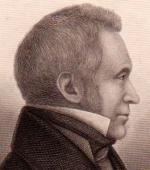
Richard Alexander F. Penrose (1827-1908)

Richard Alexander Fullerton Penrose was born in Carlisle, Pennsylvania, the second son of Charles and Valeria Fullerton Biddle Penrose on March 24, 1827; his elder brother was William McFunn Penrose. He was educated at the local Dickinson Grammar School and entered Dickinson College proper in 1842, graduating with the class of 1846. He went on to the medical school at the University of Pennsylvania and received his medical degree in March 1849.

College Relationship
Alumnus/Alumna Class Year
Honorary Degree - Year
1875

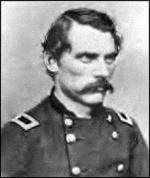
William Henry Penrose (1832-1903)

Birth: March 10, 1832; Sackett's Harbor, New York,

Death:  August 29, 1903 (age 71); Salt Lake City, Utah

Military Service: USA, 1861-96

Unit: 3rd Infantry of the Regular Army,  15th Infantry New Jersey, 1st Brigade of 6th Corps 1st Division, 3rd United States Infantry

Alma Mater: Dickinson College, B.A. (Class of 1849 non-graduate)

College Relationship
Alumnus/Alumna Class Year

William McFunn Penrose (1825-1872)

William McFunn Penrose, the eldest son of Charles Bingham and Valeria Fullerton Biddle Penrose, was born in Carlisle, Pennsylvania on March 29, 1825; Richard Alexander Fullerton Penrose was his younger brother. Their father was a well-known lawyer in the town. In 1840, William entered the local Dickinson College with the class of 1844. He won election to the Belles Lettres Society and graduated with his class. He then studied law, was admitted to the Carlisle bar in 1844, and immediately began a practice in Cumberland County.

At the outbreak of the Civil War, the six foot tall Penrose mustered in with what was to become the Sixth Reserves, 35th Regiment Pennsylvania Volunteers and was elected as a lieutenant-colonel when the unit was organized at Harrisburg in June 1861. The 35th was accepted into federal service on July 27, five days after moving to Camp Tenallytown; it wintered at Camp Pierpoint near Langley, Virginia. Penrose, as temporary commander of the regiment, saw action and was commended after the battle of Dranesville on December 20, 1861 for his coolness in command and the 35th Regiment's pursuit of the enemy. Camp Pierpoint, unfortunately, was a poorly drained establishment that brought widespread sickness, mostly probably malaria, to the regiment, including Penrose. With the regrets of his brigade commander, General Ord, Penrose resigned his commission due to illness early in 1862 and returned to Carlisle.

College Relationship
Alumnus/Alumna Class Year

Ralph Pierce (1827-1908)

Ralph Pierce was born in Franklin County, New York at the town of Moira on April 11, 1827. He was the son of Methodist preacher Hiram Pierce and his wife, Sarah Pierce. The younger Pierce prepared for college locally and enrolled at Dickinson College in Carlisle, Pennsylvania in 1848. While at the college, he was elected to the Belles Lettres Society. He graduated with his class in the summer of 1852 and immediately took up a teaching position as the head of the Cassville Academy in Blair County, Pennsylvania.

In 1854, Pierce began a short term as principal of Metropolitan Institute in Washington D.C. He then took up duties as a Methodist pastor under the Black River Conference, first in his home town of Moira and then in Torrington, New York. In 1856, the founder of Methodist activities in India, William Butler, invited Pierce to join the effort. Pierce sailed in early 1857 and spent more than six years on the sub-continent, largely in Lucknow and Bareilly in north central India. His early years of service must have been adventurous, since the Great Indian Mutiny of 1857 and 1858 was largely centered in that region.

College Relationship
Alumnus/Alumna Class Year

Esther Popel Shaw (1896-1958)

Esther Popel was born on July 16, 1896 to Joseph Gibbs and Helen King Anderson Popel of Harrisburg, PA. Esther had an older sister, Helen, and a younger brother, Samuel. The 1900 census indicates that her father was a letter carrier and the family lived at 703 State St. According to Esther’s memories, there had been Popels in Harrisburg since 1826 when her paternal grandfather and his free-born parents settled there.

Esther graduated from Central High School in Harrisburg in 1915 and enrolled at Dickinson the following fall. She was the first African American woman to enroll at the college. Esther commuted to campus daily, as Dickinson did not permit African Americans to live on campus at the time. Esther elected to pursue the Latin Scientific curriculum, which emphasized modern languages. She studied French, German, Latin, and Spanish. While at Dickinson, Esther received the 1919 John Patton Memorial Prize, an academic award granted annually to one student from each class.

Esther graduated from Dickinson in 1919. Her academic achievements earned her the distinction of being initiated into the national academic honor society Phi Beta Kappa.

College Relationship
Alumnus/Alumna Class Year
Honorary Degree - Year
2012

Bibliography of Works Written about Esther Popel Shaw


Bibliography of Writings About Esther Popel Shaw

Primary Sources

"2 Students Get Scholarships." Baltimore Afro-American, Mar 25, 1939.

"3,743 DIPLOMAS GO TO WEST SIDE HIGH SCHOOL GRADUATES." Chicago Daily Tribune, Jun 23, 1940.

Alston, Mabel. "In the Capital." Baltimore Afro-American, Dec 6, 1941.

College Relationship

George Latimer Potter (1795-1822)

George Latimer Potter was born into a distinguished Revolutionary family at Potter's Mills in what is now Centre County, Pennsylvania on June 13, 1795. He was one of seven siblings, including his elder brother, William Potter. He entered Dickinson College in Carlisle, Pennsylvania with the class of 1812, along with his brother but, unlike William, graduated with his class. Like his brother, he then studied law and passed the Centre County bar.

He moved to Danville, Pennsylvania to open a law practice. He also commanded briefly a Danville militia company called the "Columbia Guard." George Potter died on February 15, 1822 at the young age of twenty-six.

College Relationship
Alumnus/Alumna Class Year

William W. Potter (1792-1839)

William Wilson Potter was born into a distinguished Revolutionary family at Potter's Mills - in what is now Centre County, Pennsylvania - on December 18, 1792. He was one of seven siblings, which includes, George Latimer Potter, his younger brother. He attended a Lewisburg, Pennsylvania Latin School under the Reverend Thomas Hood and then, along with his brother George, entered Dickinson College in Carlisle, Pennsylvania with the class of 1812. He did not graduate but returned to Bellefonte in Centre County to read law with Charles Huston, his future brother-in-law.

Called to the Centre County bar in 1814, Potter built a large practice and a reputation as a hard-working advocate. In 1836, Potter was nominated as the Democratic candidate for a seat in the Twenty-Fifth Congress of the United States and was overwhelmingly elected. He gained a name for himself in Washington D.C, especially concerning the thorny matter of the United States Bank, and was re-elected in 1838.

Potter married Lucy Winter in March, 1816. At what appeared to be the point of a rising national notice, he died suddenly on October 28, 1839 in Bellefonte. He was forty-eight years old.

College Relationship
Alumnus/Alumna Class Year

Cornelius William Prettyman (1872-1946)

Cornelius Prettyman was born on July 21, 1872 in Leipsic, Delaware, the son of the Reverend Cornelius Witbank Prettyman of the Dickinson class of 1872 and his wife Emma Elizabeth. He prepared at the Newark Academy in his home state and then entered Delaware College in 1886. That same year he transferred to Dickinson College in Carlisle, Pennsylvania, where he excelled in the modern languages, played tennis, edited for the Dickinsonian, joined the Union Philosophical Society, and pledged with Beta Theta Pi fraternity, of which his father had been a charter member. He graduated in 1891 as a member of Phi Beta Kappa. His brother, Virgil, graduated the following year.

College Relationship
Alumnus/Alumna Class Year
President - Years of Service
1944-1946
Faculty - Years of Service
1900-1946

Leon Cushing Prince (1875-1937)

Leon Prince was born on May 15, 1875 to Morris Watson and Katherine Farnham Buck Prince in Concord, New Hampshire. He attended Bordentown Military Academy and then enrolled in New York University in 1894. During his time at military school, Prince was struck with muscular dystrophy which would confine him to a wheelchair for the rest of his life. In 1896 his father became a professor at Dickinson College in Carlisle, Pennsylvania and Prince transferred to the school shortly after in 1897. While at Dickinson, he was a member of Phi Beta Kappa honorary society and an officer in Belles Lettres Literary Society.

He graduated in 1898 and enrolled in the Dickinson School of Law. He graduated with a L.L.B. in 1900 and joined the Cumberland County Bar Association the same year. Also in 1900, Prince became an ordained clergyman of the New York Conference of the Methodist Episcopal Church and began a career as a librarian and instructor at Dickinson. Three years later he was promoted to the position of adjunct professor of history and economics. He held this position until 1910, when his father retired and Prince became a full professor of history and economics.

College Relationship
Alumnus/Alumna Class Year
Faculty - Years of Service
1900-1937

James Alexander Ventress Pue (1841-1919)

J. A. V. Pue was born in Howard County, Maryland to Arthur and Sallie Dorsey Pue on July 20, 1841. He prepared for his undergraduate career at the Dickinson Grammar School and entered Dickinson College in Carlisle, Pennsylvania in 1855 with the class of 1859. He was elected as a member of the Belles Lettres Society and graduated with his class in the early summer of 1859.

Pue studied law, but with the outbreak of the Civil War, he joined his militia cavalry unit when it rode south in May 14, 1861 and enlisted in the Confederate Army as the First Maryland Cavalry. The following day, Pue was elected as third lieutenant of Company A and was promoted to second lieutenant a year later. He was wounded at Greenland Gap, Virginia in April 1863, but this did not prevent him from joining the invasion of Pennsylvania in June. The First Maryland was attached to Fitzhugh Lee's Brigade at the time, and Pue almost certainly would have returned to Carlisle and the grounds of Dickinson College during Lee's late June occupation of the town. Pue was captured on August 7, 1864, probably at Moorefield, West Virginia, when the First was taken by surprise and suffered very heavy casualties. Following the end of the war, he moved to Bandera County, Texas with several members of his family, where he practiced law and entered the farming and stock-raising business. He also served as judge of the Bandera County Court.

College Relationship
Alumnus/Alumna Class Year

Earl Eugene Rahn (c.1892-1918)

From Birdsboro, Pennsylvania, Earl Rahn entered the Dickinson College in Carlisle, Pennsylvania in 1909. He began his academic life in the Scientific course but then changed to the Philosophical course. He participated in activities ranging from the track team to the debate team, and from drama to Glee Club. He wrote for the Dickinsonian and had a poem entitled "Fate" published in the 1915 Microcosm. In the most cruel of ironies, this poem deals with the possibility of early death. Rahn graduated with a bachelor of philosophy degree with his class of 1912.

At the outbreak of war, Rahn enlisted and took his officer training at Fort Oglethorpe, Tennessee before moving on to his unit at Columbia, South Carolina. His regiment was in France by mid-1918 and he was "struck down in youth" at Bois de Lar Rapp on October 18, 1918.

College Relationship
Alumnus/Alumna Class Year

Albert C. Ramsey (1813-1869)

Albert Ramsey was born in Carlisle, Pennsylvania in 1813. He and his brother, William Sterritt Ramsey, were the sons of William Ramsey (1779-1831) who was the Jacksonian representative during the 21st, 22nd, and 23rd United States Congresses and died in office. Both brothers entered the local Dickinson College with the class of 1830 but did not graduate. Both brothers were, however, elected to the Union Philosophical Society at the College, Albert in the class of 1829 and William with the class of 1830.

Few other details of Ramsey's early life are available but he was admitted to the York County bar in November 1834. According to items held in the Gettysburg College Special Collections, he received a master's degree in 1838 from Pennyslvania College in Gettysburg. He had served as District Attorney and was also editor of the York Democratic Press.

College Relationship
Alumnus/Alumna Class Year

Alexander Ramsey (1815-1903)

Alexander Ramsey was born near Harrisburg, Pennsylvania on September 8, 1815, the son of Thomas and Elizabeth Kelker Ramsey. He was educated locally and then attended Lafayette College in Easton, Pennsylvania. Entering the Law Department of Dickinson College in Carlisle, Pennsylvania in 1839, he earned a bachelor of laws degree in 1840. He was admitted to the Pennsylvania bar and opened a practice in Harrisburg.

At that time Ramsey began what can only be termed as a meteoric rise in politics, beginning with his appointment, almost immediately, as secretary to the electoral college of Pennsylvania, and then as clerk of the State house of representatives in 1841. By late 1842 he had been elected as a Whig to the Twenty-eighth Congress, representing Dauphin County, and served two terms from 1843 to 1847 before declining further nomination. Still only in his early thirties, his life took a momentous step when, on April 2nd, 1849, President Zachary Taylor appointed him to the post of Governor of the newly established Territory of Minnesota. Though some reports say that Ramsey would he preferred the more lucrative post of collector of tariffs at the Port of Philadelphia, he became and remained a Minnesotan for the rest of his life.

College Relationship
Alumnus/Alumna Class Year

William Sterrett Ramsey (1810-1840)

William S. Ramsey was born in Carlisle, Pennsylvania on June 12, 1810. He and his brother Albert C. Ramsey were the sons of William Ramsey (1779-1831) who was the Jacksonian representative during the 21st, 22nd, and 23rd United States Congresses and he died in office. Both brothers entered the local Dickinson College with the class of 1830 but did not graduate. Both were, however, elected to the Union Philosophical Society at the College, Albert in the class of 1829 and William with the class of 1830.

Ramsey studied the classical subjects he had begun at Dickinson in Europe and served as an attache with the American Legation in London. He was elected to the Twenty-sixth Congress in 1838 and was reelected in late 1840. Ramsey was suffering from a liver complaint, most probably from the effects of alcoholism. He had left his home in Carlisle on election day without telling anyone, though his brother had travelled from his own home in York to care for him. Shortly after his reelection, William Sterrett Ramsey shot himself through the right eye in a room at Barnum's Hotel in Baltimore, Maryland on October 18, 1840. He was thirty years old.

College Relationship
Alumnus/Alumna Class Year

William P. Reckeweg (1916-1945)

William Reckeweg was born in Audubon, New Jersey in September 1916. He attended high school there, graduating in 1933; he then entered Dickinson College in Carlisle, Pennsylvania with the class of 1937. While at Dickinson he was an active student: a football, soccer, and baseball player, and a member of the Glee Club and Sigma Chi fraternity.

After graduation, Reckeweg became employed as an insurance agent. However, by February 1941, he had enlisted in the United States Army and had been sent to Fort Indiantown Gap, Pennsylvania for training. He completed officer candidate school at Fort Benning, Georgia in August 1942; by August 1943, he was a captain. He applied for active duty and became the commander of Company C, 357th Infantry, 90th Division, just prior to the D-Day landings. He was wounded in early July in Normandy and spent six weeks in a hospital in England. William Reckeweg was killed in action on February 1, 1945, in northern Luxembourg, when shell fragments struck his company command post as his unit was digging in on newly-won high ground.

College Relationship
Alumnus/Alumna Class Year

John Reed (1786-1850)

John Reed was born in 1786 on Marsh Creek, in Adams County, the son of General William Reed. He entered Dickinson College in Carlisle, Pennsylvania with the class of 1806 but left before graduation to study law with William Maxwell of nearby Gettysburg. Reed was admitted to the bar and began practice in Westmoreland County. He quickly made a name for himself there and in 1815 he was elected to the Pennsylvania Senate and served as Deputy Attorney General for the state. In July 1820, Governor Findlay named him the President Judge of the Ninth Judicial District, comprising Cumberland, Franklin, Adams, and Perry counties.

Alumnus/Alumna Class Year
Honorary Degree - Year
1830
Faculty - Years of Service
1834-1850
Trustee - Years of Service
1821-1828

John Cromwell Reynolds (c.1810-1849)

John C. Reynolds was born the son of Reuben Reynolds in Cecil County, Maryland around 1810. He studied at an early age at the Nottingham Academy in his home county and then entered Dickinson College in Carlisle, Pennsylvania with the class of 1825. When he graduated with honors, Reynolds was still only sixteen years old. He then went on to study medicine with Dr. Nathan Smith in Baltimore.

Reynolds interned in the hospitals of Baltimore and then became a commissioned surgeon in the United States Army. He saw his first action in the second Seminole War, fought between 1835 and 1842 in Florida. Reynolds also was involved with the Cherokee unrest. This included the subsequent treaty signing authorizing the final removal of that tribe in 1835, and the escorting of 5000 tribe members across the Mississippi in the infamous "Trail of Tears" in 1838. He went on to serve under General Winfield Scott in the Mexican War in 1846.

Reynolds married Eleanor Moore of Lewistown, Pennsylvania and from then on called Mifflin County his home. John Cromwell Reynolds died on February 20, 1849 in Lewistown. He was thirty-eight years old.

College Relationship
Alumnus/Alumna Class Year

Robert Fleming Rich (1883-1968)

Robert Fleming Rich was born in Woolrich in Clinton County, Pennsylvania on June 23, 1883. His parents were Michael Bond Rich, from the famous Pennsylvania textile family, and Ida Belle Shaw. He was schooled at Mercersburg Academy and the Williamsport Commercial College before he entered Dickinson College in Carlisle, Pennsylvania in 1903 with the class of 1907. He joined Phi Kappa Psi during his freshman year and played two years on the football team, but left the College in 1906 without graduating to take up a position in the family's Woolrich Woolen Mills. Thus began a long and successful commercial career which saw him become general manager from 1930 to 1959, then president and chairman of the board of Woolrich Woolen Mills. He also engaged in other ventures in banking, manufacturing and utilities.

Rich became active in Republican politics, representing his district as a delegate to the national convention in 1924. In November 1930 he was elected to the Seventy-First Congress to fill the vacancy caused by the death of Edgar R. Kiess. He served for the next twelve years until 1942 when he did not seek renomination, but he returned to the House of Representatives in the Seventy-ninth Congress in 1945 and served another three terms. He retired from politics in early 1951 and devoted himself from then on to his work at Woolrich.

College Relationship
Alumnus/Alumna Class Year
Honorary Degree - Year
1941
Trustee - Years of Service
1917-1968

John Taylor Richards, Jr. ( -1918)

John Richards was from Hazleton, Pennsylvania and a member of the class of 1918 at Dickinson College in Carlisle, Pennsylvania, studying the Philosophical course. He was active at the College in the Y.M.C.A, and was also a member of Phi Kappa Sigma fraternity and a participant in freshman football.

Richards left to enlist in the spring of 1917 and served as a sergeant in the Quartermaster Corps of the American Expeditionary Forces. He arrived in France in November 1917 and died there on October 22, 1918.

College Relationship
Alumnus/Alumna Class Year

Henry Moore Ridgely (1779-1847)

Henry Moore Ridgely was born in Dover, Delaware on August 6, 1779. His father, Charles, was a doctor and Delaware colonial and state legislator who had been a delegate to the first state constitutional convention in 1776. His mother, Ann Moore, his father's second wife, kept a large and strict household that included her four step-children along with her own five. Ridgely studied at New Ark Academy, in Newark, Delaware in 1794 and left for Dickinson College in Carlisle, Pennsylvania a year later. While at the College he was active in the then fledgling Union Philosophical Society. He graduated in 1797 and studied law, first in Lancaster under Charles Smith and then with his elder step-brother Nicholas in Dover. He was admitted to the Delaware bar in 1802.

College Relationship
Alumnus/Alumna Class Year

Henry Milton Ritter (1847-1904)

Henry Milton Ritter was born on February 6, 1847 in Carlisle, Pennsylvania. He was one of the eight children of Henry and Mary Wonderlich Ritter, who opened the first merchant tailor establishment in the town in 1837. The younger Ritter was educated at the town schools and then entered the local Dickinson College with the class of 1867. He withdrew after one year, however, and completed business school training at the Eastman Business College in New York soon after. Ritter returned to Carlisle, entered his father's business, and ran the store in Carlisle for many years.

In January 1868, Ritter married M. Maybury Hassler of Carlisle, and the couple had three children. Henry Milton Ritter died in Carlisle on December 17, 1904. He was fifty-seven years old.

College Relationship
Alumnus/Alumna Class Year

Thomas Paschall Roberts (1843-1924)

Thomas Paschall Roberts, known as Colonel, was born in Carlisle, Pennsylvania on April 21, 1843 to William Milnor Roberts and Anna Gibson Roberts. His grandfather was John Bannister Gibson, Chief Justice of Pennsylvania. Roberts began classes at Farmers’ High School in 1859, then left in 1861 to attend the local Dickinson College, where he was elected President of the Union Philosophical Society.

He left Dickinson in 1863 to join his father in Brazil as an engineer on the Dom Pedro II railroad, and remained there until 1865. In 1872, on a U.S. government survey of the Missouri River, Roberts named Black Eagle and Rainbow Falls. During his career he worked on projects all over the United States, from the Montana Division of the Northern Pacific Railroad to the Louisville & Nashville system in Kentucky, and worked for many years for the Monongahela Navigation Company. From 1912 until his retirement on August 20, 1922 Roberts worked as an engineering consultant for the U.S. Engineer Office in Pittsburgh.

A regular contributor to newspapers and magazines, Roberts also wrote the Memoirs of John Bannister Gibson in 1890 and was one of the founders of the Engineers’ Society of Western Pennsylvania in 1880. Roberts had seven children with his wife Juliette Emma Christy, who he married on June 8, 1870. He died on February 25, 1924 at his home at 561 North Craig Street, Pittsburgh.

College Relationship
Alumnus/Alumna Class Year