Letter from Horatio King to John Cunningham
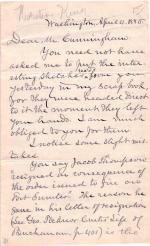
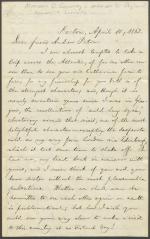
Horatio King writes John Cunningham telling him he put the sketches he received in his scrapbook.

Horatio King writes John Cunningham telling him he put the sketches he received in his scrapbook.
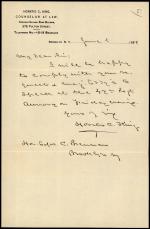
Attorney Horatio Collins King (Class of 1858) writes to Edward C. Brennan and accepts an invitation to speak at the 47th Regiment Armory in New York City.
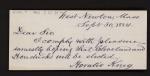
Attorney Horatio King writes to an unspecified recipient in West Newton, Massachusetts, endorsing the candidacy of Grover Cleveland and Thomas A. Hendricks in the 1884 Presidential election.
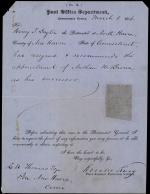
Postmaster General Horatio Collins King writes to L.A. Thomas, Postmaster of New Haven, CT, about a recent position vacancy. Collins states that Hervey T. Dayton resigned from the job and recommends Nathan U. Brown as a replacement.
Horatio Collins King writes to Frank Hamlin, declining the latter's invitation to a Sons of Maine banquet. Collins reminisces of his days as editor of The Jeffersonian and of his old friends, most of who are no longer living.
Civil War veteran William S. Harvey writes to Horatio Collins King, declining the latter's invitation to attend the reunion of the Society of the Army of the Potomac.
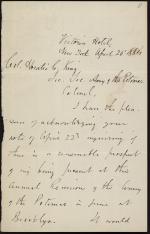
Civil War General Francis Fessenden writes to Horatio Collins King, declining the latter's invitation to attend the reunion of the Army of the Potomac in Brooklyn.
Civil War General William Hemsley Emory writes to Horatio Collins King, accepting the latter's invitation to attend the reunion of the Society of the Army of the Potomac, so long as "the gout which is very capricious and wayword, is not on [him]..
Civil War General Romeyn Beck Ayres writes to Horatio Collins King, acknowledging the latter's invitation to attend the reunion of the Society of the Army of the Potomac in Baltimore.
Civil War veteran John Murray Corse writes to Horatio Collins King (Class of 1858), sending regrets that he cannot attend the annual reunion of the Society of the Army of the Potomac due to a prior engagement.
Admiral David Dixon Porter acknowledges an invitation and tells Brevet Colonel Horatio Collins King (Class of 1858) that he will attend a reunion of the Society of the Army of the Potomac in Gettysburg, Pennsylvania on July 1-3, 1888.
Moncure D. Conway carries a letter for abolitionist William L. Garrison, who writes from Boston to his friend, Andrew Paton in Glasgow, Scotland, and introduces Conway in terms of highest commendation.
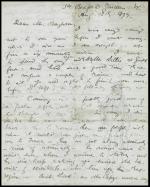
Edwin Austin Abbey writes to George Henry Boughton apologizing for not having said goodbye before leaving. Abbey further seeks forgiveness for having disliked Moncure Conway prior to formally meeting him with Boughton.
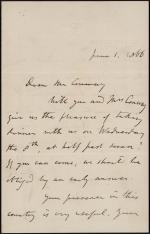
English philosopher John Stuart Mill writes Moncure D. Conway and invites him and his wife to appear as a special guest at an upcoming dinner party. Transcript included.
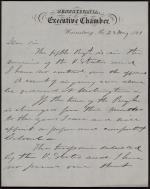
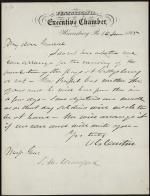
Pennsylvania Governor Andrew Gregg Curtin writes to H. C. Baird about a complaint against the officers of the Fifth regiment. Curtin notes that he has little power or control over most of the issues since that regiment is under federal authority.
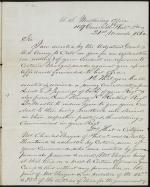
United States Mustering Officer C. J. Ruff writes Colonel William Frishmuth and requests a written response to several accusations of misconduct and corruption. “I am directed….
Pennsylvania Governor Andrew Gregg Curtin (Class of 1837) writes to Major General Samuel Wylie Crawford about a flag ceremony at Gettysburg.
Pennsylvania politician Andrew Gregg Curtin writes to John V. Hart with updates about a financial matter . Curtin hopes that once "Beckwith" is paid for the timber he sold to the Tyrone and Lock Haven Rail Road Company, he will have more money.
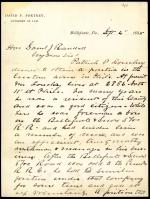
David F. Fortney writes to Samuel J. Randall, recommending Patrick P. Louchey for a position at the customs house in Philadelphia. On the reverse, Andrew Gregg Curtin writes to Randall recommending Mr. Louchey as well.
Andrew Gregg Curtin writes to William H. Rauch, offering his assistance in response to Rauch's request for help with gaining an appointment.
Andrew Curtin writes to John Cadwalader, recommending J.H. Hahn for a job. Curtin is also planning to come to Philadelphia later in the week.
C.C. McLean writes to Andrew Curtin regarding his father, Col. G.P. McLean. McLean again asks that Curtin refer the Colonel for a position in Philadelphia. On the reverse, Curtin writes a recommendation to John Cadwalader: "I remember Col.
Andrew Gregg Curtin writes to John Cadwalader in Philadelphia, recommending an unspecified Colonel Guss for a job.
James Noon to writes Andrew Gregg Curtin asking for a recommendation for a position at the custom house in Philadelphia as either "a watchman or messenger." On the reverse Curtin writes to John Cadwalader, endorsing Noon.