
About Full-Text Documents
Collections of college and personal papers, as well as a select number of individual documents, have been briefly described in entries available for browsing and searching on this site. All collection and document descriptions contain a representative image and a summary of the contents.
Search Document Descriptions
Browse Document Descriptions

August 4, 1859
President James Buchanan writes to W.C.N. Swift and voices his opinion that the Massachusetts delegation at the 1860 Democratic National Convention in Charleston, South Carolina "should be composed of sound national men who will act in unison." Buchanan also explains that he "feel[s] a deep interest in the Selection of a Sound national man as a Candidate for the next Presidency." Buchanan, who has been attempting to unite the Democratic Party, also notes his "regret to learn that any difficulty exists in harmonizing the Democracy of Massachusetts." Transcript included.
Format: Letters/Correspondence
Location: I-Friends-2001-3
Subject: Politics and Government
Time Period: 1840-1859
View Item: Letter from James Buchanan to W. C. N. Swift

October 8, 1859
Spencer Fullerton Baird (Class of 1840) writes to Osmond Tiffany, responding to the latter's request for documents about the Pacific Rail Road and the Mexican Boundary.
Format: Letters/Correspondence
Location: I-Friends-1982-7
Subject: Business and Industry, International Affairs, Science and Technology
Time Period: 1840-1859
View Item: Letter from Spencer Baird to Osmond Tiffany

October 24, 1859
Pennsylvania politician Andrew Gregg Curtin writes to John V. Hart with updates about a financial matter . Curtin hopes that once "Beckwith" is paid for the timber he sold to the Tyrone and Lock Haven Rail Road Company, he will have more money. Transcript included.
Format: Letters/Correspondence
Location: I-Purchase-1955-11
Subject: Business and Industry, Economics and Finance
Time Period: 1840-1859
View Item: Letter from Andrew Curtin to John Hart

October 27, 1859
President James Buchanan responds to John A. Wilstach's letter about domestic issues and foreign affairs. "I shall take great pleasure in reading your remarks on these important subjects at my earliest convenience," as President Buchanan explains.
Format: Letters/Correspondence
Location: I-Friends-2005-4
Subject: International Affairs, Politics and Government
Time Period: 1840-1859
View Item: Letter from James Buchanan to John Wilstach
November 14, 1859
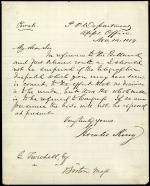
Assistant Postmaster General Horatio King writes to Ginery Twichell, president of the Boston and Worcester Railroad. King assumes that bids for new lines to Portland, ME and New Orleans, LA will be kept secret until "the whole matter is referred to Congress." Transcript included.
Format: Letters/Correspondence
Location: I-Friends-1983-10
Subject: Business and Industry, Politics and Government
Time Period: 1840-1859
View Item: Letter from Horatio King to Ginery Twichell
November 19, 1859
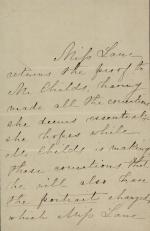
Harriet Lane writes to a Mr. Childs from the White House in 1859 regarding changes to a publication about her uncle President James Buchanan. Besides making corrections, Lane also wants Mr. Childs to use a different portrait of President Buchanan. The portrait that Mr. Childs had selected is, as Lane argues, “a serious libel against the President.” Transcript included.
Format: Letters/Correspondence
Location: MC 1998.10, B4, F16
Subject: Politics and Government
Time Period: 1840-1859
View Item: Letter from Harriet Lane to Mr. Childs

circa 1860
Andrew Curtin writes eight letters to Eli Slifer in which he discusses appointing a new colonel, providing money to Hays for a contest, an article in the Pennsylvanian, and nominations for Senate. Transcripts included.
Note: These letters are undated.
Format: Letters/Correspondence
Location: MC 2003.4, B3, F9
Subject: Military Affairs and Conflict, Personal and Family Life, Politics and Government
Time Period: 1840-1859, 1860-1879
View Item: Letters from Andrew Curtin to Eli Slifer (circa 1860)

1860
The Dickinson College catalog for the 1859-1860 academic year. Through the years, the annual catalog was variously titled "The Bulletin," "Catalogue and Register," "Course Catalog," and similar variants. The catalog typically includes the list of courses offered, requirements for enrollment, requirements for graduation, tuition and other fees, and campus facilities, college policies, and lists of teaching faculty, college trustees, and various administrators.
Format: Books and Pamphlets
Location: Dickinsoniana Periodicals
Subject: Dickinson College Academic Affairs, Dickinson College Administration, Education
Time Period: 1840-1859, 1860-1879
View Item:
1860-1862
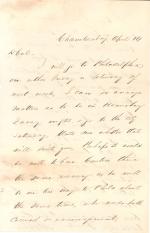
Alexander McClure writes thirteen letters to Eli Slifer, the Secretary of the Commonwealth under Governor Andrew Gregg Curtin, in which he criticizes the management of local military troops, proposes raising regiments for the Union Army, comments on various Pennsylvania political issues, and reflects upon the safety of the border during the Civil War. "Our people are nervously anxious about the safety of the border, because of the retreat of [General Nathaniel] Banks," as McClure notes. Transcripts included.
Format: Letters/Correspondence
Location: MC 2003.4, B7, F12
Subject: Military Affairs and Conflict, Personal and Family Life, Politics and Government
Time Period: 1860-1879
View Item: Letters from Alexander McClure to Eli Slifer, 1860-62

May 7, 1860
Supreme Court Chief Justice Roger Brooke Taney asks Representative George W. Hughes to "to call at my house some morning this week as you pop to the Capitol." Taney explains that he is still "suffering from my unlucky fall" and promises that he "will detain [Hughes] but a few minutes." Hughes is a Democrat from Maryland.
Format: Letters/Correspondence
Location: I-SpahrB-1951-3
Subject: Personal and Family Life, Politics and Government
Time Period: 1860-1879
View Item: Letter from Roger B. Taney to George Hughes
May 11, 1860
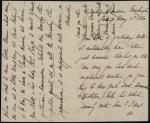
Lily Macalester writes her father, Charles Macalester, regarding her stay at the White House with her friend, First Lady Harriet Lane. Lily describes a dinner hosted by Lord Richard Lyons, the British minister to the United States, that a number of prominent officials attended, including General Winfield Scott and Vice President John C. Breckinridge. Lily also shares President James Buchanan's views on the Democratic National convention in Baltimore. "The President thinks the Convention at Baltimore has made a great mistake in not nominating Gen. Houston who would have made a good man," as Lily notes. Lily also tells her father about a dinner party as well as news regarding the impending arrival of Japanese delegates in Washington. Transcript included.
Format: Letters/Correspondence
Location: I-Friends-2000-2
Subject: Personal and Family Life, Politics and Government
Time Period: 1860-1879
View Item: Letter from Lily Macalester to Charles Macalester
May 13, 1860
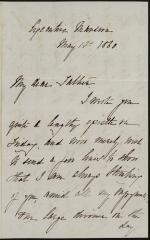
Lily Macalester writes to her father, Charles Macalester, about a dinner party she attends while staying at the White House with her friend First Lady Harriet Lane. Lily includes a description of her conversation with President James Buchanan and provides updates on other political issues, including the reaction to Edward Everett accepting the nomination for Vice President and a corruption scandal that involves the New York City Postmaster. Transcript included.
Format: Letters/Correspondence
Location: I-Friends-2000-3
Subject: Personal and Family Life, Politics and Government
Time Period: 1860-1879
View Item: Letter from Lily Macalester to Charles Macalester
May 25, 1860
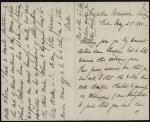
Lily Macalester writes to her father about an "elegant" party at the White House in which the Japanese delegation attended. In addition, Lily describes the plans for a future dinner party. Transcript included.
Format: Letters/Correspondence
Location: I-Friends-2000-4
Subject: International Affairs, Personal and Family Life, Politics and Government
Time Period: 1860-1879
View Item: Letter from Lily Macalester to Charles Macalester
May 26, 1860
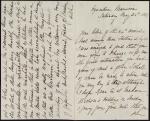
Lily Macalester writes her father, Charles Macalester, regarding her stay at the White House with her friend, First Lady Harriet Lane. Lily describes the dinner party with Japanese delegates as a "great success." "My friend the young Prince Stkahara Jugoro, is very bright" and, as Lily explains, "asked me for my card, and to write my name on it." As a result of her interaction with the Japanese delegation, Lily notes that President James Buchanan "complimented me extravagantly" after the dinner. Transcript included.
Format: Letters/Correspondence
Location: I-Friends-2000-5
Subject: International Affairs, Personal and Family Life, Politics and Government
Time Period: 1860-1879
View Item: Letter from Lily Macalester to Charles Macalester
May 29, 1860
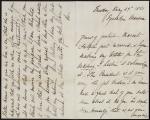
Lily Macalester writes her father, Charles Macalester, regarding her stay at the White House with her friend, First Lady Harriet Lane. Lily also discusses plans for a friend's wedding and a trip to Arlington. In addition, Lily comments on recent political news. "I understand that [Abraham] Lincoln's nomination disquieted [Illinois Senator Stephen] Douglas much," as Lily explains. Lily notes that she has "seen him but once, and then at a distance since I have been here, but I always speak of him, in terms of personal kindness to everyone." Transcript included.
Format: Letters/Correspondence
Location: I-Friends-2000-6
Subject: Personal and Family Life, Politics and Government
Time Period: 1860-1879
View Item: Letter from Lily Macalester to Charles Macalester
May 30, 1860
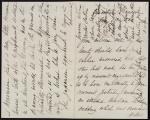
Lily Macalester writes to her aunt about the details of a wedding she attended and the bride's gown. Macalester, who is staying at the White House while in Washington D.C., also notes how "the President was quite pleased at your message" and mentions seeing the visiting Japanese dignitaries at an event. Transcript included.
Format: Letters/Correspondence
Location: I-Friends-2000-7
Subject: Personal and Family Life, Politics and Government
Time Period: 1860-1879
View Item: Letter from Lily Macalester to Mrs. Lathrop
1860-1861
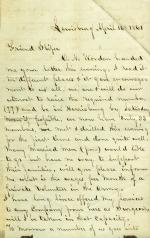
Dr. Theodore S. Christ writes eleven letters to Eli Slifer, the Secretary of the Commonwealth under Governor Andrew Curtin, regarding the organization of volunteer companies and daily life in a Union Army infantry company during the Civil War. Dr. Christ describes the injuries of soldiers and his treatments for them. "I visit the hospital several times a day, also all the men who need assistance & attendance in our regiment," as Christ notes. Christ also mentions the impact of finally receiving new uniforms and supplies. "Our Soldiers are now all newly & comfortably uniformed & equipped" and, as Christ explains, "we are now no longer ashamed to be seen." Transcripts included.
Format: Letters/Correspondence
Location: MC 2003.4, B2, F18-19
Subject: Health and Medicine, Military Affairs and Conflict
Time Period: 1860-1879
View Item: Letters from Theodore Christ to Eli Slifer
July 2, 1860
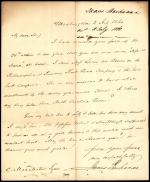
President James Buchanan writes to Charles Macalester asking for advice regarding North Carolina Bonds. Buchanan also mentions that he misses Macalester's daughter, Lily, who is friends with Buchanan's niece. An envelope postmarked 1857, which was addressed to Lily Macalester, was donated along with this letter, and it is therefore included in the attached.
Format: Letters/Correspondence
Location: I-LaskyR-2000-1
Subject: Business and Industry, Economics and Finance, Personal and Family Life
Time Period: 1860-1879

July 12, 1860
George B. Creamer prepared this oration, entitled “The Duty and Dignity of Man," for the commencement ceremonies held July 12, 1860. Authoring an original speech was among the graduation requirements for Dickinson College seniors at that time. Transcript included.
Format: Speeches and Sermons
Location: OrationsX-1860-C912d
Subject: Education, Religion and Spirituality
Time Period: 1860-1879
View Item: "The Duty and Dignity of Man," by George B. Creamer
July 12, 1860
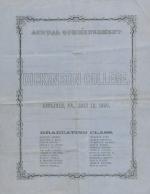
This copy of the printed program for the commencement exercises held on July 12, 1860 shows the members of the graduating class and the speeches that they were scheduled to deliver.
Format: Memorabilia and Ephemera
Location: Dickinsoniana Programs
Subject: Dickinson College Events
Time Period: 1860-1879
View Item: 1860 Commencement Program
July 12, 1860
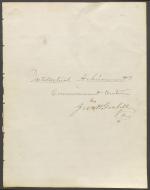
John H. Grabill prepared this oration, entitled “Intellectual Achievement," for the commencement ceremonies held July 12, 1860. Authoring an original speech was among the graduation requirements for Dickinson College seniors at that time. Transcript included.
Format: Speeches and Sermons
Location: Orations-1860-G728i
Subject: Education, Religion and Spirituality
Time Period: 1860-1879
July 17, 1860
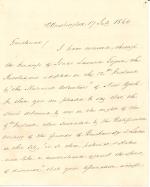
President James Buchanan writes to John T. Henry and several other men regarding a meeting of “the National Volunteers” of New York, sectional tensions, and the Presidential Election of 1860. "May the kind Providence which has watched over our Country from the beginning restore the ancient friendship & harmony among the different members of the Confederacy," as Buchanan notes. Transcript included.
Format: Letters/Correspondence
Location: MC 1998.10, B4, F3
Subject: Politics and Government
Time Period: 1860-1879
View Item: Letter from James Buchanan to John T. Henry
August 31, 1860
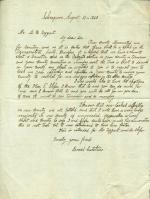
Israel Gutelius asks M. N. Taggart for help to secure Gutelius' nomination for Senator in the upcoming election. "As it is certain that there will be a split in the Democratic party," Gutelius explains that "it is believed that we have a chance to elect a Senator." Gutelius also notes that his letter should be shared with Eli Slifer. Transcript included.
Format: Letters/Correspondence
Location: MC 2003.4, B5, F8
Subject: Politics and Government
Time Period: 1860-1879
View Item: Letter from Israel Gutelius to M. N. Taggart

September 7, 1860
President James Buchanan writes to William R. Drinkard, Secretary of War John B. Floyd's chief clerk, in an attempt to solve a dispute over paying US Army Captain Montgomery Meigs. Buchanan asks Drinkard to send "the Paper addressed by Capt Meigs in reply to the Attorney Generals [Jeremiah S. Black] opinions together with all papers relating to the accounts which he refuses to pay." Transcript included.
Format: Letters/Correspondence
Location: I-Friends-2006-1
Subject: Economics and Finance, Legal Affairs, Politics and Government
Time Period: 1860-1879
December 13, [1860?]
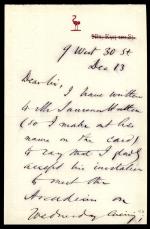
Clergyman and abolitionist Moncure Daniel Conway (Class of 1849) writes to an unspecified man, stating that he has accepted Laurence Hutton's invitation to an upcoming meeting and asking permission to bring his friend John Bigelow with him.
Format: Letters/Correspondence
Location: I-AsbellY-2003-10
Subject: Personal and Family Life
Time Period: 1860-1879