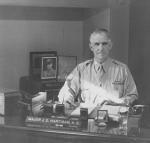
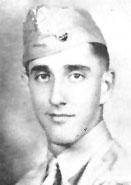
John Doane Hartigan (1890-1958)

In 1943, Colonel John Hartigan came to Dickinson as the commanding officer of the 32nd College Training Detachment (Air Crew), stationed there for training from March 1, 1943 to May 31, 1944.

After service as an aviator in the First World War, Hartigan became a member of several international committees, including the Saar Plebiscite Commission of the League of Nations. He was a personal representative for President Herbert Hoover, and assisted with the preparation of the American Military Government for Upper Austria after VE Day. While in Europe, Hartigan observed a need for well-trained diplomats, and explored the possibility of Dickinson College establishing a foreign career school. In 1948, he finalized his "Dickinson Plan" for the establishment of such a school; though he pursued this idea with the College and with contacts he had made in Europe, this plan never came to fruition.

After retiring from the Air Force, he went to live at the Army and Navy Club in Washington, D.C. John Hartigan died of a heart attack at the Washington Hospital Center on November 21, 1958.

For further information, see "The Hartigan Project" completed by Laura Dettloff and Regan Winn for History 204 during the fall 1999 semester.
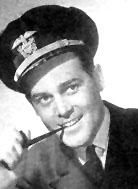
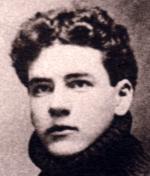
John F. Hart (1916-1945)

John Hart was born in Syracuse, New York, on October 20, 1916. He entered Dickinson in 1934, but did not complete his degree. He was a member of Phi Kappa Sigma fraternity.

He enlisted in the peacetime Naval Reserve in early 1941 and trained as an aviator in Jacksonville, Florida, earning his wings and an ensign's commission in April 1942. He flew anti-submarine PBYs in the Caribbean and the South Atlantic before being assigned to North Africa in November 1942.

In April 1943, he suffered severe injuries when his aircraft crashed and burned in Morocco. He then embarked on a thirteen month battle for life at hospitals in Boston and St. Albans, New York. On May 6, 1944 he was able to walk out of his ward and report for duty at the Naval Air Station in New York. He was then assigned to Pearl Harbor. However, on May 19, 1945, Lieutenant Jack Hart lost his life in the crash of an aircraft on a routine flight from Oahu.

College Relationship
Alumnus/Alumna Class Year

Samuel J. Harris ( -1918)

A member of the class of 1919 from Harrisburg, Pennsylvania, Samuel Harris pursued the Classical course, and was a member of Beta Theta Pi. Thereafter information on Harris becomes sparse. It is known that he was gone from the College by May 1917.

Harris joined the U.S. Army as a private, and rose to the rank of sergeant before taking his officer training at Camp Meade, Maryland. He was promoted to first lieutenant and lost his life in the course of the First World War.

College Relationship
Alumnus/Alumna Class Year

William Michael Harnsberger (1835-1862)

Birth: May 23, 1835; Port Republic, Rockingham County, Virginia

Death: September 19, 1862 (age 27); Loudoun County, Virginia

 Military Service: CSA, 1861-62

 Unit: Comapny I, Virginia 1st Calvary Regiment

Alma Mater: Dickinson College, B.A. (Class of 1856)

William Harnsberger was born on May 23, 1835 in Port Republic, Rockingham County, Virginia. As a member of the class of 1856, “Willie” was active in the Union Philosophical Society, Phi Kappa Sigma, and Zeta Psi. His brother, Henry, had been a member of the class of 1841. After receiving his bachelor of arts degree, William returned to Virginia, where he taught until the start of the Civil War.

Harnsberger enlisted in the Confederate States Army soon after the outbreak of the war, joining Co. I, Virginia 1st Calvary Regiment. He was killed on September 19, 1862 in Loudoun County, Virginia.

College Relationship
Alumnus/Alumna Class Year

Edwin Forrest Hann (1876-1970)

Edwin Forrest Hann was born on December 5, 1876 in Fairton, New Jersey, the son of John S. and Edith R. Hann. He prepared for college at the Pennington Seminary in New Jersey and originally entered Wesleyan University. By 1898 he was a member of the Dickinson class of 1901 and an active student in class and out. He was a member of the Beta Theta Pi fraternity, a valuable member of the Union Philosophical Society, serving as clerk of the society, and four year member of the campus YMCA. He graduated in 1901 with the Latin Scientific Section.

His sporting career at the College was outstanding. He was a three year letterman in football, captaining the 1899 team from his quarterback position. Fraternity feuding made for a difficult season that year but Hann was an able leader, running a kick-off back 90 yards in a 51-0 rout of Franklin and Marshall. Hann also played varsity baseball.

College Relationship
Alumnus/Alumna Class Year
Honorary Degree - Year
1923

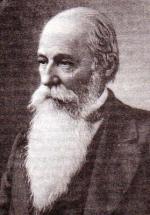
Samuel Stehman Haldeman (1812-1880)

Samuel Stehman Haldeman was born in Locust Grove, Pennsylvania on August 12, 1812, the eldest of what were to be the seven children of Henry and Frances Haldeman. He began his schooling at a local school on Conoy Creek. He also spent many hours in self-taught natural history during his spare time. When Haldeman was fourteen, he was sent to Dr. John Miller Keagy's classical school in Harrisburg and then went on to Dickinson College. He joined the class of 1831 but, with the college suffering the disruption that would lead to its temporary closing, remained only two years. Though he nurtured his emerging interest in biology and became a talented amateur scientist, he took over management of his father's new Chiquesalungo sawmill. His two brothers, Edwin and Paris, at the same time were starting an iron manufacturing business in the area and Samuel became a silent partner with them. He was always more involved in the science and the mechanics of both his businesses and continued during these years building up his impressive scientific acumen. In 1836, Henry Darwin Rogers, a former professor of Haldeman’s at Dickinson, asked him to take over the geology field operations in New Jersey that Rogers had to abandon on his being appointed the state geologist of Pennsylvania. Haldeman served in New Jersey for one year and, in 1837, came back to Pennsylvania to assist on the state survey there.

College Relationship
Alumnus/Alumna Class Year

Francis Gurney (1738-1815)

Francis Gurney was born in 1738 in Berks County, Pennsylvania. At the age 18 he enlisted in the Provincial Army. Gurney served during the French and Indian War, participating in the Canadian campaign, in action against the French West Indies islands, and in the capture of Guadeloupe.

After the war, Gurney returned to Philadelphia where he began his career as a merchant. During the American Revolution, he donated heavily to the cause both monetarily and in military service. He served as a captain with the Grenadier Company, 3rd Regiment, Philadelphia Militia, and was later promoted to lieutenant colonel. He resigned his commission on October 22, 1777 after a failure to receive an expected promotion. Gurney served throughout the remainder of the war and its aftermath in civilian offices.

During the Whiskey Rebellion his military services were again called upon. For three months, Gurney led 600 militia against rebelling farmers in western Pennsylvania. In 1799, he was promoted to brigadier general.

In addition to his other civic and military duties, Gurney served on the Board of Trustees of Dickinson College from 1798 until his death. He was often entrusted with College business in Philadelphia and Washington, D. C. Francis Gurney died on May 25, 1815.

College Relationship
Trustee - Years of Service
1798-1815

Thomas Morris Gunn (1840-1917)

Thomas M. Gunn was born in Shelbyville in Shelby County, Kentucky on March 17, 1840. He was the youngest son of William and Francis Adams Gunn. William Gunn, a presiding elder of the Lexington District of the Presbyterian Church, died when his son was only thirteen years old. Thomas Gunn was still able to enter Dickinson College in Carlisle, Pennsylvania in 1858 with the class of 1860. While at the College, he was elected to the Belles Lettres Society and graduated with his class in the early summer of 1860.

Straight from Dickinson and still only twenty years old, Gunn took the post of vice-president and professor of languages at McKenzie College in Clarkesville, Texas. He left teaching to enlist in the Union Army with the 21st Infantry of Kentucky in 1861 and served as chaplain in his unit. Following the war, Gunn embarked on a lengthy and extensive career as a Presbyterian clergyman. He was the pastor in Louisville, Kentucky in 1867. He then moved to Illinois, where he had congregations in Grand Ridge and Braidwood in the 1870s and served at Joliet from 1877 to 1885. In 1885, Gunn moved west to Walla Walla, Washington, where, in 1887, he became superintendent of missions responsible for certifying new congregations in Washington, Idaho, Oregon, and Alaska. He held this post until 1899 and then served again as a pastor in Cashmere, Washington from 1901 until his retirement.

College Relationship
Alumnus/Alumna Class Year

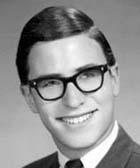
Victor Mahlon Gross (1946-1967)

Victor Gross was born in New Jersey on August 30, 1946 and was a graduate of Woodrow Wilson High School in Camden, New Jersey. He entered Dickinson College in Carlisle, Pennsylvania as a member of the class of 1968.

Second Lieutenant Gross was posted as missing on October 7, 1968 in Long An Province on his first night combat mission as an infantry unit commander. He was later recorded as died while missing due to hostile action. He had been in South Vietnam less than three weeks.

College Relationship
Alumnus/Alumna Class Year

Robert S. Grissinger (1925-1945)

Robert Grissinger was born one of twin boys on October 25, 1925 in Harrisburg, Pennsylvania but grew up in York Springs. He attended Dillsburg High School and graduated with honors. He entered Dickinson College in Carlisle, Pennsylvania as a member of the class of 1947, studying as a pre-medical student and joining the Theta Chi fraternity. He withdrew from the College when he was drafted into the service in January 1944.

After his air training program was canceled, Grissinger trained as an infantryman and embarked for the European Theater in October 1944. On November 19, 1944, he was wounded in action and was not able to return to his unit, Company G of the 397th Infantry, until after Christmas. He earned a Purple Heart in recognition of his injuries. On April 7, 1945, Grissinger was killed by a sniper at Heilbrom in western Germany while repairing his radio in action during an advance patrol, exactly one month before the end of the fighting in Europe. He was buried at the U.S. military cemetery nearby. For his part in the combat that led to his death, PFC Grissinger was awarded a Silver Star posthumously. This decoration, and a second Purple Heart, was sent to his parents.

College Relationship
Alumnus/Alumna Class Year