McClintock Hall (1964-2000)

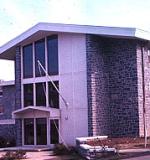
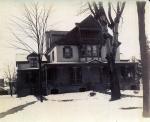
One of ten residence halls that originally made up the College’s Fraternity Quadrangle, McClintock Hall (Quad 5) was first occupied by the Sigma Alpha Epsilon fraternity in September, 1964. The building was later converted into a coeducational residence, and in the year 2000 was completely remodeled and joined with Baird Hall to form a single, larger residence hall.

McClintock Hall was named for John McClintock, a Dickinson faculty member who taught mathematics as well as the classics between 1836 and 1848, and then served on the Board of Trustees from 1849 to 1859. The building was designed by Howell Lewis Shay and Associates and constructed at a cost of approximately $200,000.

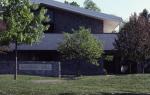
McIntire House (1948-1973)

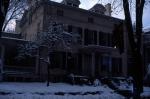
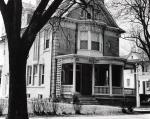
Dickinson College in Carlisle, Pennsylvania purchased the former residence of Bradford O. McIntire from his estate on June 5, 1948. The house, located on South College Street, cost $15,000, and alterations made afterward cost an additional $6,000.

McIntire House first served as a men’s dormitory, and then was home to the Commons Club from 1950 until 1952. In 1953, the house was renovated for use as a women’s residence. The College later sold the house in 1973.

McKenney Hall (1973-present)

Built next to the Upper Quads, construction on McKenney Hall began in 1972. McKenney Hall was completed in 1973 and the dedication ceremony was held on October 13th, 1973.

McKenney Hall was named in appreciation of W. Gibbs McKenny ('39), a member of the Board of Trustees since 1954, and his wife Florence Rea McKenney. W. Gibbs McKenney's father, Walter Gibbs McKenney also attended Dickinson and was a member of the Class of 1903.

Metzger Hall (1913-1963)

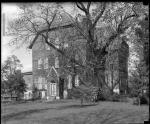
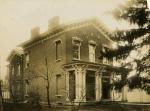
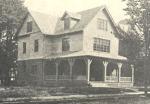
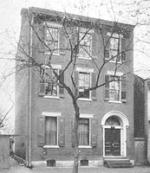
At his death in 1879, George Metzger, class of 1798, bequeathed his personal land and $25,000 to the town of Carlisle for the purpose of opening a college for women. To this end, a four-story, brick façade Victorian house was constructed at a cost of $30,000 on the two acres of Metzger property on North Hanover Street in 1881. On September 28 of that year, the Metzger Institute, a College for Young Ladies, was opened. The building provided Metzger students with a gymnasium, a dining room, and a library, as well as classroom and dormitory space. The rest of the campus included a tennis court and gardens. However, in 1913, as the Institute was struggling for funding, its trustees decided to lease the building rent-free to the local Dickinson College. The College would receive all income from the house, as long as the building was being used for the education of women.

From this time onward, Metzger Hall was home to the women of Dickinson College. As Metzger was six blocks from the main campus, residents dined, exercised, and entertained within its walls. By 1963, however, the building was in disrepair and only housed freshman women; representatives of the College therefore symbolically returned the building’s key to the Metzger Trustees that year. The property was sold shortly thereafter, and the building was subsequently razed to make way for fast-food restaurants and a gas station.

Montgomery Hall (1950-present)

Long before Dickinson College in Carlisle, Pennsylvania actually purchased Montgomery Hall, the building had a place in the history of the College. Built by Professor Robert Emory in 1837, it served as his home until 1842. The house was later owned by Professors William H. Allen (1847-1849) and John McClintock (1853-1870).

The College finally acquired the house from Reverend Harry B. Stock, class of 1891, on March 27, 1950. Purchased for $25,000, the house was then named for Colonel John Montgomery, who, along with Benjamin Rush, was instrumental in the founding of Dickinson College. A subsequent remodeling and enlargement project designed to convert the house into apartments for faculty use cost an additional $96,500.

In 1968, Montgomery Hall became a women’s dormitory. Soon after, the house began to serve various Student Developed Learning Communities, and over the years it has been home to the French and Spanish House, as well as the Volunteer House. The house was renovated in 2002 to become the home of the Department of Theatre and Dance.

Morgan Hall (1955-present)

Morgan Hall was dedicated on November 12, 1955 as the first single-purpose residence hall built for men in the history of the College. It was dedicated to the memory of James Henry Morgan (1857-1939), College alumnus, faculty member, dean, and president. A substantial portion of the total $600,000 cost was financed with a federal loan of $570,000. The architectural firm of Martin, Stewart, and Noble was responsible for the design.

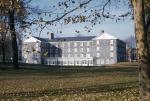
In 1965, with the opening of the Holland Union Building, the dining hall and kitchens were closed and converted to student living space. Since 1980, Morgan has largely housed freshman men and women. Major renovations were completed during the summer of 2002 and provided the building with a reorientated main entrance, now facing the Mooreland Campus, and an atrium, in addition to enlarged and modernized suites.

"New College" (1802-1803)

This brick structure was the first building constructed on the seven acre lot now known as the John Dickinson Campus of Dickinson College in Carlisle, Pennsylvania. It stood on the site of the present West College. This "New College" (distinct from the "Old College," a building along Liberty Avenue) was authorized by the Board of Trustees on September 26, 1798. The cornerstone was officially laid on June 20, 1799. The building was designed by John Keen of the Carpenter’s Company in Philadelphia, and was constructed at a cost of $12,000.

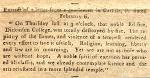
Tragedy struck when, less than two months after opening its doors to students, "New College" burned to the ground during a windy and snowy night on February 3, 1803. News of the tragedy appeared throughout the country, including in New York's Weekly Museum of February 19, 1803 (as shown).

Edison C. Nickel Potato Chip Factory

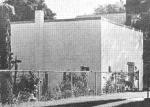
In 1949 Edison C. Nickel built a one story cinder-block potato chip factory adjacent to Dickinson College in Carlisle, Pennsylvania, near the South College building. Despite protests from Carlisle residents who believed that the factory would be a nuisance and a threat to the health and welfare of the community, the factory went into operation. Dickinson College offered to purchase the building in 1953, but the offer was withdrawn because of a disagreement over price.

The College eventually purchased the building for $16,000 in 1957 with the intention to convert it into a rifle range. This plan was never carried out, however, and the building was instead leased to and renovated by various agencies of the federal government, including the Agency for International Development and the General Services Agency. Although these agencies had already been leasing space in East College, the government’s use of the structure became the subject of student concern on multiple occasions, as rumors of connections with the Central Intelligence Agency, the Carlisle War College, and the Carlisle Police Department arose. One actual use for the building most probably was as the site of the emergency headquarters of the Labor Department of the United States should nuclear war decimate Washington DC.

North College (1822-1856)

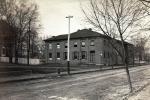
The reopening of the College in 1821 sparked the undertaking of major renovations to the campus. One of these renovations included the construction of a woodhouse and an icehouse to the north of West College in 1822. The woodhouse, built at a cost of $265 by John and George McCarter, was to be 80 feet long, 22 feet wide, and 12 feet high. The icehouse was to be 9 feet on each side and sunk 16 feet into the ground. Both buildings were made of limestone. Twenty-five years later, in July 1847, President Robert Emory authorized a $300 renovation supervised by contractor William H. Horn to provide living quarters for students, more specifically for young tradesmen, who were also provided with space to carry on their respective trades. Along with the new look and purpose came a new name, "North College," denoting the building’s location on the campus. North College was destroyed by fire on November 11, 1856, one week after Dickinson alumnus James Buchanan was elected as the fifteenth President of the United States. North College is believed to have been located approximately on the site of the white building in the background of the above image.

"Old College" (1781-1805)

Constructed in 1781 to house the Latin School which was under the care of the Presbyterian congregation in Carlisle, Pennsylvania, "Old College" fronted on Liberty Alley on Town Lot #219, the lot donated by Thomas and John Penn on March 3, 1773. The construction of this brick building, according to the records of contractor John Creigh, cost £42/3/5½. An addition, faced with stone, was authorized by the Board of Trustees of Dickinson College on October 20, 1785, and was completed at a cost of $583.62. With the expansion completed, the property was legally transferred to the College trustees on October 3, 1788.

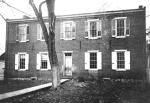
The first classes of the undergraduate courses were taught in the building until in 1802, in anticipation of the completion of a new building, the trustees of the College sold “Old College” to Charles McClure for $533.33. The College was granted the right to continue its use of the building, however, after the “New College” was destroyed by fire. Once Dickinson permanently vacated “Old College” in 1805, the building reverted to Charles McClure. Following McClure's death in 1811, the building came under the ownership of several schools in succession until, through carelessness or arson, it burned down on April 28, 1860. A new schoolhouse was then constructed on the site following the same design, and the image which appears here shows that all-brick building.

Old Gymnasium (1885-1953)

The first gymnasium of Dickinson College in Carlisle, Pennsylvania was completed in 1885, and was made possible by a gift from Clemuel Ricketts Woodin. The building was designed by Charles L. Carson and constructed at a cost of $7,513.28. The gymnasium was later equipped through a donation by William Clare Allison, and officially dedicated on January 6, 1888. A central heating plant was built into the basement of the gymnasium in 1889, so that by 1890 student dormitories and college classrooms no longer required individual stoves for heating. This addition brought to campus a familiar landmark - a tall smokestack.

In 1931, after the Alumni Gymnasium was completed, the so-called "Old Gymnasium" was converted into a social and recreational hall. It served as the dining hall for the cadets of the Air Crew Training Program during the Second World War. In 1946, this structure became the home of the College Commons. On May 17, 1953, the building’s western wall collapsed during a storm, and the building was razed shortly thereafter. The heating plant was retained, however, and an addition was added in 1955 for $70,000. The old heating plant and its boilers were finally replaced in 1966, and the tall smokestack was demolished in 1987.

The Pagoda (1871-1886)

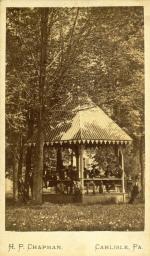
Erected in late spring 1871 as part of President Robert Dashiell's ambitious campus improvement campaign at Dickinson College in Carlisle, Pennsylvania, the pagoda was a pentagonal wooden gazebo that stood near the south wall on the John Dickinson campus. Designed to be a prominent campus fixture, the structure was painted in brilliant colors of white and chrome yellow with accents in red and ultramarine blue. The pagoda was nestled in a small grove of trees that dotted the campus, and was the site for many campus gatherings such as Class Day exercises during commencement.

Parker House (1938-1952)

Also known as the “Junior House,” the Parker House was one of three buildings that housed the women of Dickinson College in the first half of the twentieth century. Located on North Hanover Street, it was the former residence of William H. Parker, and was leased to Dickinson College in September 1938. Because of its proximity to Metzger Hall and Gibbs House, Parker House was used intermittently as a women’s dormitory until the opening of Drayer Hall in 1952.

Phi Delta Theta House (1931-1964)

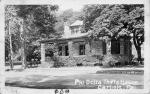
When officially named in the 1980s in honor of J. William Stuart, class of 1932, this house had already enjoyed fifty years of service to Dickinson College in Carlisle, Pennsylvania. A need for more living space led Dickinson’s chapter of Phi Delta Theta to construct Stuart House in 1931. Their previous residence, a stone lodge located on the corner of Louther and College Streets, could no longer accommodate the fraternity.

Stuart House served the fraternity, with a gap in 1944-1945 when it was rented to the College as a women's dormitory, until June 13, 1964, when the College purchased it at a cost of $57,000. Phi Delta Theta then relocated to the newly constructed Fraternity Quadrangle. A $24,000 renovation shortly after the purchase enabled Stuart House to become the new home of the Office of Communication and Development. The building later became a student residence once again in the 1980s.

Note: View a short film that shows clips relating to the construction of the Phi Delta Theta House by following this LINK.

Phi Delta Theta House (1899-1931)

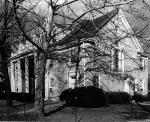
This stone lodge was built for the Phi Delta Theta fraternity at Dickinson College in Carlisle, Pennsylvania in 1899. It was designed by Harry E. Yessle.

The College’s purchase of the building for $8,300 was authorized on June 5, 1931, after the fraternity had constructed a new, larger house. The building was remodeled as classroom and office space for the department of education and psychology, and in 1958, it was assigned to the music department when education and psychology relocated to Reed Hall. It later served as the College’s Media Center, then again as a fraternity residence, and in the year 2000 it was converted into a student social space, "The Quarry," featuring a popular coffee bar.

Phi Kappa Psi House (1904-1964)

On April 2, 1904, the Phi Kappa Psi fraternity at Dickinson College in Carlisle, Pennsylvania purchased a house at 228 West High Street, immediately west of the President's House. The three-story brick house had been built around the time of the Civil War, was the former family home of Abram Bosler, Dickinson College class of 1905 and a member of Phi Kappa Psi.

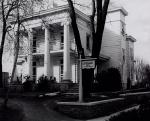
In 1925 the house underwent major renovations that included the addition of a larger porch and large white pillars that reached to the third story. In 1963, the fraternity sold the house to the College when they moved into Quad 9 (now Wilson Hall) of the Fraternity Quadrangle in fall 1964. The house briefly served in 1966 as the site for the Open Door coffee house, but the house was razed soon thereafter.

Phi Kappa Sigma House (1923-1963)

The Phi Kappa Sigma fraternity at Dickinson College in Carlisle, Pennsylvania purchased the former home of John Lindner at 28 North College Street in 1923. Three years later the exterior of the building was renovated: a colonial-style doorway was added and the old wooden steps were replaced by brick ones and a piazza. The fraternity then called in a professional architect to remodel the interior of the house in 1927, which resulted in the addition of an Italian marble fireplace.

The fraternity disbanded briefly from 1943 until 1946, during which time the building was rented out to the College. The members resurrected the fraternity following the war and once again occupied the house in 1946 until the building was bought by the College and razed in 1963 to make room for the Holland Union Building. Phi Kappa Sigma members then moved into Biddle House for the 1963-64 school year. With the completion of the Fraternity Quadrangle, they moved into Quad 8 (now Armstrong Hall) in the fall of 1964.

Phi Kappa Sigma House (1906-1923)

In 1904 the Phi Kappa Sigma fraternity of Dickinson College in Carlisle, Pennsylvania purchased a lot at 47 South College Street from Merkel Landis, Esq., class of 1896, at a cost of $1,200.

Construction began according to the designs of M. I. Kast of Harrisburg in 1906, and in January 1907 the $4,000 building was completely finished. It consisted of three stories, the façade being composed of brown stone on the first floor with the other two bearing shingles under a slate roof. The first floor housed the social space, the second floor was the dormitory area, and the third floor provided a meeting room for the fraternity.

By 1923 the house had become too crowded, and so the fraternity purchased the former home of John Lindner on North College Street.

President's House (1890-present)

Before it became home to Dickinson College’s presidents, this Carlisle, Pennsylvania house, which was built in 1833, was the home of the Hon. John Reed, a local judge. Reed introduced law into the Dickinson College curriculum, and gave his first law instructions to students in the basement of this house.

Preferring not to reside in the President's home located in East College due to its close proximity to the students' living quarters, incoming President George Reed purchased the house and subsequently sold it to the College on January 9, 1890 for $8,000. A second floor was immediately added on to the house at a cost of $7,000, these funds being provided by a gift of William Clare Allison.

Under President Corson, a new north face designed by W. W. Emmart was added in 1937, paid for by Mrs. Paul Appenzellar whose husband was a member of the class of 1895. This redesign established the entrance on the eastern side of the house, turning the old front entrance and porch into an open terrace. In 1979, under President Samuel Banks, the facade was sandblasted to reveal the natural brick exterior.

Reed Hall (1954-present)

Acquired by Dickinson College in Carlisle, Pennsylvania as part of a property exchange on June 11, 1954, the former Allison Memorial Church House was renamed in honor of President George Edward Reed. The house was remodeled in 1958 at a cost of $25,589, and began serving the department of psychology and education.

When these departments later relocated, Reed Hall became a student residence, serving various fraternities and other student organizations.

Florence Jones Reineman Wildlife Sanctuary (1966-present)

Created by a trust under the will of Mrs. Florence W. Erdman in memory of her mother, the Florence Jones Reineman Wildlife Sanctuary was established for Dickinson College in Carlisle, Pennsylvania in 1966, and dedicated on September 30, 1971.

This 3037-acre sanctuary, located in Green Valley, Perry County, was to be used solely for field studies in botany, biology, and geology, as well as the conservation and preservation of wildlife. Recreation such as hunting, fishing, or trapping is prohibited. The trustees, in exchange for supervision and educational use by the College, would pay all capital costs and program funding.

Sellers House

On June 28, 1943, Dickinson College purchased the Sellers House, the former residence of Montgomery P. Sellers, for $15,000. This orange brick building, located on West High Street, served as a dormitory for men until 1944, when it became the College Health Center. In 1952, it was converted into the Dean’s Residence. Eight years later, Sellers House again became a student residence, this time housing female students.

For a number of years, Sellers House continued to serve as a student residence, housing different fraternities and sororities, as well as other special interest groups. In April 2003, the college dedicated the building as the Milton B. Asbell Center for Jewish Life at Dickinson College.

Sigma Alpha Epsilon House (1946-1964)

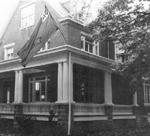
The Sigma Alpha Epsilon fraternity at Dickinson College in Carlisle, Pennsylvania had lost both its first house and second house to the outbreak of two world wars. But the fraternity regrouped and purchased yet another home in 1946. After some renovations, the brothers were able to move into their new home in the spring of 1947. The new house was located at 200 South College Street and was a three story red brick house with white trim and a large front porch with double white columns.

Sigma Alpha Epsilon remained at this location until 1964 when the fraternity moved into Quad 5 (now part of Baird-McClintock Hall) in the Fraternity Quadrangle. The house on South College Street was then sold to the Dickinson School of Law and was later demolished.

Sigma Alpha Epsilon House (1922-1942)

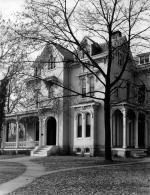
After having lost their first house for military use during the First World War, the Sigma Alpha Epsilon fraternity of Dickinson College in Carlisle, Pennsylvania had moved into East College. In 1922, however, the fraternity purchased the former home of Wilbur Fisk Sadler, a large white Victorian house situated on the southwest corner of College and Louther Streets. The ornate three story building was remodelled in 1928 to better accommodate the fraternity.

The brothers of Sigma Alpha Epsilon remained in this location until 1942, when the Second World War caused their numbers and support from their alumni to dwindle dangerously low and the fraternity was forced to sell the house. The number of members still at the wartime College remained so low for the next few years that a chapter house was not required. In 1946, however, the fraternity had recovered sufficiently to warrant the purchase of their third house.

The former Sadler house was later demolished and its site is now occupied by the Holland Union Building.

Sigma Alpha Epsilon House (c.1900-c.1917)

Around 1900 the Sigma Alpha Epsilon fraternity at Dickinson College in Carlisle, Pennsylvania purchased a three story building located just off of the northeast corner of West and Louther Streets (170 W. Louther). Red brick with white trim, their home was a simple building constructed in the "old style." Here they lived until the house was commandeered for military housing following the outbreak of the First World War. The fraternity then moved into the eastern section of East College for five years before purchasing their second house. The first fraternity house has since been expanded and is currently used for private residence.