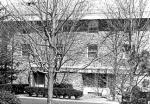
Sigma Chi House (1925-1964)

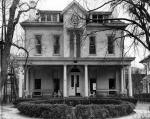
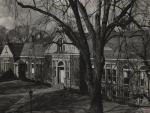
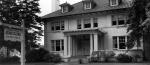
Having outgrown their former residence, the members of the Sigma Chi fraternity at Dickinson College in Carlisle, Pennsylvania purchased the former residence of Charles Berg at 41 South College Street for $32,000. This price included the cost of alterations to the building. Here they resided until the house was purchased by Dickinson College on June 23, 1964; the fraternity then moved to Quad 4 (now Baird Hall) in the Fraternity Quadrangle. The building then became known as the Todd House.

Sigma Chi House (1905-1925)

In 1900, the Sigma Chi fraternity at Dickinson College in Carlisle, Pennsylvania purchased a lot on West High Street adjacent to South College, and upon the site was constructed a house designed by Ray Zug, class of 1897 and a member of the fraternity. The formal dedication of the building took place in 1905.

The fraternity occupied the building only until 1925 when it was sold to the College for $9,000. In 1924 the fraternity had purchased the former home of Charles Berg on South College Street. The College rented the building to Tau Epsilon Phi, a fraternity at the Dickinson Law School. It was then razed in 1927 to make room for the new Alumni Gymnasium.

South College (1835-1836)

Dickinson College in Carlisle, Pennsylvania purchased the former site of the German Reformed Church on January 7, 1835, at a cost of $2,050. This building, located opposite West College across High Street, was given the name South College, and was used as the College Grammar School until it was destroyed by fire on December 23, 1836. A new, larger South College was constructed on its site.

South College (1838-1927)

Built to replace its predecessor at Dickinson College in Carlisle, Pennsylvania which was destroyed by fire in 1836, the second South College was completed on January 1, 1838. It was built to the design of Peter B. Smith, and was constructed at a cost of $5,825.

At first, the second South College contained a dormitory and classrooms for only the College Grammar School. In later years, however, the building would serve as a library, museum, and science department for the College as well. Another floor was added to the building in 1887, and the entire structure was refurnished at a cost of $5,215.

In 1927, South College was razed to provide space for the Alumni Gymnasium. A third South College was constructed behind the gymnasium in 1948.

South College (1948-present)

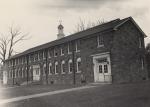
A Second World War surplus building purchased by Dickinson College in Carlisle, Pennsylvania in 1948 became the third South College in the college history. To make the newest South College more suitable for academic purposes, the College dismantled and re-erected the building at a cost of $46,943. John K. Bixler designed the new structure, which opened in June 1948.

The new South College featured classrooms and faculty offices on the upper floors, with the lower level including a student lounge, which was later enhanced with a snack bar. When the Holland Union Building was completed, the College converted this student common area into extra classrooms and offices for the mathematics department. An indoor handball court also graced the building for years. In 1967 a portion of the building became the IBM computer center, the first such center in the College’s history, and a year later the center offered the College’s first computer science courses. The mathematics and computer science departments occupied South College until moving into a new science building in 1999. Elements of computer services also moved from the building in 2003, taking offices in the basement of the Library after the creation of the combined Library and Information Services, while the mainframe, other hardware, and its support personnel remained in South College.

Boyd Lee Spahr Library (1967-1998)

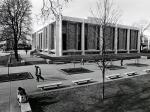
The longtime interest of Board of Trustees president Boyd Lee Spahr in advancing the collections and services of the Dickinson College Library in Carlisle, Pennsylvania reached its peak on November 4, 1967, when Dickinson College’s Boyd Lee Spahr Library was dedicated. It had been designed by Howell Lewis Shay and Associates, and constructed at a cost of $2,250,000.

The new library consisted 62,000 square feet of space on three levels: the main floor was used for reference and operations, while the upper and lower levels contained the stacks of books. On October 12, 1967, members of the Dickinson community participated in a book walk, which moved the entire library collection from Bosler Hall into the new Spahr Library. Two memorials were also established in the building. The Alexander A. Sharp Room for recreational reading continued first Dickinson female trustee Mary Sharp Foucht’s memorial to her father, which had been first established in the library in Bosler. The May Morris Room provided a home for the Dickinsoniana Collection, rare books, and manuscripts. May Morris, a member of the class of 1909, was the College’s longtime librarian and the second female full professor in Dickinson history.

Theta Chi House (1925-1964)

In 1925 the Theta Chi fraternity at Dickinson College in Carlisle, Pennsylvania purchased the former Long residence at 270 West High Street, adjacent to the former home of Abram Bosler, class of 1905. Before the fraternity could move in, the house was completely remodeled at a cost of $32,000; some of the renovation included the addition of new heating and plumbing systems, a new porch, and a stucco exterior. The members dedicated their new home in 1926.

During the Second World War, the house was rented out to the College for use as a dormitory, but the members of Theta Chi returned to their home in the summer of 1946. The fraternity would occupy this house until 1964 when they moved into Quad 2 (now Buchanan Hall) in the Fraternity Quadrangle. The building was later torn down.

Tome Hall (2000-present)

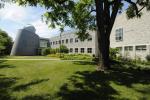
In October 2000, the New Science Building, at Dickinson College in Carlisle, Pennsylvania was dedicated during homecoming weekend.

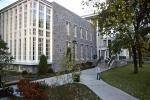
The structure is located across Louther Street from the Holland Union Building next to the James Center. Construction of the $13.3 million building had begun two years earlier, and classes had been held within its walls since the fall of 1999. Designed by the architectural firm of Ellensweig Associates, the new building contains enlarged classroom and laboratory space, faculty offices, and a large lecture hall in addition to the Kanev planetarium and the Britton observatory. The building houses the departments of mathematics, physics and astronomy, and computer science.

In Fall 2001, with the renaming of the Tome Scientific Building as the Stern Center for Global Education, the "New Science Building" was also rechristened as the New Tome Building.

Tome Scientific Building (1885-2000)

Long the dream of Professor Charles Francis Himes, Tome Scientific Building was Dickinson College’s first building constructed solely for scientific purposes. Situated along Louther Street, on the Carlisle, Pennsylvania campus between Old West and East College, the building was completed on June 24, 1885, to the design of architect Charles L. Carson. The construction costs of $23,000 were more than covered by a generous $25,000 donation made by the building’s namesake, Jacob Tome. The building featured classroom and office wings, with the center serving as a museum. This museum was removed in 1947 when the chemical laboratories were enlarged, a renovation that cost $35,000.

In 1958, Tome underwent a $165,000 interior renovation, the building being completely remodeled with much-needed modern equipment. This new look included the Bonisteel Planetarium which was installed in the center space formerly occupied by the museum. The planetarium was designed by Henry L. Yeagley, professor of natural philosophy, and was financed by a $50,000 donation from Roscoe O. Bonisteel, class of 1912.

Robert A. Waidner Admissions Building

The Alpha Chi Rho House was purchased for $55,000 in 1964 and became the home of the Admissions Office. It was later lavishly refurnished in the late 1980s. In 1990, after this renovation was completed, the house was named in honor of Robert A. Waidner, class of 1932 and a member of the Board of Trustees.

Waidner-Spahr Library (1998-present)

In March 1997, the Spahr Library underwent a major renovation project which included an expansion of the current library; on October 23, 1998, the Robert A. Waidner section of the Waidner-Spahr Library was officially dedicated. The new extension nearly doubled the amount of space available in the Spahr wing (which underwent its own renovation), and allowed the College to house all of its books, collections, and holdings under one roof. The expanded library  contains computer labs, classrooms, and individual study rooms. It was designed by Perry Dean Rogers and Partners, and the construction cost $14 million ($12.5 million for Waidner and $1.5 million to renovate Spahr). Its namesake, Mr. Waidner, was a member of the class of 1932 and of the Dickinson College Board of Trustees.

Emil R. Weiss Center for the Arts (1983-present)

After the completion of the Kline Life/Sport Learning Center, the Alumni Gymnasium at Dickinson College in Carlisle, Pennsylvania underwent a two year, $3.4 million renovation in 1981 to become the Emil R. Weiss Center for the Arts. The renovated center, designed by Robert A. Spillman of Spillman Farmer architects, was dedicated on May 21, 1983. It was named in honor of Emil R. Weiss, Dickinson College class of 1953 and a member of the Board of Trustees, whose generous gift made the renovation possible. Major renovations included the addition of a second ceiling to the gymnasium area to create a fourth floor, as well as an addition to the south side of the building.

The Weiss Center houses the Departments of Music and Fine Arts, providing classroom and office space as well as practice rooms and art studios. The basement and first floor are home to the Howard Lane Rubendall Recital Hall (named in honor of the alumnus and former College president), and the Trout Art Gallery (a tribute to Brook and Mary Trout by their daughters Ruth, class of 1936, and Helen), which was dedicated on October 14, 1983.

West China Union University (1910-1926)

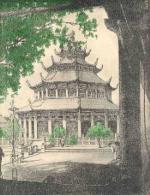
The West China Union University, located in Chengtu, Szechuan Province, China, was the product of the collective efforts of four Protestant, denominational missionary boards and eventually became a division of the West China Educational Union, which was created in 1906. One of the founding members of the University was Dr. John F. Goucher, Dickinson College class of 1868 and namesake of Goucher College. The university became the focal point of the Carlisle, Pennsylvania college's Dickinson-in-China program.

Once established, the University had a difficult task in trying to convert the people of the Szechuan province, as it was the only institution with a christianizing purpose in the region; the faculty and administration were attempting to convert the beliefs of a population in excess of 100 to 150 million people. Due to the rise of anti-christian and anti-western sentiment in China at the time, the West China Union University was closed in 1926, and the Educational Union itself closed three years later.

West College (1805-present)

Tragedy struck Dickinson College in Carlisle, Pennsylvania when on February 3, 1803, “New College,” which was more than three years under construction and had only recently begun to be used for school purposes, was completely destroyed by fire. The trustees immediately decided to rebuild, heartened by the support of the local community. Some gentlemen journeyed to the big cities to solicit funds for the project; numerous political leaders of note appear on the list of subscribers from Washington, D.C., including President Thomas Jefferson and several members of his cabinet. While funds were being raised, a committee was charged to secure a plan for the new building. Hugh Henry Brackenridge took it upon himself to travel to Philadelphia to ask Benjamin Latrobe, recently employed as architect for the construction of the National Capitol Building, to provide such a plan. Within a very short time, Latrobe obliged by offering his drawings and suggestions for the new college building, free of charge.

Wilson Hall (1964-2005)

Students first occupied Wilson Hall (Quad 9), one of ten residence halls that made up the Dickinson College’s Fraternity Quadrangle, in September 1964. It originally served as the residence of the Phi Kappa Psi fraternity, and when the fraternity relocated, the building became a general residence hall. The building was named in honor of James Wilson, a signer of the Declaration of Independence who was an original patentee of the Carlisle Grammar School and a founding trustee of Dickinson College.

The building was designed by Howell Lewis Shay and Associates, and constructed at a cost of approximately $200,000.

Witwer Hall (1967-present)

The final building to be constructed on Dickinson College’s Benjamin Rush campus, Witwer Hall was dedicated on October 14, 1967. The hall, which was first used as a residence hall for women, was designed by Elmer H. Adams and constructed at a cost of $500,000. The name of the building recognizes the generosity of Mr. and Mrs. Harold R. Witwer and Mr. and Mrs. Samuel W. Witwer, and of the endowed support of the Witwer Family Memorial Fund.