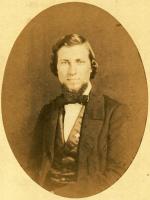
Samuel Cushman Caldwell (1836-1923)

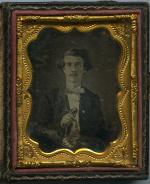
Samuel Cushman Caldwell was born on April 10, 1836 in the west end of Old West at Dickinson College in Carlisle, Pennsylvania. His father, science professor Merritt Caldwell, and his mother had their home on the first and second floors of the college building. Professor Caldwell was forced to resign from his position at Dickinson in March 1848 due to poor health. He died soon after in Portland, Maine. There, the younger Caldwell lived with family, preparing at the Hebron Academy for college. In 1855, Samuel Caldwell returned as a student to Dickinson College, where he was elected to the Union Philosophical Society and graduated with his class in 1858. Caldwell taught Greek and Latin in Maryland and at the Rock River Seminary in Mount Morris, Illinois. He then returned to Portland, Maine to study law. Caldwell was admitted to the bar there in 1863, but took up journalism instead. He worked for The Methodist as assistant editor to George R. Crooks, one of his father's former students of the Dickinson class of 1840. 
College Relationship
Alumnus/Alumna Class Year
Honorary Degree - Year
1899

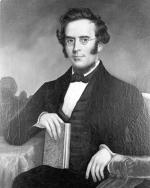
Merritt Caldwell (1806-1848)

Merritt Caldwell was born on November 29, 1806 to William and Nancy Caldwell of Oxford, Maine. He attended Bowdoin College and Medical School, graduating in 1828. He received his master’s degree from that institution in 1831. From 1828 until 1834, Caldwell was principal of the Maine Wesleyan Seminary.

Caldwell came to Dickinson College in 1834 as professor of mathematics, metaphysics, and political economy. He is credited with introducing the first biology classes at the college, known then as “natural science.” In 1841, he was forced by ill health to take a break from teaching, but returned to the school upon his sufficient recovery. Caldwell traveled to London in 1846 where he participated in the World’s Temperance Conference before a four month tour of Europe. Caldwell’s delicate health had improved during his European tour, but this proved only temporary.

He resigned his position at the College in March 1848 due to failing health. Merritt Caldwell died of tuberculosis on June 6, 1848 in Portland, Maine.

College Relationship
Faculty - Years of Service
1833-1848

James Hope Caldwell (1860-1941)

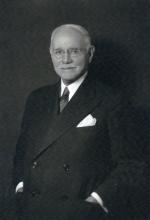
On September 25, 1860 in Newman, Georgia, James Hope Caldwell was born to the educator and minister, Dr. John H. Caldwell, and his wife, Elizabeth Hodnett Caldwell. His father was a founder of Andrew College in Cuthbert, Georgia. Caldwell attended the Wilmington Conference Academy before entering Dickinson in 1876. He became a member of Phi Kappa Psi fraternity and ended his senior year as a member of Phi Beta Kappa. He received a B.A. degree from Dickinson in 1880 and a M.A. degree in 1883.

After leaving Dickinson, Caldwell enrolled at the University of Pennsylvania Law School, where he received his law degree in 1884. That same year, he was admitted to the bar and moved to New York City to practice law. He eventually became a senior partner at Caldwell & Raymond, a firm specializing in municipal and state bond issues. While at Caldwell & Raymond, he served as bond counsel for the cities of Buffalo, Syracuse, Miami Beach, Nashville, and Chattanooga. He also represented several leading motion picture companies when President Taft's Attorney-General George W. Wickersham sued for a dissolution of the motion-picture trust.

College Relationship
Alumnus/Alumna Class Year
Trustee - Years of Service
1930-1941

Paul D. Burtner (?-1967)

Second Lieutenant Burtner died in an automobile accident near Del Rio, Texas, on March 20, 1967, a few days after he had received his wings as an Air Force pilot. A Philosophy and English major and a graduate of the class of 1965, he was the son of Lt. Colonel Clare Paul Burtner and Mrs. Margaret Burt Burtner, both of the class of 1941.

At Dickinson Burtner was a member of the Kappa Sigma fraternity and served all four years on the Student Senate and as its president during his senior year.

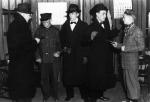
Image Note: Cast of The Ghost Train with Paul Burtner at far right in 1938.

College Relationship
Alumnus/Alumna Class Year

James Burnside (1809-1859)

James Burnside was born in Bellefonte, Pennsylvania on February 22, 1809, the eldest son of Judge Thomas Burnside. He prepared at the Bellefonte Academy and entered Dickinson College in Carlisle, Pennsylvania with the class of 1828, graduating with highest honors. He then studied law in the office of his father and was admitted to the Bellefonte bar in 1830 and began practicing law in his father's firm.

Burnside was elected in October 1844 to the Pennsylvania state legislature and was re-elected the following year. Governor William Bigler named his fellow Centre County resident as the first judge of the newly formed Twenty-Fifth Judicial District on April 20, 1853, and, in October, 1853, his position was confirmed by election.

Burnside married Rachel Cameron, daughter of a fellow judge, on June 2, 1848. The couple had two sons and a daughter. On Friday evening, July 2, 1859, he was thrown from a runaway buggy in Bellefonte and died instantly from a fractured skull. James Burnside was fifty years old.

College Relationship
Alumnus/Alumna Class Year

John Buonocore III (1965-1985)

John Buonocore III, a twenty-year-old Dickinson College junior, was one of five Americans killed in a terrorist attack on Rome's Leonardo da Vinci Airport on December 27, 1985. Buonocore was standing at the check-in counter of Trans World Airlines when Arab suicide terrorists began hurling hand grenades and firing Kalashnikov rifles at holiday travelers. The attack was aimed at the terminal of El Al, an Israeli airline, and was a reprisal for an Israeli air raid on the headquarters of the Palestinian Liberation Organization in Tunis, Tunisia on October 1, 1985. There was a similar attack in Vienna at the Schwechat Airport at about the same time on the same day. A total of nineteen people died in the two attacks, including Natasha Simpson, the eleven-year-old daughter of Victor L. Simpson, the Associated Press news editor in Rome. Abu Nidal, an elusive Palestinian terrorist and leader of the infamous Faith Revolutionary Council, was the apparent mastermind behind the attacks.

Only one of the five attacking terrorists survived as airport security forces returned fire. In his clothes, authorities found a note, in Arabic, which read:

“As you have violated our land, our honor, our people, we in exchange will violate everything, even your children to make you feel the sadness of our children. The tears we have shed will be exchanged for blood. The war has started from this moment.”

The letter was signed, “The Martyrs of Palestine.”

College Relationship
Alumnus/Alumna Class Year

James Buchanan (1791-1868)

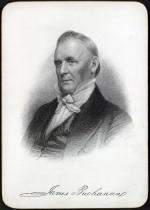
James Buchanan, fifteenth president of the United States, was born near Mercersburg, Pennsylvania on April 23, 1791 to parents of Scotch-Irish descent. Buchanan attended the Mercersburg Academy until the fall of 1807, when he entered the junior class of Dickinson College. He found the school to be in "wretched condition" with "no efficient discipline." However, his own behavior while at Dickinson was far from exemplary; he was expelled during the fall vacation of 1808 for bad behavior. After making a pledge of good behavior to his minister, Dr. John King (a college trustee), Buchanan was readmitted to Dickinson. In his senior year, he felt slighted by the faculty because he did not win the top award of the College for which his literary society had nominated him. Buchanan commented, "I left college, . . . feeling little attachment to the Alma Mater."

College Relationship
Alumnus/Alumna Class Year
Honorary Degree - Year
1842

Andrew Buchanan (1780 - 1848)

Andrew Buchanan was born on April 8, 1780 to Andrew and Rachel Gilleylen Buchanan in Chester County, Pennsylvania. Despite the death of his father when young Andrew was five and then the death of his step-father in 1790, Buchanan received an education and enrolled with the class of 1798 at Dickinson College in Carlisle, Pennsylvania. After graduating with his class, he studied law and was admitted to the bar in Harrisburg in 1801 and practiced in York, Pennsylvania for a short time before moving his practice to Waynesburg, in Greene County, Pennsylvania in 1803.

One of the earliest practicing lawyers in the district, a political career at the local, state, and national level followed. He became a county commissioner and served in the Pennsylvania Legislature between 1831 and 1835. Buchanan was then elected to the House of Representatives and served between March 1835 and March 1839 first calling himself a Jacksonian in the Twenty-Fourth Congress and then a Democrat in the Twenty-Fifth. After these two terms, which included service as chairman of the politically charged Elections Committee, he retired from politics and devoted himself to his law practice.

College Relationship
Alumnus/Alumna Class Year

Josephine Brunyate Meredith (1879-1965)

Josephine Brunyate was born on April 14, 1879, in Halifax, Nova Scotia, Canada, the daughter of a prominent clergyman, Edwin Richard Brunyate and his wife Eliza. Home tutored first, she attended the State Model School in Trenton, New Jersey and then entered Dickinson College in Carlisle, Pennsylvania with advance standing in 1899. She graduated with Phi Beta Kappa honors in three years in 1901. After her graduation, Brunyate taught in high schools located in Pleasantville, Atlantic City, and Trenton, New Jersey. In August, 1908 she married Arthur J. Meredith of Boston, Massachusetts and had one daughter. Following the death of her husband in 1917, she returned to teaching at the high school in Woodbury, New Jersey.

College Relationship
Alumnus/Alumna Class Year
Honorary Degree - Year
1952
Faculty - Years of Service
1919-1948

David Bachman Brunner (1835-1903)

David Bachman Brunner was born on March 7, 1835 in Amity Township, Pennsylvania in what is now Washington County but then Berks. His Lutheran father, John Brunner, was a carpenter who purchased an area farm soon after David was born. His mother was Elizabeth Bachman Brunner and he was one of seven children. David Brunner attended the local log schoolhouse of Daniel Lee from the time he was seven and was apprenticed as a carpenter when he was twelve. He continued his education beyond this, however, and attended the Freeland Academy (now Ursinus College) for long enough to earn money as a local teacher himself. Determined to study the classics further, he entered Dickinson College in Carlisle, Pennsylvania in 1856 at the relatively late age of twenty-one. He was an active member of the Union Philosophical Society and graduated with his class in 1860.

College Relationship
Alumnus/Alumna Class Year