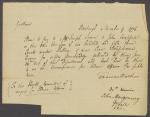
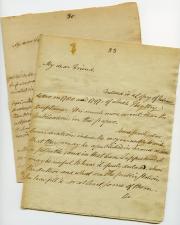
Receipt for Wheat from John Montgomery to Curtis and Peter Grubb
John Montgomery issues a receipt for wheat to Curtis and Peter Grubb.

John Montgomery issues a receipt for wheat to Curtis and Peter Grubb.
Thomas Walker writes the Committee of Congress for Indian Affairs and asks that they pay Joseph Simon and John Campbell for the "sundry merchandize" that they provided "for the use of this Department." John Montgomery, John Harris, and Jasper Yea
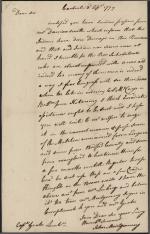
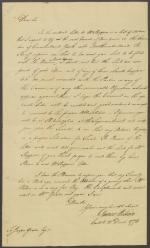
John Montgomery writes to Captain Jasper Yeates concerning impending Indian War. As he believes that residents are unprepared and in need of immediate assistance, Montgomery asks Captain Yeates to write a Mr. Wilson for assistance.
Isaac Norris, the Speaker of the Pennsylvania Provincial Assembly, writes to Governor John Penn regarding legislation and the taxation of property.
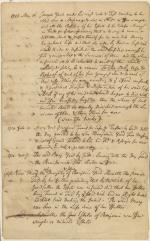
James Oliver writes this notice of judgment against Thomas Buchanan for debt to "the Constable of East Pennsborough and to the Keeper of the Gaol of said county."
Attorney John Dickinson writes this legal opinion regarding Joseph Yard's will .
Attorney John Dickinson writes this legal opinion regarding George Churchman's case, which is centered on a disagreement over land. "I have concluded ... that Churchman's title to the Land in Dispute, is good in Law," as Dickinson notes.
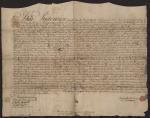
John Dickinson sells the tract of land, "Brothers Portion," near Dove, Kent County in Delaware to William Killen on August 12, 1766. Dickinson signs the deed with his personal seal and Caesar Rodney signs it as the Recorder.
Philadelphia attorney John Dickinson sends this bill of exchange for 100 pounds to pay John Hanbury Osgood, who is in London.
Charles Nisbet writes to Selina Hastings, the Countess of Huntingdon, about Methodist leader John Wesley's success in England and other related religious issues.
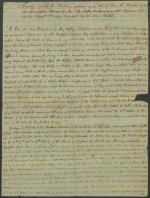
The testimony of Charles Nisbet against the doctrines contained in an extract from the minutes of some late conversation between Reverend John Wesley and others at a public conference in London on August 7, 1770. Transcript included.
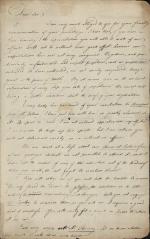
Charles Nisbet writes to the Minister of Drumelzier and inquires about various events since his visit three months ago. Nisbet also requests updates on several ministers as well as a few other individuals. "Does [Mr.
This legal notice, which is related to the case of Robert Urie v. Joseph Hudson, calls for the Sheriff of Cumberland County to collect the debt that Hudon owes Urie.
Attorney James Wilson prepares this legal document about auditing accounts for the case of Stevenson & Thompson v. Ross & Cole.
Attorney James Wilson writes to Jasper Yeates and discusses upcoming cases he will try in Cumberland, York, and Northumberland counties. Wilson also announces the birth of his son.
John Dickinson acknowledges the receipt of Benjamin Rush's pamphlet and mentions that he would only reenter Pennsylvania affairs to serve America.
Joseph Priestley writes to Anna L. Aikin of Warrington Academy about her poetry on Corsica for James Boswell and Samuel Johnson. Priestley also provides Aikin with an update on his own writing.
Joseph Priestley writes to Jeremy Bentham, returning a friend's paper and alerting Bentham that he will be in the country for a month. Transcript included.
Joseph Priestley writes to John Seddon, the secretary and librarian of Warrington Academy, regarding a divinity tutor at Warrington and new students.
Joseph Priestley writes to John Seddon regarding Seddon's invitation to Liverpool, recent books, work, and news regarding lectures at the Academy. Transcript included.
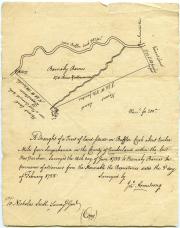
The collection contains papers related to John Armstrong's service as a surveyor in Cumberland County between 1755 and 1783. These papers include correspondence with the Surveyor-General of Pennsylvania and Delaware, John Lukens, complaints from his clients, and several survey maps drawn by Armstrong. Born in County Fermagh, Ireland in 1717, Armstrong emigrated to Pennsylvania with his wife, five brothers, and a sister. He established himself as a surveyor but in 1756 joined the militia as a captain during the Seven Years' War (French and Indian War). He led a victorious assault on the stronghold of Kittanning, earning forever the label "the Hero of Kittanning." After the war, Armstrong returned to surveying, being named deputy-surveyor in 1762. He later served several terms in the Continental Congress from 1776 to 1788, and was a founding trustee of the Carlisle Grammar School and Dickinson College.
The collection contains materials relating to family life on the Eastern Shore of Maryland and in Ohio. The central figure is Daniel Bowdle (1796-1876), who as a young man moved to Cincinnati and became the successful business man of his family, with real estate and other interests. He aided his less fortunate kin in Talbot County, MD, including making provisions for the old age of James Lloyd, a beloved slave. The letters of William James Bowdle (1834-1876; Class of 1854) reflect student life at Dickinson College; letters of numerous other relatives are supplemented by genealogical notes on the Bowdle Family. Also included are papers on the settlement of the estate of Capt. Patrick Dickey, dated 1806-1841, which involve lands in Ohio and in Mason Co., VA.
Moncure Daniel Conway was born into a southern aristocratic family, but ultimately became one of the nation's leading abolitionists and humanitarians. Conway was a graduate of Dickinson College in 1849 and was trained for the ministry at Harvard Divinity School. The collection consists mainly of correspondence relating to all phases of Conway's career; his student days at Dickinson and at Harvard, his anti-slavery witness, and his pastorate at South Place Chapel in London. His letters reflect his wide acquaintance with leading intellectual and political figures of his day; some of his correspondents include Ralph Waldo Emerson and Dr. Annie Besant.
The journal in this collection has been digitized and is available for reading online (see the link for related entries below).
This collection is comprised of correspondence and legal papers reflecting the legal and political career of John Dickinson, statesman and president of the Supreme Executive Council of Delaware and Pennsylvania. The majority of the collection is comprised of correspondence from Dickinson to such prominent individuals as James Wilson, Caesar Rodney, and Benjamin Rush. The collection also contains financial papers and papers related to Dickinson's public duties, particularly to his duties as president of the Supreme Executive Council of Pennsylvania.
Elizabeth Graeme Fergusson (1737-1801) was a Philadelphia writer who was known for hosting literary salons attended by individuals such as John Dickinson, Jacob Duché, Francis Hopkinson, Dr. Benjamin Rush, and Annis Boudinot Stockton. The collection consists of a commonplace book compiled by Fergusson that contains handwritten poems and transcriptions of correspondence dating from 1770 to 1787. The poetry includes odes, elegies, and neoclassical-style poems written by Fergusson and others, such as her husband, Henry Hugh Fergusson; her niece, Anna Young Smith; and Francis Hopkinson. The book also includes transcriptions of correspondence between Fergusson and Anna Young Smith and Elias Boudinet, as well as correspondence between Smith and her husband, Dr. William Smith.
The commonplace book has been completely digitized and is available for reading online (see link for related entries below).