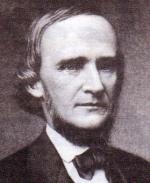
George Duffield III (1794-1868)

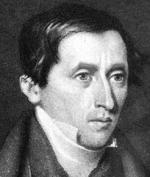
George Duffield III was born on July 4, 1794 in Lancaster County, Pennsylvania. His father, George Duffield, Jr., served as the Comptroller General of Pennsylvania. The younger Duffield studied at the University of Pennsylvania, obtaining a degree in 1811. He then pursued a four-year course of study at the Theological Seminary of the Reformed Church in New York. His teacher and founder of the Seminary, John Mitchell Mason, would later become president of Dickinson in 1821. After completing his studies at the Seminary, Duffield was officially licensed to preach and entered the Presbyterian ministry on April 20, 1815. In September 1816, Duffield visited the town of Carlisle and was invited to preach at the First Presbyterian Church on the town square. His preaching style charmed the congregation, which uncharacteristically united in calling Duffield to lead their church. By accepting their call, Duffield achieved what his grandfather, the noted revivalist of the First Great Awakening, George Duffield, had failed to do during his time in Carlisle nearly fifty years before.
College Relationship
Trustee - Years of Service
1820-1833

Alfred Victor du Pont (1798-1856)

Alfred du Pont was born on April 11, 1798 in France to Eleuthere and Sophie Dalmas du Pont. His father's career during the French Revolution as both moderate politician and printer fell into disfavor as the Revolution became increasingly radical. The du Pont family fled to the United States, arriving on January 1, 1800. After a period in Bergen Point, New Jersey, the family settled outside Wilmington, Delaware, where in 1802 the E. I. du Pont de Nemours and Company was established to produce the high quality gunpowder in great demand at the time.

Du Pont’s early studies were directed by his parents and perhaps a private tutor. In 1811 he was sent to Mont Airy College, north of Philadelphia in Germantown. His father intended him to have a useful education in chemistry, so Alfred was sent to Dickinson College to study under Professor Thomas Cooper. Du Pont arrived in May 1816 and entered the College as a member of the class of 1818. He joined the Belles Lettres Literary Society, and a few months later was elected its president. In September 1816, Professor Cooper and College President Jeremiah Atwater’s quarrels divided the faculty; both men left the College, and were followed by most of the remaining faculty. Dickinson College was closed, and the students dismissed.

College Relationship
Alumnus/Alumna Class Year

Sumner Mathias Drayer (1872-1967)

Born in New Cumberland, Pennsylvania, Sumner Drayer studied at the Dickinson Preparatory School. He married Agnes Pettigrew on March 17, 1906. Among numerous business ventures, Drayer served as the president of the Voneiff-Drayer company, which operated the chain of Miss America Candy Stores.

As a prominent businessman, he joined the Board of Trustees of Dickinson College in 1933. Over the years, he and his wife donated generously of their time and money to the college. Most notably, they contributed a large portion of the costs for the construction of the first women's dormitory built expressly for that purpose by the College. This building, Drayer Hall, bears their name in recognition of their substantial gift.

Though he never enrolled in the College, Sumner Drayer was awarded a degree by appointment as a member of the Class of 1902 for his service to the school. Agnes Pettigrew-Drayer died on January 31, 1954 and Sumner Drayer died on February 3, 1967 at the age of 95.

College Relationship
Alumnus/Alumna Class Year
Trustee - Years of Service
1933-1967

Joseph Clarence Doyle (1939-1968)

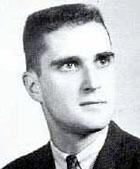
A native of Butler, Pennsylvania and a graduate of the class of 1961, Joe Doyle was a member of Phi Kappa Psi, the vice president of the Young Democrats, and took part in the Freshmen Plays. He was a Cadet First Lieutenant of Company D of the R.O.T.C. detachment.

Doyle became a regular officer in the United States Army and served three tours of duty in Vietnam. The last of these began in December 1967 with his serving as an aerial surveillance officer in military intelligence captain at Can Tho. During a reconnaissance mission over Kien Tuong Province on Wednesday, February 28, 1968, his plane was struck by ground fire. Captain Doyle ejected from the aircraft but died of multiple injuries shortly after. He was 28 and married.

College Relationship
Alumnus/Alumna Class Year

Philip W. Downes (1837-1895)

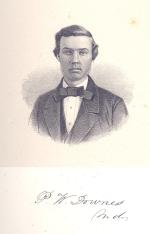
Philip W. Downes was the eldest son of William H. Downes and his wife Annie Hardcastle Downes and was born in Caroline County, Maryland in 1837. When he was ten, his father was elected as a Maryland state delegate. The younger Downes entered Dickinson College in Carlisle, Pennsylvania, where he was elected as a member of the Union Philosophical Society and graduated with the class of 1858. Downes studied law in Easton, Maryland and was admitted to the Maryland bar in 1861.

Based on available records, the activities of Downes over the next decade or so are unclear; it is known that he served as Maryland's commissioner of fisheries from 1874 to 1878. Beginning in 1877, successful already in business and his practice, Downes began buying up sections of the Upper Denton, Maryland waterfront on the Choptank River. A few years later, he owned most of the properties south of the Denton Bridge. The operation and later sale of these properties made him a wealthy man. Downes became the first president of the Denton National Bank in 1881 and a director the next year of the newly established Mutual Fire Insurance Company of Denton.

By 1880, Downes had been married to his wife, Annie, for more than a decade and the couple had two children, James, aged ten, and Armand, aged two. He also had gained the title "Colonel" by that point in his career. Philip Downes died in Denton, Maryland in 1895. He was fifty-eight years old.

College Relationship
Alumnus/Alumna Class Year

Paul Herbert Doney (1900-1941)

Paul Herbert Doney was born in Columbus, Ohio on July 10, 1900. His father was the head of Willamette University, from which Paul graduated in 1920. He took a second A.B. degree from Wesleyan University in Connecticut and then gained a S.T.B. degree from the Boston University School of Theology in 1925. Preferring literature to the church, he then earned a M.A. in English at Harvard University in 1928.

Doney joined the Dickinson faculty in 1928 as an associate professor of English Literature. In 1929 he succeeded the late Bradford Oliver McIntire as the Thomas Beaver Professor of English Literature. He retained his interest in the Methodist Church, serving on the board of the Allison Memorial Methodist Church and as president of the Carlisle Rotary.

On August 9, 1941, while vacationing at the summer home of good friend George R. Stephens at Fenwick's Island, near Ocean City, Maryland, Paul Doney died of a heart attack after swimming into the surf to rescue his nine-year old son. He was survived by his wife and three children.

His wife Lucy Holt Doney began work in the Bosler Library in 1943, taking particular interest in the English Research Room, which was maintained as a memorial to her late husband. At the time of her death in July 1958, she was the assistant librarian, with the rank of associate professor.

College Relationship
Faculty - Years of Service
1928-1941

James Herbert Dieffenderfer (1923-1945)

James Dieffenderfer was a native of Easton, Pennsylvania and graduated from Wilson High School in 1941. He entered Dickinson in the autumn of 1941 and enlisted in the United States Marine Corps in 1942. He was a participant in the unprecedented accelerated degree program; when he enlisted he was assigned to Franklin and Marshall College, completing his Dickinson degree there on February 29, 1944. In his time between the two colleges, he became a member of Phi Kappa Sigma fraternity.

Upon graduation, he was trained at Parris Island and completed officer candidate school at Camp Le Jeune, North Carolina in October 1944. He was assigned to the Pacific in December 1944 with fellow Dickinsonian Milton Fussell and joined the 1st Battalion, 1st Marine Division for the invasion of Okinawa in April 1945. On May 2, 1945, Lt. Dieffenderfer was killed in action on the island, joining more than 12,500 Americans lost (including three Dickinsonians) in securing what was intended to be the main staging area for the final invasion of the Japanese home islands.

College Relationship
Alumnus/Alumna Class Year

John Dickinson (1732-1808)

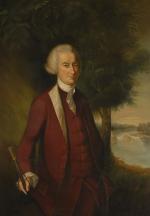
When, in Fathers of the Revolution, Philip Guedalla described the American War for Independence as “a sedate rebellion…founded on equity and quotations from Blackstone,” he may well have had John Dickinson in mind. Erudite and reserved, Dickinson had the respect but not the love of his contemporaries. It is helpful to keep in mind he was born the same year as George Washington and Joseph Haydn, two other deeply religious men of conservative temperaments and refined tastes.

Dickinson enjoyed the serene childhood of a southern plantation. His family were English, having settled in the seventeenth century in Maryland; Dickinson himself was born in Talbot County, on November 2, 1732. He grew up at Poplar Hall, the elegant brick mansion of his father, Judge Samuel Dickinson. There, surrounded by flat fields of wheat and tobacco, young Dickinson received private tutelage in Latin. Highly impressionable, he entertained himself with making a model of the bridge over the Rhine as found in Caesar’s Commentaries.

College Relationship
Trustee - Years of Service
1783-1808

Oliver James Dickey (1823-1876)

Oliver James Dickey was born on April 6, 1823 in Old Brighton, in Beaver County, Pennsylvania, where his father, John Dickey, was postmaster and later sheriff. The older Dickey also served in the State senate and was a Whig member of the U.S. Congress in two terms during the 1840s. The son began his education at Beaver Academy before entering Dickinson College in 1839 with the class of 1844. He left his course in 1843 before graduating, and took up the study of law in Beaver, Pennsylvania with James Allison, who himself had served in Congress twenty years before.

College Relationship
Alumnus/Alumna Class Year

William Lewis Dewart (1821-1888)

William Lewis Dewart was born in Sunbury, Pennsylvania on June 21, 1821, the only son of Lewis and Elizabeth Ligett Dewart. His father was an influential railroad director and politician who had been speaker of the Pennsylvania house, congressman from Sunbury, an unsuccessful candidate for governor of the state. William was educated in Harrisburg and at the Dickinson College Grammar School in Carlisle, Pennsylvania. After two years at the school, Dewart entered Dickinson College proper with the class of 1842 in September 1837 but left to enroll at Princeton where he graduated in 1839. He returned to Sunbury to study law and was called to the Northumberland County bar in January 1843.

College Relationship
Alumnus/Alumna Class Year