Sigma Alpha Epsilon House (1922-1942)

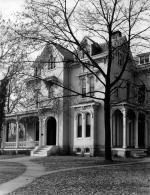
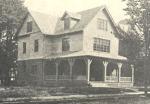
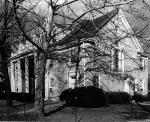
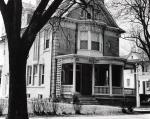
After having lost their first house for military use during the First World War, the Sigma Alpha Epsilon fraternity of Dickinson College in Carlisle, Pennsylvania had moved into East College. In 1922, however, the fraternity purchased the former home of Wilbur Fisk Sadler, a large white Victorian house situated on the southwest corner of College and Louther Streets. The ornate three story building was remodelled in 1928 to better accommodate the fraternity.

The brothers of Sigma Alpha Epsilon remained in this location until 1942, when the Second World War caused their numbers and support from their alumni to dwindle dangerously low and the fraternity was forced to sell the house. The number of members still at the wartime College remained so low for the next few years that a chapter house was not required. In 1946, however, the fraternity had recovered sufficiently to warrant the purchase of their third house.

The former Sadler house was later demolished and its site is now occupied by the Holland Union Building.
Sigma Alpha Epsilon House (c.1900-c.1917)

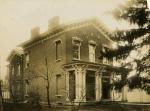
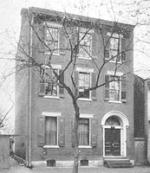
Around 1900 the Sigma Alpha Epsilon fraternity at Dickinson College in Carlisle, Pennsylvania purchased a three story building located just off of the northeast corner of West and Louther Streets (170 W. Louther). Red brick with white trim, their home was a simple building constructed in the "old style." Here they lived until the house was commandeered for military housing following the outbreak of the First World War. The fraternity then moved into the eastern section of East College for five years before purchasing their second house. The first fraternity house has since been expanded and is currently used for private residence.

Sellers House

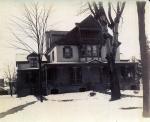
On June 28, 1943, Dickinson College purchased the Sellers House, the former residence of Montgomery P. Sellers, for $15,000. This orange brick building, located on West High Street, served as a dormitory for men until 1944, when it became the College Health Center. In 1952, it was converted into the Dean’s Residence. Eight years later, Sellers House again became a student residence, this time housing female students.

For a number of years, Sellers House continued to serve as a student residence, housing different fraternities and sororities, as well as other special interest groups. In April 2003, the college dedicated the building as the Milton B. Asbell Center for Jewish Life at Dickinson College.

Florence Jones Reineman Wildlife Sanctuary (1966-present)

Created by a trust under the will of Mrs. Florence W. Erdman in memory of her mother, the Florence Jones Reineman Wildlife Sanctuary was established for Dickinson College in Carlisle, Pennsylvania in 1966, and dedicated on September 30, 1971.

This 3037-acre sanctuary, located in Green Valley, Perry County, was to be used solely for field studies in botany, biology, and geology, as well as the conservation and preservation of wildlife. Recreation such as hunting, fishing, or trapping is prohibited. The trustees, in exchange for supervision and educational use by the College, would pay all capital costs and program funding.

Reed Hall (1954-present)

Acquired by Dickinson College in Carlisle, Pennsylvania as part of a property exchange on June 11, 1954, the former Allison Memorial Church House was renamed in honor of President George Edward Reed. The house was remodeled in 1958 at a cost of $25,589, and began serving the department of psychology and education.

When these departments later relocated, Reed Hall became a student residence, serving various fraternities and other student organizations.

President's House (1890-present)

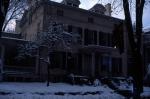
Before it became home to Dickinson College’s presidents, this Carlisle, Pennsylvania house, which was built in 1833, was the home of the Hon. John Reed, a local judge. Reed introduced law into the Dickinson College curriculum, and gave his first law instructions to students in the basement of this house.

Preferring not to reside in the President's home located in East College due to its close proximity to the students' living quarters, incoming President George Reed purchased the house and subsequently sold it to the College on January 9, 1890 for $8,000. A second floor was immediately added on to the house at a cost of $7,000, these funds being provided by a gift of William Clare Allison.

Under President Corson, a new north face designed by W. W. Emmart was added in 1937, paid for by Mrs. Paul Appenzellar whose husband was a member of the class of 1895. This redesign established the entrance on the eastern side of the house, turning the old front entrance and porch into an open terrace. In 1979, under President Samuel Banks, the facade was sandblasted to reveal the natural brick exterior.

Phi Kappa Sigma House (1923-1963)

The Phi Kappa Sigma fraternity at Dickinson College in Carlisle, Pennsylvania purchased the former home of John Lindner at 28 North College Street in 1923. Three years later the exterior of the building was renovated: a colonial-style doorway was added and the old wooden steps were replaced by brick ones and a piazza. The fraternity then called in a professional architect to remodel the interior of the house in 1927, which resulted in the addition of an Italian marble fireplace.

The fraternity disbanded briefly from 1943 until 1946, during which time the building was rented out to the College. The members resurrected the fraternity following the war and once again occupied the house in 1946 until the building was bought by the College and razed in 1963 to make room for the Holland Union Building. Phi Kappa Sigma members then moved into Biddle House for the 1963-64 school year. With the completion of the Fraternity Quadrangle, they moved into Quad 8 (now Armstrong Hall) in the fall of 1964.

Phi Kappa Sigma House (1906-1923)

In 1904 the Phi Kappa Sigma fraternity of Dickinson College in Carlisle, Pennsylvania purchased a lot at 47 South College Street from Merkel Landis, Esq., class of 1896, at a cost of $1,200.

Construction began according to the designs of M. I. Kast of Harrisburg in 1906, and in January 1907 the $4,000 building was completely finished. It consisted of three stories, the façade being composed of brown stone on the first floor with the other two bearing shingles under a slate roof. The first floor housed the social space, the second floor was the dormitory area, and the third floor provided a meeting room for the fraternity.

By 1923 the house had become too crowded, and so the fraternity purchased the former home of John Lindner on North College Street.

Phi Kappa Psi House (1904-1964)

On April 2, 1904, the Phi Kappa Psi fraternity at Dickinson College in Carlisle, Pennsylvania purchased a house at 228 West High Street, immediately west of the President's House. The three-story brick house had been built around the time of the Civil War, was the former family home of Abram Bosler, Dickinson College class of 1905 and a member of Phi Kappa Psi.

In 1925 the house underwent major renovations that included the addition of a larger porch and large white pillars that reached to the third story. In 1963, the fraternity sold the house to the College when they moved into Quad 9 (now Wilson Hall) of the Fraternity Quadrangle in fall 1964. The house briefly served in 1966 as the site for the Open Door coffee house, but the house was razed soon thereafter.

Phi Delta Theta House (1931-1964)

When officially named in the 1980s in honor of J. William Stuart, class of 1932, this house had already enjoyed fifty years of service to Dickinson College in Carlisle, Pennsylvania. A need for more living space led Dickinson’s chapter of Phi Delta Theta to construct Stuart House in 1931. Their previous residence, a stone lodge located on the corner of Louther and College Streets, could no longer accommodate the fraternity.

Stuart House served the fraternity, with a gap in 1944-1945 when it was rented to the College as a women's dormitory, until June 13, 1964, when the College purchased it at a cost of $57,000. Phi Delta Theta then relocated to the newly constructed Fraternity Quadrangle. A $24,000 renovation shortly after the purchase enabled Stuart House to become the new home of the Office of Communication and Development. The building later became a student residence once again in the 1980s.

Note: View a short film that shows clips relating to the construction of the Phi Delta Theta House by following this LINK.