Fraternity Quadrangle ("The Quads")

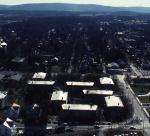
The College authorized the construction of ten campus fraternity residences on December 10, 1960. The “Quads,” as they are known, replaced the individual houses in which the college fraternities had resided up to this time, and were first occupied in September 1964. The buildings were arranged with six halls (today known as Conway, Buchanan, Cooper, Baird, McClintock, and Longsdorff Halls) comprising the Upper Quad, and four buildings (today known as Atwater, Armstrong, Wilson, and Davidson Halls) completing the Lower Quad.

The Fraternity Quadrangle was designed by Howell Lewis Shay and Associates. The buildings were completed at a cost of $2,241,000, most of which was financed by a federal loan and bond issues.

For more information please follow the links below:
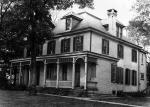
Four Church Avenue

Four Church Avenue was the name given a row of brick cottages situated behind the President's House, to the east of South College on the Church Avenue alley. Under the control of absentee landlords, the rents for these cottages were low and their condition poor.*

In 1948, President Edel's administration took the opportunity to purchase the buildings at a cost of $13,200 on December 27, 1948. The buildings were repaired and rented to College maintenance employees for some years. They were demolished during the 1970's and the space where they stood is now a parking area.

* C.C. Sellers (p.590) suggests rumors of "houses of ill fame" were attached to Four Church Avenue, but these are largely unsubstantiated. Such "services" were available, however, at the time in rooms on nearby South West Street, above the Briggs Cafeteria, now the area on which the Bosler Public Library extension stands.

"Fink Hall" (1900-1966)

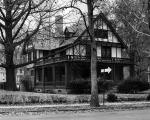
The College purchased a house at 333 West High Street for $7,000 on December 26, 1900. This house was first used as the residence for the Headmaster of Conway Hall following the completion of that building in 1905. In 1930, it was converted into a double house, one half serving as a residence for faculty and the other as the College’s Health Center. The building later became a women’s dormitory, and in 1966 the house was razed to provide room for the construction of the Boyd Lee Spahr Library.

The name “Fink Hall,” which was applied to this house, was not an official name. For decades, students used the name in fond reference to the longtime Director of Health Services, Oneta M. Fink, R.N.

Filler Hall (1959-1963)

Acquired by the College at a cost of $32,000, Filler Hall, the former residence of R. P. Masland, was purchased in March of 1959. Located along North College Street, the building was named in honor of former college president Mervin Grant Filler, class of 1893. Shortly after its purchase, Filler Hall underwent an extensive renovation which included the addition of a thirty-booth electronic language lab. Richard C. Reed designed the renovation, which was made possible by a $50,000 gift from Iréneé du Pont.

In the summer of 1963, just over four years after it was purchased, Filler Hall was razed to provide room for the construction of the Holland Union Building.

Emory Chapel (1877-1918)

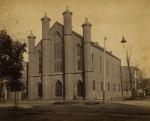
Emory Chapel, located on the northeast corner of West and Pomfret Streets, was built in 1858 as a Methodist church intended specifically for the College’s religious community. The building was designed by Thomas Balbirnie in Victorian Gothic style, and was constructed at a cost of just over $10,000. Emory Female College used the chapel from 1863 until 1866.

In 1877, Dickinson College assumed the debts of the church and converted the chapel into the Grammar School, which remained there until 1886. Four years later, Emory Chapel was leased to the Dickinson Law School, which utilized the building until the completion of Trickett Hall in 1917. The College finally sold Emory Chapel to the United Brethren Church in 1919, and it was torn down shortly thereafter.

East College (1836-present)

Built shortly after the reopening of the College under Methodist Church auspices, East College was completed on November 5, 1836. The building was designed by Henry Myers and was constructed at a cost of $9,588. Fireproof walls effectively divided the building into four sections. Recitation rooms and student dormitories comprised three of these sections. The fourth section, located on the eastern end of the building, was occupied by the College president until 1890. The building underwent renovations in 1882 which removed the recitation area on the southern side of the third floor. When Denny Hall opened in 1896, the remaining recitation areas on the second floor were also removed and East College became a dormitory with a few student social offices.

In 1924 the trustees authorized $60,000 for an extensive renovation. The majority of the inner structure of the building was removed to bring the sanitation facilities and electric lighting up to the standards of the time. In addition, the four stairways that led to second floor entrances were removed, so that entry to each section of the building was now through colonial-style ground floor doors.

Drayer Hall (1952-present)

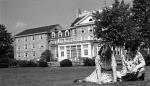
Drayer Hall was the first residence hall in Dickinson’s history built by the College solely for women. It was also the first new building constructed on the Benjamin Rush campus, a twelve-acre tract which had been acquired from the Moore Estate in 1932. Construction was begun in November 1950, and the building was appropriately dedicated on what the College had designated as Women’s Day, May 1, 1952.

Drayer Hall was designed by Sydney E. Martin, and constructed at a cost of almost $785,000. The building was named in honor of Sumner M. Drayer (Class of 1902, by appointment) and his wife, Agnes, the principal donors toward the capital campaign which financed the construction. In addition, Mary Sharp Foucht contributed funds to establish the Sharp Memorial Lounge in memory of her father, Alexander Sharp, Class of 1883.

After some of the building’s recreational space was renovated in 1965, Drayer Hall housed the College’s Health Center. At various times through the years, Drayer Hall has served as a residence for men and women, sometimes for upperclassmen and other times for first year students.

The Depot (1995-2013)

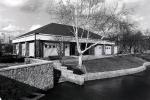
A multi-purpose facility designed primarily as a student social space, the Depot replaced the Lumberyard, which had collapsed in January 1994. The Depot, which opened on March 4, 1995, was designed by Spillman Farmer Architects and constructed at a cost of $1.4 million.

The Depot was demolished in February 2013 as part of a project to expand the Kline Athletic Center.

Denny Memorial Hall (1896-1904)

The Denny family property directly to the east of campus on the northeast corner of High and West Streets had been secured for the college for only $1 through the influence of Charles Francis Himes, a Dickinson alumnus, faculty member, and administrator who had connections to the Dennys through marriage. The only stipulation of the transfer of property was that any structure that might occupy that site should bear the Denny name as a memorial.

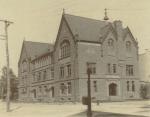
On June 8, 1896, following one year of construction, this agreement was honored with the opening of Denny Memorial Hall. Built at a cost of $40,000, Denny was designed by Thomas P. Lonsdale as a classroom and office building “devoted solely to recitation purposes.” The Denny family donated $12,000 to the project, and Eliza E. Smith gave $10,000 in order to provide meeting halls for the College’s two literary societies, the Union Philosophical Society and the Belles Lettres Society. These two halls honored the memory of her brother, Abraham Herr Smith, Class of 1840.

Denny Memorial Hall was destroyed by fire on March 3, 1904, but was replaced the following year by a new building bearing the same name.

Denny Hall (1905-present)

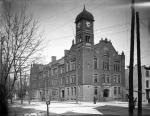
The second building in the College history to bear the Denny family name, Denny Memorial Hall was constructed to replace the first building of that name, which was destroyed by fire in March 1904. The cornerstone of the new building was laid on June 7, 1904, just three months after its predecessor had burned down. It was completed just one year later, being dedicated on June 6, 1905 in a ceremony which also celebrated the opening of Conway Hall. Architect Miller I. Kast designed the second Denny Hall, which cost $62,964.84 and was financed by an intense subscription campaign.

The hall, like its predecessor, included large meeting rooms for the College’s two literary societies, as well as classrooms and offices. The Lenore Allison Tower, a clock and bell tower which was a departure from the earlier building, recognized a $2500 gift of William Clare Allison towards the fund-raising campaign. The college bell was moved from the cupola of West College and placed in Allison Tower upon completion of the building.

Denny Memorial Hall was completely renovated and modernized in 1983-1984, at a cost of about $2.5 million.