William Clare Allison United Methodist Church (1958-2013)
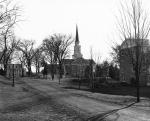
When the Allison Memorial Methodist Church was destroyed by fire on January 20, 1954, Dickinson College president William W. Edel arranged a trade with the members of the church. In exchange for the site of the destroyed church, adjacent to the President’s House, the College offered a section of the Benjamin Rush campus along Mooreland Avenue, close to the church’s parsonage, for the construction of a new church building. The new Allison Methodist Church, standing on the ground acquired in the trade, was designed by Hensel Fink, and was completed on April 20, 1958. It was constructed at a cost of $850,000, to which the College contributed $200,000. The church design was in keeping with the prevalent style of the College campus, complete with limestone façade; it also boasted of a 150-foot steeple and a sanctuary that could seat 750 people. A small chapel was dedicated to Bishop Fred Pierce Corson, Class of 1917 and former president of the College, for his many years of service to the church. This new building served as a “Church-Chapel” to the College community for some time. The building was sold to the college in January of 2013, and is now a multi-purpose space known as Allison Hall.
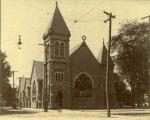
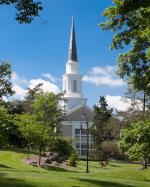
William Clare Allison Memorial Methodist Church (1892-1954)

The William Clare Allison Memorial Methodist Church was completed in 1892. Construction of the Gothic style building had lasted for two years and the dedication took place on March 6, 1892. A large amount of the construction cost had been donated by Mrs. William Clare Allison as a memorial to her husband. The church property extended from High Street back to Church Alley. President George Reed allocated some of the land at the President's House for the church's usage, as a donation by Mr. Allison had allowed for the renovation of the house a few years earlier. Perhaps the most distinguished feature of the church was the set of stained glass windows on two sides of the building; each depicted the life of Christ and had been designed by Tiffany and Co.

Disaster struck the church on January 20, 1954, when faulty electrical wiring in the basement caused a fire that completely destroyed the church and most of its contents. The damage was estimated at over $300,000. Dickinson College offered the congregation space in Bosler Hall in which to hold their services until a new church building could be completed.

Allison Hall (2013-present)

Allison Hall was acquired by Dickinson College in January, 2013. Previously, it served as the Allison United Methodist Church. The structure was designed by Hensel Fink, and was completed on April 20, 1958. It was constructed after the Allison Memorial Methodist Church was destroyed by fire on January 20, 1954. and cost $850,000 to build.

Adams Hall (1963-present)

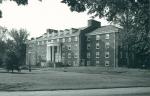
Located at the southern end of the Benjamin Rush campus, Adams Hall was dedicated as a women’s dormitory on October 5, 1963. Authorized in December 1960, the hall was designed by architect Elmer H. Adams and constructed at a cost of $1,031,000. Dr. and Mrs. Rolland Adams made the generous $250,000 donation that made construction possible; the building bears their name in recognition of this gift.

Originally home to 165 female students, Adams Hall also once contained the College Guest Suite, which was furnished and decorated through the support of the Mary Dickinson Club. The building began serving as a dormitory for both men and women in 1974, and has housed both upperclassmen and freshman students over the years.

Three Mile Island (1979)

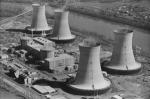
On March 28, 1979, the eastern United States faced the threat of a nuclear meltdown at the Three Mile Island (TMI) nuclear power facility in Middletown, Pennsylvania, twenty-five miles southeast of Dickinson College, on the Susquehanna River. The crisis originally began when a valve opened unnoticed, and allowed thousands of gallons of coolant water to flow from one of the plant's reactors. This caused temperatures within the unit to raise to over 5000 degrees, causing the fuel core to begin to melt. The threat of the overheated reactor and leaking radiation had an immediate impact on the College.

The Salmagundi

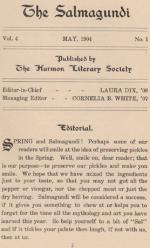
The Salmagundi was the literary magazine published by the Harman Literary Society following its resurrection in 1900 at Dickinson College in Carlisle, Pennsylvania. The original Salmagundi was composed by Washington Irving in 1807 “simply to instruct the young, and reform the old, correct the town and castigate the age.” This objective the Harman Literary Society adopted as its own with the establishment of their magazine.

The name Salmagundi was derived from two Latin roots – salgama meaning “pickles” and condita meaning “preserved,” thus making the literal translation of the magazine “pickles preserved.” However, the Webster’s dictionary provided another definition for Salmagundi as “a mixture of chopped meat and pickled herring, with oil, vinegar, pepper and onions.” While the Harman Literary Society’s Salmagundi had nothing to do with food, the members used both definitions to describe in its pages the contents of their magazine as “…the chopped meat represented the real food for thought, in the magazine…They [the pickled herring] are not particularly nourishing, yet who would do without them?…not enough vinegar to make Sal really sour, nor yet sufficient pepper to make her truly dark and bitter, but just that happy combination of the two, that only the real chef can strike…she is well seasoned with the oil of good will.”

"Red Devils"

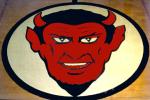
The Dickinson football team traveled to George Washington University for a game on Saturday, October 25, 1930. The Dickinson Red and White were heavily outmatched in the end, but they held off George Washington throughout the first half. The score at half was GW 7 and Dickinson 6. Because of this show of grit and spirit against a superior team, a Washington writer from the Public Ledger dubbed the Dickinson team "the Red Devils."

Dickinson students apparently were taken with the name because in the Dickinsonian of the very next week (November 6, 1930), a headline on the next game, against the Pennsylvania Military College, read RED DEVILS OUTPLAY CADETS, BUT GAME ENDS IN 7-7 SCORE.

The flavor of the time really comes through in the actual articles in the Dickinsonian of Thursday, October 30, 1930.

GRIDDERS FIGHT ODDS BUT LOSE TO GEORGE WASHINGTON 27-6 "Displaying an offense that spoke volumes for the work being done this year by Coaches Griffith and McAndrews, the 'Red Devils' of Dickinson College succumbed to George Washington, by a 27-6 score on Saturday at Washington. Though outweighed by the Capital city gridders, whose line averaged 195 pounds, and the backs 185 pounds, the Dickinson team outfought the victors throughout the entire first half, until the sheer force of weight caused the worn out battlers to yield up a touchdown. The offense displayed was easily the strongest shown during the present campaign."

The Priestley Award

Established during the presidency of William Edel, the Joseph Priestley Award is bestowed annually upon a distinguished scientist for notable discoveries and contributions to mankind. In 1952 Sir Hugh Stott Taylor became the first recipient of the Priestley Award for his research and teaching in physical chemistry. Linus Pauling, Margaret Mead, Stephen Jay Gould, and Francis Crick are just a few of the many noted recipients of the award since its inception.

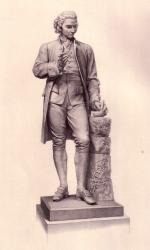
A marble statue of Joseph Priestley, crafted by Francis J. Williamson, was unveiled in Birmingham, England in 1874 to mark the 100th anniversary of Priestley’s discovery of oxygen. Dickinson College owns two smaller plaster replicas of this statue; one is on display in the Rector Science Complex, and the other is exhibited among the many Joseph Priestley papers and artifacts in the Archives and Special Collections. A stipple engraving of the statue was rendered by artist George J. Stodart at the time of the unveiling, and this image was widely circulated through popular magazines and artistic journals of the day.

Note:  Several audio and video clips from Priestley Award recipients' lectures are available by following this LINK.

John C. Pflaum Lectures in History (1972-present)

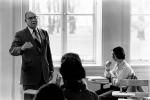
The Pflaum Lectures in History are supported by income from a fund contributed to by students and friends of the late Professor John C. Pflaum in appreciation of his effective teaching. The lectures bring to campus scholars who, like Professor Pflaum, are particularly successful in oral presentation of historical topics. The first lecture was held in the spring of 1972 in honor of Pflaum's retirement; the speaker was Dr. Bell I. Wiley, who provided his insight on "Some Glimpses of the Confederacy High Brass." Although the original intention of the lectures was to provide scholars for topics in history that were of particular interest to Prof. Pflaum, the area has since been much expanded, as the professor himself showed a wide variety of interests in his historical pursuits. The list of Pflaum lecturers since 1972 includes such notable scholars as Edward Acton, Grayton Tunstall, John Voll, Mercedes Vilanova, and former Assistant Secretary of State Harold H. Saunders.

The Mermaid Story

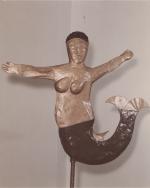
The Dickinson College mermaid was originally designed as a weathervane to be placed on top of the cupola of Old West. It is believed that the architect of the building, Benjamin Latrobe, intended the weatherwane to be in the form of Triton, in reference to the ancient Temple of the Winds in Athens. The local metalworker who was given the task of crafting the Triton likely had little knowledge of the temple or this mythical male sea god, so he created the closest thing he could imagine - a mermaid. Alumnus and faculty member Charles Francis Himes, class of 1855, first detailed this theory in a pamphlet, printed in the early 20th century