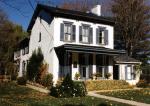
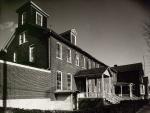
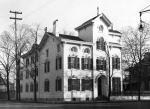
Kline Life/Sports Learning Center (1980-present)
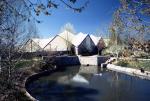
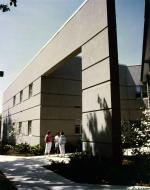
The groundbreaking ceremony for the Kline Life/Sports Learning Center, built to replace the Alumni Gymnasium, took place on May 18, 1979. The facility was opened in September 1980 and officially dedicated during Homecoming Weekend on October 25 of that same year. It was designed by Daniel F. Tully and constructed at a cost of $3.5 million. The Center is dedicated to the memory of Josiah and Bessie Kline, whose grant of $500,000 made the building possible.

The Kline Center is a multi-use facility which can accommodate many sports and activities. It has an indoor track, basketball and volleyball courts, squash and racquetball courts, a swimming pool and diving area, a dance floor, a climbing wall, and a seminar room. A Fitness Center, offering free weights and both strength training and aerobic exercise machines, was added to the building in 1998. In addition to its sports and recreational spaces, the Kline Center also houses the department of physical education, the College Health Center, and the College Counseling Center, the latter two located within the Fitness Center addition.
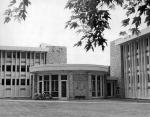
Kisner-Woodward Hall (1969-present)

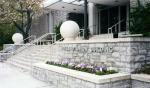
Kisner-Woodward Hall was the first building at Dickinson College designed to be a coed dormitory, and was first occupied by students in April 1969. This student residence was named for Hugh B. Woodward and Helen Kisner Woodward, both members of the class of 1908, whose generous donation made the construction of the building possible.

The building was designed by Howell Lewis Shay and Associates, and constructed at a cost of $820,000.

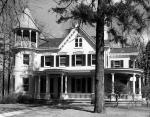
Kappa Sigma House (c.1932-1963)

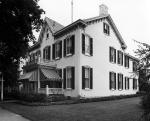
Sometime after 1932, the Kappa Sigma fraternity moved out of the east end of East College and into a house on the northeast corner of College and Louther Streets. The third floor of the large home provided dormitory space for the members, while study rooms occupied the first and second floors. The basement contained a recreational room. In 1961 the rise in numbers in the fraternity prompted the purchase of a carriage house to the rear of the main building to provide additional social and dormitory space.

The house was destroyed by fire on December 16, 1963, and in 1964 the group moved to Quad 3 (now Cooper Hall) in the Fraternity Quadrangle.

Benjamin D. James Center (1987-2006)

The Benjamin D. James Center was built on the northwest corner of Louther and College Streets on land acquired by the College from the Church of the Brethren in 1985. The building was dedicated on October 17, 1987, and provided classrooms, offices, and the department laboratories for geology, psychology and environmental science.

The building was named in honor of Benjamin D. James, a member of the class of 1934, college professor, coach, dean of admissions, dean of students, and professor emeritus of psychology and education. The James Center was designed by Spillman Farmer Architects and constructed at a cost of $2.8 million.

In the summer of 2006, the James Center was demolished to clear land for the construction of the Rector Science Complex. One wing of the new Rector Complex was named James Hall, as a continuing tribute to Dr. Benjamin James.

Jackson House (1961-1963)

The College purchased the former residence of W. L. Jackson on July 14, 1961, at a cost of $37,500. The house, located at 42 North College Street, was part of a land acquisition project designed to secure room for the construction of a new student union.

The Jackson House served as a men’s honors dormitory until 1963, when it was razed to make way for the new Holland Union Building.

Holland Union Building (1966-present)

The Holland Union Building, fondly called the “HUB” by members of the Dickinson College community, was dedicated on June 4, 1966, as a center for student services. It was designed by Howell Lewis Shay and Associates, and was constructed and equipped at a cost of $2,465,000. The building is named after Homer C. Holland, Class of 1913, who generously donated $200,000 to the subscription campaign that was organized to provide funds for the building’s construction. The Mathers Theater, located inside the Holland Union Building, is named in honor of James M. Mathers, Class of 1931, whose widow gave $100,000 in his memory to the College during the same campaign.

In addition to the Mathers Theater, the Holland Union Building is home to the College’s cafeteria, the Union Station Snack Bar, the Underground coffee bar, the Devil’s Den Convenience Store, the College Bookstore, the College radio station (WDCV), the Microroom (a 24-hour computer lab), a dance studio, a post office, the cashier’s office, numerous offices and conference rooms, a social hall, a meditation room, and lounges.

Herman Bosler Biddle Athletic Field (1909-present)

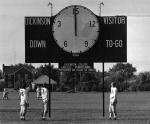
On June 8, 1909, Edward William Biddle donated this six-acre field to the College as a memorial to his son Herman, a member of the Class of 1903. The College has owned the field ever since, with subsequent land purchases having increased the size of the field to over eleven acres.

The site now features a football field, an outdoor track, tennis courts, and fields for soccer, field hockey, lacrosse, and baseball. In addition, weight training facilities and a locker room were authorized in 1962 and paid for by the Washington Redskins football organization, in return for pre-season use of the field and facilities. The main entrance to the field is a large stone gate located in the northeast corner bearing a plaque in tribute to Biddle.

Hartman House (1983-present)

This house, located on West Louther Street, was built in 1890 and served as the home of Dickinson President James Henry Morgan for nearly fifty years.

In 1983, the most recent occupants of the house, John Hartman, class of 1932, and his wife Thora, donated it to the College, and the building in turn was given their name as a sign of appreciation.

After the donation, the house became the home of the Office of Alumni and Parent Associations, the first permanent home for this office in the College’s history. The addition of the adjacent house created the Hartman Alumni Center, which is used for formal and informal college gatherings as well as for hosting important guests of the College.

Goodyear Building (1979-present)

The Goodyear Building is a three story brick building standing at 595 West Louther Street. It was built in 1891 by John Lindner, owner of the Lindner Shoe Company, to house his factory. For nearly thirty years the factory produced fine women’s shoes, at its height employing 900 workers in three shifts. Financial troubles, and an inability to keep up with rapid changes in women’s shoes, caused the Lindner Shoe Company to be sold in November 1922 to the Bedford Shoe Company, also of Carlisle.

The Bedford Shoe Company was started in 1891 by Alonzo F. Bedford and Harry W. Johnson. After Johnson left the company, he was replaced by William H. Goodyear. In 1919, the Bedford Shoe Company sold its older factory to the G. R. Kinney Corporation. Three years later, Bedford and Goodyear purchased the Lindner factory, often hailed as the most modern factory in the Carlisle shoe industry. When Alonzo Bedford retired, the Bedford Shoe Company remained under Goodyear’s control.

The G. R. Kinney Corporation, another shoe manufacturer, purchased the factory on West Louther Street in 1963. They renamed the building the Goodyear Warehouse, and used it as extra storage and rental space.

Gibbs House (1939-1964)

The College acquired the Gibbs House, the former home and carriage house of John Hays, in June 1939. The house is located on North Hanover Street, approximately five blocks from the college campus. An endowment from Rebecca McClure Gibbs enabled Dickinson College to purchase the building, and final costs, after a number of alterations to the house, totaled $23,000. Gibbs House was the first dormitory intended specifically for senior women, and its location across the street from Metzger Hall was ideal for keeping all of the female students quartered near one another. Gibbs House remained in use as a college residence hall until 1964, when it was sold to Roy E. Hoffman.