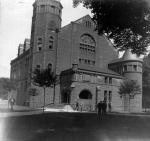
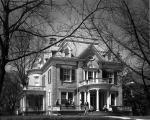
Davidson Hall (1964-2005)

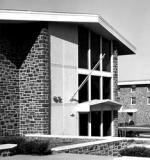
One of four residence halls that make up Dickinson College’s “Lower Quad,” Davidson Hall (Quad 10) was originally one of the ten buildings constructed to house the College’s fraternities in the 1960s. Davidson first housed students in September 1964, as the home of the Phi Delta Theta fraternity, and later became a general residence hall.

The building was named in honor of Robert Davidson, one of the first professors, and subsequently the second president of Dickinson College, 1804-1809. Davidson also served as pastor of the Carlisle Presbyterian Church for more than 25 years. The building was designed by Howell Lewis Shay and Associates, and constructed at a cost of approximately $200,000.
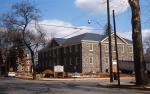
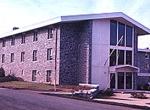
Dana Hall (1966-present)

Built specifically for the College’s Biology Department, Dana Hall was dedicated on October 8, 1966. The building, situated on the northeast corner of College and Louther Streets, was designed by Elmer H. Adams and built at a cost of $1.3 million.

The building is named in honor of Charles A. Dana, whose foundation made a $300,000 grant toward the project. The Longwood Foundation contributed an additional $480,000 for the construction of this building. The Biology Department has been the building’s primary occupant since its opening.

Cooper Hall (1964-present)

One of six residence halls that make up Dickinson College’s “Upper Quad,” in the Fraternity Quadrangle, Cooper Hall (Quad 3) began housing students in September 1964. It is named after Thomas Cooper, friend of Joseph Priestley and professor of natural philosophy and chemistry from 1811 to 1815. Members of the Kappa Sigma fraternity were the first students to occupy the hall, which later became a general residence hall.

Cooper Hall was designed by Howell Lewis Shay and Associates, and constructed at a cost of approximately $200,000. The building was completely remodeled in 1998.
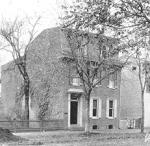
Cook International House (1986-present)

The Cook International House, located at 239 West Louther Street, housed the Office of Off-Campus Studies (Office of Global Education) and the Internship Office until 2001, when these offices moved into the new Global Education Center in the newly-renovated Stern Center. Professor Emeritus Donald Flaherty, a professor of Political Science from 1952 until 1983, donated the house to the College through an annuity trust in 1986. It was named in honor of Winfield (Class of 1932) and Isabelle Cook, whose gifts created an endowed fund for the College’s international programs and helped establish Dickinson Centers in the European cities hosting Dickinson study-abroad programs, including Bremen, Germany; Toulouse, France; Malaga, Spain; Bologna, Italy; Norwich, England; and Moscow, Russia. The house now is the home of the College's Community Studies Center.

Conway Hall (1964-present)

One of the ten “Quads” which made up Dickinson College’s Fraternity Quadrangle, Conway Hall (Quad 1) was first occupied in September 1964. The hall, which is the second building in the institution’s history to bear the Conway name, was named for Moncure Daniel Conway, Class of 1849, a distinguished author and anti-slavery, world peace activist.

The building first served as home to the Phi Epsilon Pi fraternity, and later became a general residence hall. The building was designed by Howell Lewis Shay and Associates and constructed at a cost of approximately $200,000.
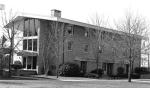
Conway Hall (1905-1966)

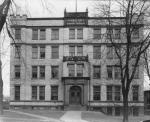
Conway Hall was dedicated on June 6, 1905 as a home for the Dickinson Preparatory School, complete with offices, classrooms, and living quarters. Miller I. Kast designed the building, and Andrew Carnegie paid the $63,480 construction costs in full, in honor of his friend Moncure Daniel Conway, Class of 1849.

When the preparatory school closed in 1917, the College began to use Conway Hall as a residence hall for freshmen men. The building was also used as a locker room for teams competing at Biddle Field (the front step of Conway is preserved near the main stand entrance to Biddle Field), as well as a barracks for the 32nd training detachment for eleven months during World War II.

Conway Hall was closed and razed in the summer of 1966 to provide room for the construction of Boyd Lee Spahr Library.

College Farm (1967-present)

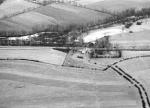
The College Farm, located in South Middleton Township between Mount Holly Springs and Boiling Springs, Pennsylvania, was given to Dickinson College in nearby Carlisle in 1967. The farm, which was valued at $110,000, was the gift of Ivo V. Otto, class of 1904, and his wife Clara.

The 180-acre property was to be used by the College for educational purposes, and one idea at the time was the possibility of future development of a “model urban community,” which would be used by faculty and students to explore the benefits and drawbacks that are inherent with the establishment of such a community.

Since approximately 2006, this property has served as a working farm and educational resource that provides produce to the college’s dining hall, a local food bank, and members of the farm’s co-op. The farm is also home to a flock of sheep and a flock of laying hens and includes state-of-the-art sustainable operations, such as solar-electric and solar-hot-water systems. It is run by staff members, student workers, and interns.

Buchanan Hall (1964-present)

Located in the “Upper Quad,” Buchanan Hall (Quad 2) is one of ten residence halls that originally made up the College’s Fraternity Quadrangle. First occupied in September 1964, the hall is named for James Buchanan, Class of 1809, whose lifelong political career culminated in his becoming the fifteenth President of the United States. The building was first used as the home of the Theta Chi fraternity, and later served as a general residence hall.

Designed by Howell Lewis Shay and Associates, the building cost approximately $200,000.

Bosler Hall (1886-present)

The construction of Bosler Hall on the John Dickinson Campus began in 1884, and was completed on June 23, 1886. The building was made possible through a gift from Helen (Beltzhoover) Bosler and was named the James Williamson Bosler Memorial Library in memory of her husband, a member of the class of 1854. Faced with red sandstone, the building was the first designed specifically for the purpose of housing the college’s library. Bosler Hall also included a chapel and assembly space on the top floor. Constructed at a cost of $68,000, the building was designed by architect Charles L. Carson.

In 1940-41 the building was transformed, enlarged, and refaced with limestone in the Georgian style according to the designs of architect William W. Emmart. This renovation was completed for $135,440.

Following the construction of the Boyd Lee Spahr Library in 1967, major alterations were made to Bosler Hall, and it became the home of the fine arts and modern language departments. The building was renovated once again in 1983 at a cost of approximately $2 million. Primary among the changes for this renovation was the establishment of space in the building to house the Media Center.

Biddle House

Biddle House was the former home of College alumnus and trustee Edward M. Biddle, Jr., and was purchased by the College on December 14, 1946 at a cost of $25,000. The house was used primarily as living space for men or women, as needed, in different years; it would later be occupied by fraternities and other student groups. The basement provided space for organizations such as the Alumni Office and the Faculty Club.

Shortly after Sigma Alpha Epsilon moved out in 1990, Biddle House became the Arts House residence and then the home of campus offices and departments such as Religious Affairs and the Counseling Center. The basement housed the Department of Theater and Dance until 2002, and from 1994 to 2004 the Clarke Center for Interdisciplinary Study of Contemporary Issues occupied the first floor. From 2004 onwards the building has been occupied by the Registrar's Office, the Career Center, and Academic Advising.