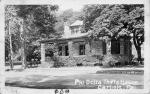
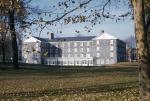
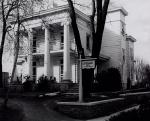
Phi Delta Theta House (1899-1931)

This stone lodge was built for the Phi Delta Theta fraternity at Dickinson College in Carlisle, Pennsylvania in 1899. It was designed by Harry E. Yessle.

The College’s purchase of the building for $8,300 was authorized on June 5, 1931, after the fraternity had constructed a new, larger house. The building was remodeled as classroom and office space for the department of education and psychology, and in 1958, it was assigned to the music department when education and psychology relocated to Reed Hall. It later served as the College’s Media Center, then again as a fraternity residence, and in the year 2000 it was converted into a student social space, "The Quarry," featuring a popular coffee bar.
Parker House (1938-1952)

Also known as the “Junior House,” the Parker House was one of three buildings that housed the women of Dickinson College in the first half of the twentieth century. Located on North Hanover Street, it was the former residence of William H. Parker, and was leased to Dickinson College in September 1938. Because of its proximity to Metzger Hall and Gibbs House, Parker House was used intermittently as a women’s dormitory until the opening of Drayer Hall in 1952.

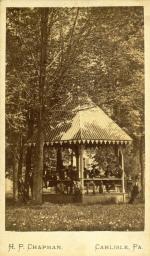
The Pagoda (1871-1886)

Erected in late spring 1871 as part of President Robert Dashiell's ambitious campus improvement campaign at Dickinson College in Carlisle, Pennsylvania, the pagoda was a pentagonal wooden gazebo that stood near the south wall on the John Dickinson campus. Designed to be a prominent campus fixture, the structure was painted in brilliant colors of white and chrome yellow with accents in red and ultramarine blue. The pagoda was nestled in a small grove of trees that dotted the campus, and was the site for many campus gatherings such as Class Day exercises during commencement.

Old Gymnasium (1885-1953)

The first gymnasium of Dickinson College in Carlisle, Pennsylvania was completed in 1885, and was made possible by a gift from Clemuel Ricketts Woodin. The building was designed by Charles L. Carson and constructed at a cost of $7,513.28. The gymnasium was later equipped through a donation by William Clare Allison, and officially dedicated on January 6, 1888. A central heating plant was built into the basement of the gymnasium in 1889, so that by 1890 student dormitories and college classrooms no longer required individual stoves for heating. This addition brought to campus a familiar landmark - a tall smokestack.

In 1931, after the Alumni Gymnasium was completed, the so-called "Old Gymnasium" was converted into a social and recreational hall. It served as the dining hall for the cadets of the Air Crew Training Program during the Second World War. In 1946, this structure became the home of the College Commons. On May 17, 1953, the building’s western wall collapsed during a storm, and the building was razed shortly thereafter. The heating plant was retained, however, and an addition was added in 1955 for $70,000. The old heating plant and its boilers were finally replaced in 1966, and the tall smokestack was demolished in 1987.

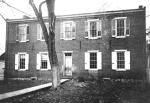
"Old College" (1781-1805)

Constructed in 1781 to house the Latin School which was under the care of the Presbyterian congregation in Carlisle, Pennsylvania, "Old College" fronted on Liberty Alley on Town Lot #219, the lot donated by Thomas and John Penn on March 3, 1773. The construction of this brick building, according to the records of contractor John Creigh, cost £42/3/5½. An addition, faced with stone, was authorized by the Board of Trustees of Dickinson College on October 20, 1785, and was completed at a cost of $583.62. With the expansion completed, the property was legally transferred to the College trustees on October 3, 1788.

The first classes of the undergraduate courses were taught in the building until in 1802, in anticipation of the completion of a new building, the trustees of the College sold “Old College” to Charles McClure for $533.33. The College was granted the right to continue its use of the building, however, after the “New College” was destroyed by fire. Once Dickinson permanently vacated “Old College” in 1805, the building reverted to Charles McClure. Following McClure's death in 1811, the building came under the ownership of several schools in succession until, through carelessness or arson, it burned down on April 28, 1860. A new schoolhouse was then constructed on the site following the same design, and the image which appears here shows that all-brick building.

North College (1822-1856)

The reopening of the College in 1821 sparked the undertaking of major renovations to the campus. One of these renovations included the construction of a woodhouse and an icehouse to the north of West College in 1822. The woodhouse, built at a cost of $265 by John and George McCarter, was to be 80 feet long, 22 feet wide, and 12 feet high. The icehouse was to be 9 feet on each side and sunk 16 feet into the ground. Both buildings were made of limestone. Twenty-five years later, in July 1847, President Robert Emory authorized a $300 renovation supervised by contractor William H. Horn to provide living quarters for students, more specifically for young tradesmen, who were also provided with space to carry on their respective trades. Along with the new look and purpose came a new name, "North College," denoting the building’s location on the campus. North College was destroyed by fire on November 11, 1856, one week after Dickinson alumnus James Buchanan was elected as the fifteenth President of the United States. North College is believed to have been located approximately on the site of the white building in the background of the above image.

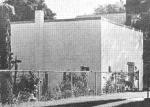
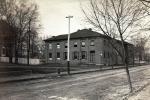
Edison C. Nickel Potato Chip Factory

In 1949 Edison C. Nickel built a one story cinder-block potato chip factory adjacent to Dickinson College in Carlisle, Pennsylvania, near the South College building. Despite protests from Carlisle residents who believed that the factory would be a nuisance and a threat to the health and welfare of the community, the factory went into operation. Dickinson College offered to purchase the building in 1953, but the offer was withdrawn because of a disagreement over price.

The College eventually purchased the building for $16,000 in 1957 with the intention to convert it into a rifle range. This plan was never carried out, however, and the building was instead leased to and renovated by various agencies of the federal government, including the Agency for International Development and the General Services Agency. Although these agencies had already been leasing space in East College, the government’s use of the structure became the subject of student concern on multiple occasions, as rumors of connections with the Central Intelligence Agency, the Carlisle War College, and the Carlisle Police Department arose. One actual use for the building most probably was as the site of the emergency headquarters of the Labor Department of the United States should nuclear war decimate Washington DC.

"New College" (1802-1803)

This brick structure was the first building constructed on the seven acre lot now known as the John Dickinson Campus of Dickinson College in Carlisle, Pennsylvania. It stood on the site of the present West College. This "New College" (distinct from the "Old College," a building along Liberty Avenue) was authorized by the Board of Trustees on September 26, 1798. The cornerstone was officially laid on June 20, 1799. The building was designed by John Keen of the Carpenter’s Company in Philadelphia, and was constructed at a cost of $12,000.

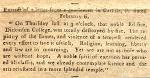
Tragedy struck when, less than two months after opening its doors to students, "New College" burned to the ground during a windy and snowy night on February 3, 1803. News of the tragedy appeared throughout the country, including in New York's Weekly Museum of February 19, 1803 (as shown).

Morgan Hall (1955-present)

Morgan Hall was dedicated on November 12, 1955 as the first single-purpose residence hall built for men in the history of the College. It was dedicated to the memory of James Henry Morgan (1857-1939), College alumnus, faculty member, dean, and president. A substantial portion of the total $600,000 cost was financed with a federal loan of $570,000. The architectural firm of Martin, Stewart, and Noble was responsible for the design.

In 1965, with the opening of the Holland Union Building, the dining hall and kitchens were closed and converted to student living space. Since 1980, Morgan has largely housed freshman men and women. Major renovations were completed during the summer of 2002 and provided the building with a reorientated main entrance, now facing the Mooreland Campus, and an atrium, in addition to enlarged and modernized suites.

Montgomery Hall (1950-present)

Long before Dickinson College in Carlisle, Pennsylvania actually purchased Montgomery Hall, the building had a place in the history of the College. Built by Professor Robert Emory in 1837, it served as his home until 1842. The house was later owned by Professors William H. Allen (1847-1849) and John McClintock (1853-1870).

The College finally acquired the house from Reverend Harry B. Stock, class of 1891, on March 27, 1950. Purchased for $25,000, the house was then named for Colonel John Montgomery, who, along with Benjamin Rush, was instrumental in the founding of Dickinson College. A subsequent remodeling and enlargement project designed to convert the house into apartments for faculty use cost an additional $96,500.

In 1968, Montgomery Hall became a women’s dormitory. Soon after, the house began to serve various Student Developed Learning Communities, and over the years it has been home to the French and Spanish House, as well as the Volunteer House. The house was renovated in 2002 to become the home of the Department of Theatre and Dance.