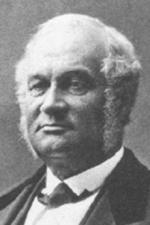
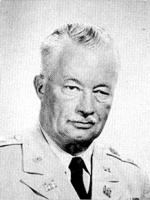
John Reed (1786-1850)

John Reed was born in 1786 on Marsh Creek, in Adams County, the son of General William Reed. He entered Dickinson College in Carlisle, Pennsylvania with the class of 1806 but left before graduation to study law with William Maxwell of nearby Gettysburg. Reed was admitted to the bar and began practice in Westmoreland County. He quickly made a name for himself there and in 1815 he was elected to the Pennsylvania Senate and served as Deputy Attorney General for the state. In July 1820, Governor Findlay named him the President Judge of the Ninth Judicial District, comprising Cumberland, Franklin, Adams, and Perry counties.

Alumnus/Alumna Class Year
Honorary Degree - Year
1830
Faculty - Years of Service
1834-1850
Trustee - Years of Service
1821-1828
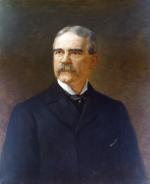
George Edward Reed (1846-1930)

George Reed was born in Brownsville, Maine on March 28, 1846 as the tenth of eleven children of the Reverend George and Ann Hellyer Reed. His father died when George was 10 and after living with relatives he was reunited with his mother in Lowell, Massachusetts at the age of 10. He went to public schools in Lowell and worked farm jobs in the summers, including the memorable Civil War year of 1864 when he worked for some time at a "contraband camp" in New Bern, North Carolina, where 10,000 former slaves were sheltered.

He prepared for college at Wilbraham Academy in Massachusetts and went on to study at Wesleyan University from which he graduated with honors in 1869. Reed had funded some of his time at Wesleyan by preaching every Sunday, and, although he had been intending a career in the law, a year of theology at Boston University set him on the path of the Methodist ministry. He served his first pastorate in Willimantic, Connecticut, and went on to a series of posts in Massachusetts, New York, and Connecticut over a span of nearly twenty years. In 1885, Reed received an honorary doctorate of systematic theology from Wesleyan University and a doctorate of laws from Lafayette College in 1889.

College Relationship
President - Years of Service
1889-1911
Faculty - Years of Service
1889-1911

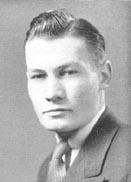
William P. Reckeweg (1916-1945)

William Reckeweg was born in Audubon, New Jersey in September 1916. He attended high school there, graduating in 1933; he then entered Dickinson College in Carlisle, Pennsylvania with the class of 1937. While at Dickinson he was an active student: a football, soccer, and baseball player, and a member of the Glee Club and Sigma Chi fraternity.

After graduation, Reckeweg became employed as an insurance agent. However, by February 1941, he had enlisted in the United States Army and had been sent to Fort Indiantown Gap, Pennsylvania for training. He completed officer candidate school at Fort Benning, Georgia in August 1942; by August 1943, he was a captain. He applied for active duty and became the commander of Company C, 357th Infantry, 90th Division, just prior to the D-Day landings. He was wounded in early July in Normandy and spent six weeks in a hospital in England. William Reckeweg was killed in action on February 1, 1945, in northern Luxembourg, when shell fragments struck his company command post as his unit was digging in on newly-won high ground.

College Relationship
Alumnus/Alumna Class Year

William Sterrett Ramsey (1810-1840)

William S. Ramsey was born in Carlisle, Pennsylvania on June 12, 1810. He and his brother Albert C. Ramsey were the sons of William Ramsey (1779-1831) who was the Jacksonian representative during the 21st, 22nd, and 23rd United States Congresses and he died in office. Both brothers entered the local Dickinson College with the class of 1830 but did not graduate. Both were, however, elected to the Union Philosophical Society at the College, Albert in the class of 1829 and William with the class of 1830.

Ramsey studied the classical subjects he had begun at Dickinson in Europe and served as an attache with the American Legation in London. He was elected to the Twenty-sixth Congress in 1838 and was reelected in late 1840. Ramsey was suffering from a liver complaint, most probably from the effects of alcoholism. He had left his home in Carlisle on election day without telling anyone, though his brother had travelled from his own home in York to care for him. Shortly after his reelection, William Sterrett Ramsey shot himself through the right eye in a room at Barnum's Hotel in Baltimore, Maryland on October 18, 1840. He was thirty years old.

College Relationship
Alumnus/Alumna Class Year

Alexander Ramsey (1815-1903)

Alexander Ramsey was born near Harrisburg, Pennsylvania on September 8, 1815, the son of Thomas and Elizabeth Kelker Ramsey. He was educated locally and then attended Lafayette College in Easton, Pennsylvania. Entering the Law Department of Dickinson College in Carlisle, Pennsylvania in 1839, he earned a bachelor of laws degree in 1840. He was admitted to the Pennsylvania bar and opened a practice in Harrisburg.

At that time Ramsey began what can only be termed as a meteoric rise in politics, beginning with his appointment, almost immediately, as secretary to the electoral college of Pennsylvania, and then as clerk of the State house of representatives in 1841. By late 1842 he had been elected as a Whig to the Twenty-eighth Congress, representing Dauphin County, and served two terms from 1843 to 1847 before declining further nomination. Still only in his early thirties, his life took a momentous step when, on April 2nd, 1849, President Zachary Taylor appointed him to the post of Governor of the newly established Territory of Minnesota. Though some reports say that Ramsey would he preferred the more lucrative post of collector of tariffs at the Port of Philadelphia, he became and remained a Minnesotan for the rest of his life.

College Relationship
Alumnus/Alumna Class Year

Albert C. Ramsey (1813-1869)

Albert Ramsey was born in Carlisle, Pennsylvania in 1813. He and his brother, William Sterritt Ramsey, were the sons of William Ramsey (1779-1831) who was the Jacksonian representative during the 21st, 22nd, and 23rd United States Congresses and died in office. Both brothers entered the local Dickinson College with the class of 1830 but did not graduate. Both brothers were, however, elected to the Union Philosophical Society at the College, Albert in the class of 1829 and William with the class of 1830.

Few other details of Ramsey's early life are available but he was admitted to the York County bar in November 1834. According to items held in the Gettysburg College Special Collections, he received a master's degree in 1838 from Pennyslvania College in Gettysburg. He had served as District Attorney and was also editor of the York Democratic Press.

College Relationship
Alumnus/Alumna Class Year

Earl Eugene Rahn (c.1892-1918)

From Birdsboro, Pennsylvania, Earl Rahn entered the Dickinson College in Carlisle, Pennsylvania in 1909. He began his academic life in the Scientific course but then changed to the Philosophical course. He participated in activities ranging from the track team to the debate team, and from drama to Glee Club. He wrote for the Dickinsonian and had a poem entitled "Fate" published in the 1915 Microcosm. In the most cruel of ironies, this poem deals with the possibility of early death. Rahn graduated with a bachelor of philosophy degree with his class of 1912.

At the outbreak of war, Rahn enlisted and took his officer training at Fort Oglethorpe, Tennessee before moving on to his unit at Columbia, South Carolina. His regiment was in France by mid-1918 and he was "struck down in youth" at Bois de Lar Rapp on October 18, 1918.

College Relationship
Alumnus/Alumna Class Year

John Drake Pusey (1905-1966)

John Drake Pusey was born in Council Bluffs, Iowa in 1905. He graduated from Northwestern University and subsequently attended the Chicago Art Institute and the Yale University School of Fine Arts. He went on to study abroad in France at the Louvre, the Luxembourg Art Museum, and the Prado in Spain.

Returning to the United States, Pusey found employment in a number of areas. In the 1930s, he was commissioned by pharmaceutical and bio-medical research pioneer Eli Lilly to paint murals to decorate his home. In 1938, the San Francisco World's Fair hired Pusey to paint murals and oversee the artistic side of the event. He also worked as an art director for Universal Studios. With the approach of the Second World War, Pusey enlisted in the United States Army and served in both that war and the Korean War, rising to the rank of lieutenant colonel of the United States Army Corps of Engineers on the strength of his skills in developing camouflage techniques and designs.

College Relationship
Faculty - Years of Service
1957-1965

James Alexander Ventress Pue (1841-1919)

J. A. V. Pue was born in Howard County, Maryland to Arthur and Sallie Dorsey Pue on July 20, 1841. He prepared for his undergraduate career at the Dickinson Grammar School and entered Dickinson College in Carlisle, Pennsylvania in 1855 with the class of 1859. He was elected as a member of the Belles Lettres Society and graduated with his class in the early summer of 1859.

Pue studied law, but with the outbreak of the Civil War, he joined his militia cavalry unit when it rode south in May 14, 1861 and enlisted in the Confederate Army as the First Maryland Cavalry. The following day, Pue was elected as third lieutenant of Company A and was promoted to second lieutenant a year later. He was wounded at Greenland Gap, Virginia in April 1863, but this did not prevent him from joining the invasion of Pennsylvania in June. The First Maryland was attached to Fitzhugh Lee's Brigade at the time, and Pue almost certainly would have returned to Carlisle and the grounds of Dickinson College during Lee's late June occupation of the town. Pue was captured on August 7, 1864, probably at Moorefield, West Virginia, when the First was taken by surprise and suffered very heavy casualties. Following the end of the war, he moved to Bandera County, Texas with several members of his family, where he practiced law and entered the farming and stock-raising business. He also served as judge of the Bandera County Court.

College Relationship
Alumnus/Alumna Class Year

Morris Watson Prince (1843-1931)

Morris Watson Prince was born a minister's son in an old New England family in East Boothbay, Maine in 1843. He went to school in Bucksport and went on to Wesleyan College where he was graduated Phi Beta Kappa in 1868. One of his classmates was George Edward Reed. He studied theology at Boston University and in 1871 followed his father's steps into the Methodist ministry.

His career was a successful one, serving in various pastorates in New Hampshire, at Plymouth and Concord. After twenty years as a pastor he became president of the Maine Conference Seminary in Bucksport between 1871 and 1884. Prince retired to his preferred vocation as pastor in Connecticut at Hartford and New Haven, and at New York City in Brooklyn. He turned down several offers from other institutions until his old classmate Reed, now president of Dickinson College in Carlisle, Pennsylvania, persuaded him to join his faculty in 1894 as professor of history and political science. His career as a professor was late in beginning, but he served diligently for fifteen years.

College Relationship
Faculty - Years of Service
1896-1911