
About Full-Text Documents
Collections of college and personal papers, as well as a select number of individual documents, have been briefly described in entries available for browsing and searching on this site. All collection and document descriptions contain a representative image and a summary of the contents.
Search Document Descriptions
Browse Document Descriptions

June 22, 1863
Jacob G. Frick writes a memorandum to A. L. Russell, Adjutant General of Pennsylvania, that lists the field and staff officers submitted for the Pennsylvania Regiment Militia. Transcript included.
Format: Letters/Correspondence
Location: MC 2003.4, B4, F18
Subject: Military Affairs and Conflict
Time Period: 1860-1879
View Item: Memorandum from Jacob Frick to A. L. Russell
July 1863
Union officer Jacob G. Frick describes how two soldiers (Harley Palmer and Charley Palmer) without any weapons reacted during a military engagement. While Charley followed orders to cross a river in order to avoid "any danger," Frick notes that "Harley ran off and got a gun and accoutrements from some one who managed to get sick just as the fight commenced." Transcript included.
Format: Letters/Correspondence
Location: MC 2003.4, B4, F17
Subject: Military Affairs and Conflict
Time Period: 1860-1879
View Item: Letter from Jacob Frick to Unknown Recipient

July 3, 1863
Thomas Miller Griffith writes to his brother and sister and describes the scenes in Carlisle as the Confederates occupied and shelled the town in the days before the Battle of Gettysburg. As the Confederates first approached Carlisle in late June 1863, Griffith recalls the expedited Commencement ceremonies at Dickinson College, the rush to get students home, and the busy streets as "people were removing their things into and through [town]." Confederate General Albert G. Jenkins' troops, however, did not impress Griffith. "The rebels were so exceedingly dirty that they were not fit to enter any decent church," as Griffith explains. After those Confederate soldiers left, Griffith notes that a group of Union soldiers from Harrisburg arrived to "a hearty welcome." In addition to describing the skirmish, Griffith describes the damage that results from the Confederate shelling on July 1. Griffith, a member of the Class of 1858, also mentions his cold interactions with several Dickinson College alumni who had joined the Confederate army as well as the use of Dickinson College as a hospital. Transcript included.
Format: Letters/Correspondence
Location: MC 2005.4, B1, F2
Subject: Dickinson College Academic Affairs, Dickinson College Events, Dickinson College History, Education, Military Affairs and Conflict
Time Period: 1860-1879
July 15, 1863
George D. Chenoweth describes the Confederate invasion, occupation, and shelling of Carlisle. He mentions leaving Carlisle before the raid, and the pleasure of finding none of their personal belongings disturbed upon his return. 12,000 men entered the town, setting up camp around the town and on the College’s campus. He writes of men thieving groceries, supplies, etc. from the town and townspeople, some of whom were taken prisoner until confessions were given as to the locations of supplies. After receiving news of the Union forces attacking near Gettysburg, the initial Rebel force left, to be replaced by a militia from Harrisburg.
Chenoweth also describes the shelling of the town by the Rebel cavalry overnight, where many homes were damaged and people took refuge in their basements. Others escaped the town for safer locations. The quickened nature of Commencement is also described. The Union victories in Gettysburg and Vicksburg are mentioned. Chenoweth then makes predictions concerning the “crushing [of] the rebellion.” Transcript included.
Format: Letters/Correspondence
Location: I-Original-1863-4
Subject: Carlisle and Cumberland County, Military Affairs and Conflict
Time Period: 1860-1879
View Item: Letter from George D. Chenoweth to James W. Marshall

July 16, 1863
Susanna Thompson writes a letter to Agnes Cuddy asking for information about the "rebels" and expressing worry over the state of the soldiers, including John T. Cuddy. Thompson also asks her friend for information about what happened when the Confederates invaded Carlisle and burned the US Army barracks during the Gettysburg campaign. Transcript included.
Format: Letters/Correspondence
Location: MC 2001.9, B1, F12
Subject: Carlisle and Cumberland County, Military Affairs and Conflict, Personal and Family Life
Time Period: 1860-1879
View Item: Letter from Susanna Thompson to Agnes Cuddy
July - September 1863
John Taylor Cuddy writes five letters to his friends and family describing his experience as a soldier for the Union Army during the Civil War. Cuddy discusses the places he has traveled through and the battles he has witnessed. In addition, Cuddy mentions Confederate General Robert E. Lee's defeat at Gettysburg. The Union "nipped lee in pennyslvana and drove him out of meryland," as Cuddy notes. Transcripts included.
Format: Letters/Correspondence
Location: MC 2001.9, B1, F9
Subject: Military Affairs and Conflict, Personal and Family Life
Time Period: 1860-1879
View Item: Letters from John Cuddy (Jul. - Sept. 1863)
July 28, 1863
Augustus Schell writes to former Secretary of State Jeremiah Sullivan Black regarding events leading up to the start of the Civil War, particularly Fort Sumter.
Format: Letters/Correspondence
Location: I-SpahrB-1959-9
Subject: Military Affairs and Conflict, Politics and Government
Time Period: 1860-1879
View Item: Letter from Augustus Schell to Jeremiah Black (Copy)

July - December 1863
Thomas William Dick writes four letters to family members describing his experience as a soldier in the Union Army during the Civil War. Dick states that he was present at President Abraham Lincoln's Gettysburg Address and shook hands with Lincoln, who "...appeared very glad to see [him]." Transcripts included.
Format: Letters/Correspondence
Location: Mc 2001.10, B1, F8
Subject: Military Affairs and Conflict, Personal and Family Life, Politics and Government
Time Period: 1860-1879
View Item: Letters from Thomas Dick (Jul. - Dec. 1863)
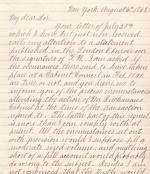
August 6, 1863
In a response to Augustus Schell sent to Jeremiah Sullivan Black in July, Black writes to Schell regarding James Buchanan's Cabinet, Fort Sumter, and General John Adams Dix.
Format: Letters/Correspondence
Location: I-SpahrB-1959-9
Subject: Military Affairs and Conflict, Politics and Government
Time Period: 1860-1879
View Item: Letter from Jeremiah Black to Augustus Schell (Copy)
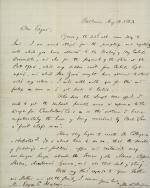
August 13, 1863
John Keagy Stayman questions Edgar E. Hastings as to when the draft will be lifted from Cumberland County, as he is “considered by Uncle Sam a ‘first class man’.” He also asks whether or not Dickinson College is still being used as a hospital, and hopes that it will quickly be vacated so that the smells of the medical supplies will dissipate from the “tower of the Muses, Classic Shades, Academic Groves, and all that sort of thing.” Transcript included.
Format: Letters/Correspondence
Location: I-Friends-2013-3
Subject: Carlisle and Cumberland County, Dickinson College History, Military Affairs and Conflict
Time Period: 1860-1879
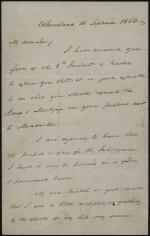
September 10, 1863
Former President James Buchanan writes Joseph Camp Griffith Kennedy regarding his health and finances. "My own heart is good, except that I am a little crippled in walking by the effects of my late very severe attack of rheumatism," as Buchanan explains. Buchanan also notes that "Judge Black has been here [in Wheatland, Pennsylvania] for a day or two." Judge Jeremiah Sullivan Black served as the Attorney General and as Secretary of State during the Buchanan administration. Joseph Kennedy was a statistician and was in charge of the 7th and 8th U.S. Censuses. He also founded a newspaper, the Intelligencer. Transcript included.
Format: Letters/Correspondence
Location: I-Friends-2005-6
Subject: Economics and Finance, Health and Medicine, Politics and Government
Time Period: 1860-1879
View Item: Letter from James Buchanan to Joseph C. G. Kennedy
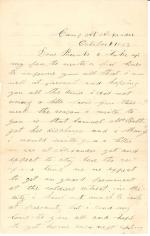
October - November 1863
John Taylor Cuddy writes four letters to his friends and family describing his experience as a soldier of the Union Army during the Civil War. Cuddy describes the places he has traveled through, expresses his wish for a furlough to return home, and comments on the latest war news. General Ulysses S. "Grant has whipped [Confederate General] Bragg and Charleston will fall before long and I think that will end the [war]," as Cuddy notes. Transcripts included.
Format: Letters/Correspondence
Location: MC 2001.9, B1, F9
Subject: Military Affairs and Conflict, Personal and Family Life
Time Period: 1860-1879
View Item: Letters from John Cuddy (Oct. – Nov. 1863)

November 5, 1863
Mary Goodin writes to her sister, Jane Hastings, about settling into a new home in East Bloomfield, Pennsylvania and apologizes for not writing in five weeks. Transcript included.
Format: Letters/Correspondence
Location: I-Friends-1975-16
Subject: Personal and Family Life
Time Period: 1860-1879
View Item: Letter from Mary Goodin to Jane Hastings

November 11, 1863
Former President James Buchanan writes to Dickinson College President Herman Johnson Merrills with information on several alumni, including William Speer (Class of 1788), Jesse Magaw (Class of 1806), and Buchanan's brother George Buchanan (Class of 1805). James Buchanan is a member of the Class of 1803. Transcript included.
Format: Letters/Correspondence
Location: MC 1998.10, B4, F7
Subject: Dickinson College Administration, Dickinson College Alumni Affairs, Dickinson College History, Education, Politics and Government
Time Period: 1860-1879
View Item: Letter from James Buchanan to Herman Johnson
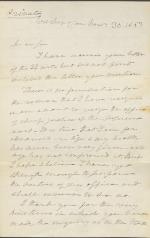
November 30, 1863
Supreme Court Chief Justice Roger B. Taney writes a private letter to Nahum Capen of Boston regarding a rumor about Taney resigning: "There is no foundation for the rumor that I have resigned or am about to resign the office of Chief Justice of the Supreme Court," as Taney explains. While "it is true that I am far advanced in life & my health has never been very firm," Taney notes that "I hope and believe I have yet strength enough to perform the duties of my office and shall endeavor to do so." Taney also underscores that this letter is private and he does not want it released to the press. Transcript included.
Format: Letters/Correspondence
Location: I-SpahrB-1960-4
Subject: Health and Medicine, Personal and Family Life, Politics and Government
Time Period: 1860-1879
View Item: Letter from Roger B. Taney to Nahum Capen

1864
The Dickinson College catalog for the 1863-1864 academic year. Through the years, the annual catalog was variously titled "The Bulletin," "Catalogue and Register," "Course Catalog," and similar variants. The catalog typically includes the list of courses offered, requirements for enrollment, requirements for graduation, tuition and other fees, and campus facilities, college policies, and lists of teaching faculty, college trustees, and various administrators.
Format: Books and Pamphlets
Location: Dickinsoniana Periodicals
Subject: Dickinson College Academic Affairs, Dickinson College Administration, Education
Time Period: 1860-1879
View Item:
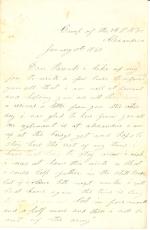
January - February 1864
John Taylor Cuddy writes four letters to his family describing his experience as a soldier of the Union Army during the Civil War. Cuddy, who has only three months left in the army, also discusses whether to join the veteran corps. Transcripts included.
Format: Letters/Correspondence
Location: MC 2001.9, B1, F10
Subject: Military Affairs and Conflict, Personal and Family Life
Time Period: 1860-1879
View Item: Letters from John Cuddy (Jan. - Feb. 1864)

1864-1866
William Meredith writes seven letters to Eli Slifer, Secretary of the Commonwealth, regarding the applicability of the Act of 1840 to interest payments, the announcement of a draft for more soldiers , warrants against various railroad companies, and other political affairs. Transcripts included.
Format: Letters/Correspondence
Location: MC 2003.4, B7, F24
Subject: Business and Industry, Economics and Finance, Military Affairs and Conflict, Politics and Government
Time Period: 1860-1879
View Item: Letters from William Meredith to Eli Slifer

1864-1866
William Meredith writes two letters to Pennsylvania Governor Andrew Curtin in which he differentiates between the acts of 1840, 1862, and 1863 that each relate to treasury payments, and discusses the reduction of state debt. Transcripts included.
Format: Letters/Correspondence
Location: MC 2003.4, B7, F24
Subject: Economics and Finance, Politics and Government
Time Period: 1860-1879
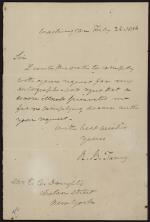
February 26, 1864
Supreme Court Chief Justice Roger Brooke Taney responds to Mr. E. C. Doughty's request for Taney's autograph. Taney also notes that his response has been delayed due to severe illness. Transcript included.
Format: Letters/Correspondence
Location: I-SpahrB-undated-45
Subject: Personal and Family Life, Politics and Government
Time Period: 1860-1879
View Item: Letter from Roger B. Taney to E. C. Doughty
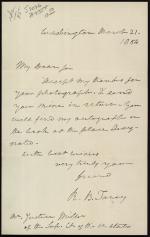
March 21, 1864
Supreme Court Chief Justice Roger Brooke Taney writes to Associate Supreme Court Justice Samuel Freeman Miller and thanks Miller for his photograph. Taney notes that he has enclosed his own photograph and autograph.
Format: Letters/Correspondence
Location: I-SpahrB-undated-43
Subject: Personal and Family Life, Politics and Government
Time Period: 1860-1879
March - April 1864
John Taylor Cuddy writes four letters to his parents describing his experience as a soldier of the Union Army during the Civil War. Cuddy mentions seeing Uncle Abraham in his regiment and notes that he hopes to be home soon. Cuddy also makes a point to tell his mother that he has not been corresponding with women. "You are [very] much mistaken if you think I write to [any] girl like Sarah Mcbeth [or] have [anything] to do with her," as Cuddy explains. Transcripts included.
Format: Letters/Correspondence
Location: MC 2001.9, B1, F10
Subject: Military Affairs and Conflict, Personal and Family Life
Time Period: 1860-1879
View Item: Letters from John Cuddy (Mar. – Apr. 1864)
April 2, 1864
Former President James Buchanan writes to his nephew, James Buchanan Henry, regarding Isabella Lynch, the daughter of one of his late friends. As Henry is an attorney, Buchanan asks him to look into Lynch's situation at the Convent of Visitation in Brooklyn. "The letter of Isabella Lynch gives a sad account of her sufferings which has caused me to feel deeply for the daughter of my old friend [David Lynch]," as Buchanan explains. Buchanan also instructs Henry to "supply her wants to the extent of $50 and give me information." Transcript included.
Format: Letters/Correspondence
Location: I-Friends-2010-2
Subject: Personal and Family Life, Religion and Spirituality
Time Period: 1860-1879
View Item: Letter from James Buchanan to James Henry

April 7, 1864
Former President James Buchanan's letter to his nephew, James Buchanan Henry, includes a list of individuals who have discharged their bonds or mortgages since April 1. Buchanan also provides instructions on various financial matters as well as a note about a "Tin Box." Transcript included.
Format: Letters/Correspondence
Location: MC 1998.10, B4, F8
Subject: Economics and Finance, Personal and Family Life
Time Period: 1860-1879
View Item: Letter from James Buchanan to James Henry

April 14, 1864
Supreme Court Chief Justice Roger Brooke Taney (Class of 1795) writes to Associate Supreme Court Justice Robert Cooper Grier (Class of 1812) and discusses Grier's health as well as his own. Transcript included.
Format: Letters/Correspondence
Location: I-SpahrB-undated-44
Subject: Health and Medicine, Politics and Government
Time Period: 1860-1879
View Item: Letter from Roger B. Taney to Robert Grier