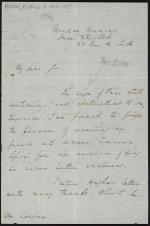
Letter from James Buchanan to John Maclean
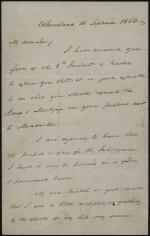
James Buchanan writes to John Maclean a month before his term as a US Senator from Pennsylvania starts.

James Buchanan writes to John Maclean a month before his term as a US Senator from Pennsylvania starts.
US Senator James Buchanan writes to Arnold Plumer about his Texas speech, a "Judge Cahon Nashville," and a letter that James K. Polk wrote to John K. Kane in June 1844. Buchanan also discuses the Tariff of 1842 and the Whigs in Pennsylvania.
James Buchanan writes to Sir Edward Curt and conveys his regrets that he cannot attend Her Majesty's Ball because he has "been unwell for the last two or three days." Buchanan is the Minister to Great Britain during President Franklin Pierce's adm
President James Buchanan responds to John A. Wilstach's letter about domestic issues and foreign affairs.
US Senator James Buchanan writes to Henry D. Gilpin about his unconfirmed nomination. While "a week ago I thought there was no doubt," Buchanan explains that "from the [temper?] manifested to day on the rejection of John S.
Former President James Buchanan writes Joseph Camp Griffith Kennedy regarding his health and finances.
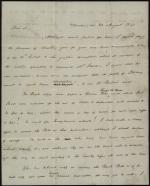
President James Buchanan writes to William R. Drinkard, Secretary of War John B. Floyd's chief clerk, in an attempt to solve a dispute over paying US Army Captain Montgomery Meigs.
Representative James Buchanan writes to Peter Stephen Du Ponceau of Philadelphia about Du Ponceau's earlier letter, which Buchanan had delivered to Ambrose Spencer, the chairman of the Committee on Agriculture.
Senator James Buchanan writes to Stimpson Harvey Woodward, an entrepreneur in Pittsburgh, Pennsylvania, regarding Whigs politics and the Bank of the United States.
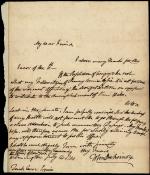
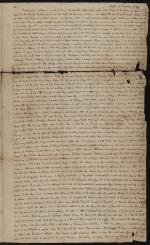
Former President of Pennsylvania John Dickinson writes to Confederation Congress delegate Tench Coxe, commenting on the ratification of the United States Constitution by New Hampshire (the required ninth and final state) and the creation of the ne
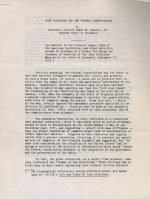
Charles Nisbet writes bookseller William Young to discuss various political and religious events in France, Ireland, and the United States.
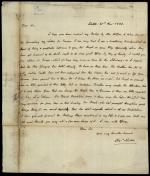
Charles Nisbet writes to bookseller William Young regarding a packet from an unspecified Mr. Wilson with two letters for Europe. Nisbet also asks for a paper, discusses Carlisle weather, and speculates about the French Revolution.
Charles Nisbet writes to his daughter Mary, discussing the theater in Carlisle, the Democrats, and the French.
Pennsylvania Attorney General Richard Rush writes to the members of an unspecified "Board of Health," stating his resignation as solicitor.
John Carson writes to Robert McPherson, a member of the Board of Trustees, and discusses Charles Nisbet's qualifications as a candidate for President of Dickinson College.
Charles Nisbet writes Ashbel Green to acknowledge Green's letter from September 12th and to justify questions about Green's intent in giving Nisbet's private letters to his political opponents.
This memorandum by David Stewart Erskine, the Earl of Buchan, was apparently at one time covering note for a number of letters from Dickinson College President Dr. Charles Nisbet to Erskine.
Dickinson College President Charles Nisbet writes to Dr. Jonathan Ingham of Bucks County, Pennsylvania with reflections on education, politics, international affairs, as well as other contemporary American issues. Transcript included.
Richard Rush writes to an unspecified "M. Carey." Rush desires to "cultivate... correspondence," although he will be busy for several months due to obligations with Congress and the Supreme Court.
James M.
Acting Secretary of State Richard Rush writes to Jonathan Russell, the United States minister to Sweden and Norway, regarding "the claims of several citizens of the U.
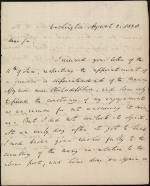
Richard Rush responds to John F. Watson's request for assistance in obtaining an "appointment as governor or superintendent of the Marine Assylum near Philadelphia." Rush explains that he talked to Secretary of the Navy Samuel L.
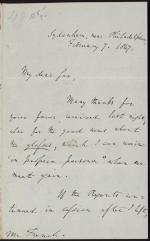
Richard Rush, United States Minister to France, thanks Benjamin B. French for finding his glasses and discusses the recent meeting of the Regents of the Smithsonian Institution.
Richard Rush, United States Minister to France, asks Benjamin B. French when the Regents of the Smithsonian Institution adjourned and if French has heard about a pair of spectacles Rush lost.
Richard Rush, United States Minister to France, informs a Mr.