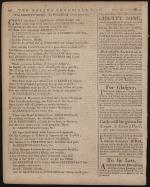
"The Liberty Song" (1768)
"The Liberty Song" was written in 1768 when John Dickinson set out to reflect on the political strife caused by the Townshend Acts of 1767, the latest in a series of British crown taxes levied on the colonies.

"The Liberty Song" was written in 1768 when John Dickinson set out to reflect on the political strife caused by the Townshend Acts of 1767, the latest in a series of British crown taxes levied on the colonies.
Wilhelmina Nisbet, the Countess of Leven, writes six letters to Charles Nisbet on a number of different issues, including commenting on contemporary religious movements and arguing that Nisbet should not accept the position as President of Dickin
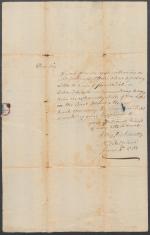
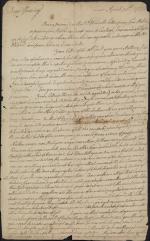
Continental Congressman John Dickinson writes to his colleague, James Wilson, and asks him to support General Charles Lee's request for financial assistance related to " his Estate being confiscated in England." "I do most earnestly beg of You to
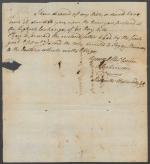
Continental Congressman John Dickinson asks Caesar Rodney, President of Delaware, to convey a resolution to the Council of Assembly. The resolution dictates a state payment of forty-five hundred thousand dollars to the Continental Treasury.
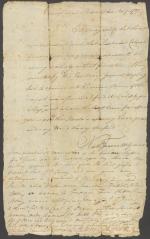
John Dickinson writes two letters to attorney George Read concerning legal matters. The first expresses his unwillingness to engage Mr. Gooding in a chancery suit. The second concerns the examination of a witness, Mrs.
John Dickinson writes to Samuel Cadwalader Morris and a Mr. Cadwalader to request the payment of eight pounds and six pence to Mr. Henry Maag. This letter is a copy of the original. Transcript included.
John Dickinson writes Samuel Cadwalader Morris to confirm a financial matter and asks Morris to forward the enclosed letters. Transcript included.
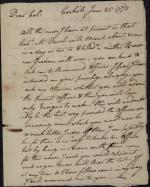
John Dickinson writes Continental Army General Charles Lee to explain his opinion on the Declaration of Independence.
John Dickinson writes two letters to Major General Nathanael Greene.
John Dickinson writes to Mr. Baynton and Wharton, a Philadelphia mercantile firm, on the issue of settling a disagreement over an unnamed policy. Dickinson mentions Mr. Philips as the identity of one of the parties involved.
Elizabeth Graeme Fergusson's commonplace book contains handwritten poems and transcriptions of correspondence dating from 1770 to 1787.
Major General Nathanael Greene and Colonel Richard Humpton, both officers in the Continental Army, write Lieutenant Colonel Francis Gurney to certify that he is innocent of providing any support or information to the United Kingdom.
John Adams, a delegate to the Second Continental Congress, writes to Abigail Adams on the state of creating a new country.
Second Continental Congress Representative John Adams writes to James Warren, a judge in Watertown, Massachusetts, and discusses the arrival of gunpowder, the formation of a continental treasury, and asks if "your new Legislative and Executive fee
Edward Biddle writes to Jasper Yeates and Matthias Slough regarding "a favourable crisis approaching" in the form of the Constitutionalist party, then dominating the Pennsylvania government.
Joseph Priestley writes to the Duke of Northumberland, Hugh Percy, and asks for the Duke's patronage in order to write a history of experimental philosophy, continuing his previous work. Transcript included.
William Irvine writes Lieutenant Colonel David Grier and discusses officers, new recruits, and supplies. Transcript included.
John Armstrong writes to his son James about his attempt to seek his fortune in the West Indies. Armstrong also discusses news of General William Irvine, Dr. McCoskry, Dr. Benjamin Rush, and Mr. Waddell. Transcript included.
John Montgomery issues this receipt to John Harvie and Jasper Yeates for the sum borrowed from Frederick Ferree by the Commission of Indian Affairs.
Continental Congress delegate John Montgomery signs this agreement to take up 150 acres of land on Jack's Creek in Cumberland County.
Continental Congress delegate John Montgomery issues this receipt to John Harvie and Jasper Yeates for ninety pounds paid to messenger William Wilson.
The Commissioners of Indian Affairs of the Middle Department at Fort Pitt write to merchant Benjamin Morgan and order flints for militia companies under the command of Captain Pigman, Captain Sullivan, Captain Baird, and Captain Shields.
John Montgomery issues a receipt for funds paid by the Continental Congress to Jasper Yeates and himself for militia pay and allowance.
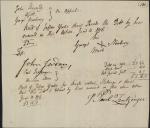
John Montgomery, Hugh Patrick, George Newberry and Paul Zantzinger issue receipts for various items between June 11 and June 20, 1776 to Jasper Yeates.
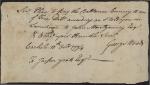
George Wood sends an order to Jasper Yeates to pay a debt to John Montgomery. Includes Montgomery's receipt dated October 19, 1774.