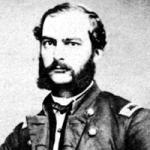
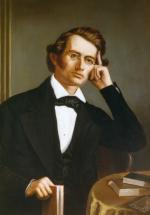
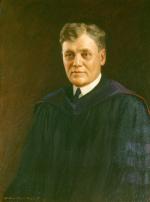
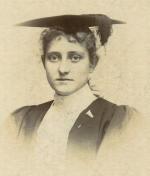
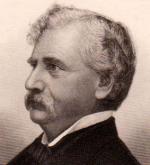
Alfred Victor du Pont (1798-1856)

Alfred du Pont was born on April 11, 1798 in France to Eleuthere and Sophie Dalmas du Pont. His father's career during the French Revolution as both moderate politician and printer fell into disfavor as the Revolution became increasingly radical. The du Pont family fled to the United States, arriving on January 1, 1800. After a period in Bergen Point, New Jersey, the family settled outside Wilmington, Delaware, where in 1802 the E. I. du Pont de Nemours and Company was established to produce the high quality gunpowder in great demand at the time.

Du Pont’s early studies were directed by his parents and perhaps a private tutor. In 1811 he was sent to Mont Airy College, north of Philadelphia in Germantown. His father intended him to have a useful education in chemistry, so Alfred was sent to Dickinson College to study under Professor Thomas Cooper. Du Pont arrived in May 1816 and entered the College as a member of the class of 1818. He joined the Belles Lettres Literary Society, and a few months later was elected its president. In September 1816, Professor Cooper and College President Jeremiah Atwater’s quarrels divided the faculty; both men left the College, and were followed by most of the remaining faculty. Dickinson College was closed, and the students dismissed.
College Relationship
Alumnus/Alumna Class Year

George Duffield III (1794-1868)

George Duffield III was born on July 4, 1794 in Lancaster County, Pennsylvania. His father, George Duffield, Jr., served as the Comptroller General of Pennsylvania. The younger Duffield studied at the University of Pennsylvania, obtaining a degree in 1811. He then pursued a four-year course of study at the Theological Seminary of the Reformed Church in New York. His teacher and founder of the Seminary, John Mitchell Mason, would later become president of Dickinson in 1821. After completing his studies at the Seminary, Duffield was officially licensed to preach and entered the Presbyterian ministry on April 20, 1815. In September 1816, Duffield visited the town of Carlisle and was invited to preach at the First Presbyterian Church on the town square. His preaching style charmed the congregation, which uncharacteristically united in calling Duffield to lead their church. By accepting their call, Duffield achieved what his grandfather, the noted revivalist of the First Great Awakening, George Duffield, had failed to do during his time in Carlisle nearly fifty years before.

College Relationship
Trustee - Years of Service
1820-1833

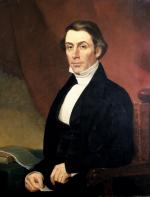
Robert Duncan (c.1768-1807)

Robert Duncan was born c1768, the son of Carlisle attorney Stephen Duncan. The elder Duncan was a founding trustee of both the Carlisle Grammar School and Dickinson College; Robert presumably attended the grammar school before enrolling in Dickinson College. As a member of the first graduating class of the College, Duncan delivered the first valedictory address at Commencement on September 26, 1787. This speech was transcribed by fellow Dickinsonian John Young of the Class of 1788.

After graduation, Duncan studied law, most likely with his father, and had been admitted to the bar in Cumberland County by 1790. His brother, Thomas, was a very successful attorney as well, and in June 1804, the two of them purchased one-half of the Kittanning Manor in Armstrong County. The Duncans paid $8,000 for their 2300 acres. Soon after, Robert moved his family to the estate, which had been renamed Appleby. When Robert Duncan died on April 5, 1807 at the age of 39, he left his half of the lands to his wife Ellen (Ellenor) and their daughter Mary.

College Relationship
Alumnus/Alumna Class Year

Stephen Duncan (1729-1794)

Stephen Duncan was born in 1729 and came to prominence in Cumberland County with a successful law practice and a thriving business as a merchant. By 1780, he was noted in county tax records as the heaviest taxpayer in the county.

He also served as Treasurer of Cumberland County until he resigned to take a seat in the Pennsylvania Assembly, from 1780 to 1783. At the founding of Dickinson College, of which he was a charter trustee, he took upon himself the unofficial task of college treasurer. Duncan served as a trustee of the College until his death.

He married Ann Fox (1732-1796) and the couple had nine children, including Robert Duncan. Several of their offspring married into prominent Carlisle families. Stephen Duncan died in Carlisle on March 30, 1794. His wife followed him that December.

College Relationship
Trustee - Years of Service
1783-1794

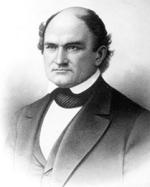
John Price Durbin (1800-1876)

John Price Durbin was born on October 10, 1800 in Bourbon County, Kentucky, the eldest of five sons. Shortly after his father died, he was apprenticed to a cabinet maker at the age of 13; he worked for several years until his religious conversion at age 18. Through tutors and self-education, he began to study English grammar, and later Latin and Greek. Durbin soon became a licensed preacher and in 1819 traveled to Ohio to enter the ministry. In 1821 he began to minister in Hamilton, Ohio, and at the same time took up studies at nearby Miami University. The following year he moved again and was forced to continue his studies independently. Durbin resumed formal studies at Cincinnati College and received both a bachelor's and a master's of arts degree in 1825. Immediately following his graduation, he became a professor of languages at Augusta College in Kentucky. He married Frances B. Cook of Philadelphia on September 6, 1827, and in 1831 was elected Chaplain of the United States Senate. This appointment was followed in 1832 with a position as editor of the Christian Advocate.

College Relationship
President - Years of Service
1834-1845

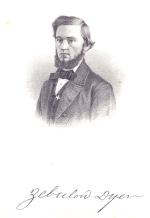
Zebulon Dyer (1837-1861)

Birth: June 29, 1837; Upper Tract, Pendleton County, West Virginia

Death: December 3, 1861 (age 24); Allegheny Mountain

 Military Service: CSA, 1861

 Unit: 25th Infantry Regiment Virginia

Alma Mater: Dickinson College, B.A. (Class of 1859)

Zebulon Dyer while attending Dickinson was a member of the Union Philosophical Society and Phi Kappa Sigma; he received his bachelor of arts degree in 1859. Until the outbreak of the Civil War, he spent the next two years teaching and studying law.

Dyer enlisted as a Sergeant in Company H, 25th Infantry Regiment Virginia of the Confederate States Army.  He died from wounds at the Allegheny Mountain on December 13, 1861. He was twenty-four years old.

College Relationship
Alumnus/Alumna Class Year

Joseph Dysart (1820-1893)

Joseph Dysart was born on July 8, 1820 on the family farm, Eden Hill, in Huntingdon County, Pennsylvania, one of three sons of James and Jane Dysart. His family hired a tutor who introduced him to the classics and then he attended the early public schools of the county. When nineteen, he traveled to Iowa for the land sales that were expected in October 1839. When these sales were postponed he and a friend returned home on foot, covering an average of forty miles a day. Soon after, he entered Dickinson's Preparatory School and then the College in the class of 1845. He was an exemplary student, was elected as a member of the Union Philosophical Society, and on graduation with his class gave the valedictory speech. Following his degree, he became principal of the Hillsboro Male Academy on Maryland’s Eastern Shore. Falling ill, he left Hillsboro in 1847 and took up teaching in Mississippi, first as a private tutor and than as principal of the Aberdeen Male Academy in Aberdeen, Mississippi between 1851 and 1853. In his spare time, he studied law and passed the Mississippi bar. He then traveled to Lee County in Illinois where he owned land and took up farming. Selling up to the railroad at a healthy profit, he moved on once again in April 1856 to the town of Vinton in Benton County, Iowa.

College Relationship
Alumnus/Alumna Class Year

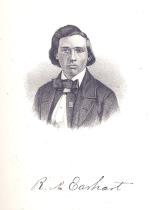
Robert Nixon Earhart (1833-1907)

Robert N. Earhart was born in Blairsville, Pennsylvania on April 9, 1833 to merchant David Earhart and his wife, Catharine Altman Earhart. His father took his large family, of which Robert was the youngest, to Pleasant Valley, Iowa during the 1840s. The younger Earhart received his preparatory education at Alexander College, a Presbyterian institution in Dubuque, Iowa that closed in 1857. He then returned to his native state for his undergraduate degree, enrolling at Dickinson College in Carlisle in the autumn of 1854. Earhart was elected to the Belles Lettres Society and graduated with his class in 1858.

Earhart then attended the B.D. Garrett Biblical Institute in Evanston, Illinois and qualified in 1860 as a clergyman of the Methodist Episcopal Church. He returned to his home area in Iowa and joined the Upper Iowa Conference of that church, where he served congregations for the remainder of his active life. His pastorates included churches at Toledo in Tuma County, at Osage in Mitchell County, and at the First Methodist of Manchester in Delaware County. After forty-one years of service to northern Iowa, he retired from the pulpit in 1901.

College Relationship
Alumnus/Alumna Class Year

Milton Walker Eddy (1884-1964)

Milton Walker Eddy was born in 1884 in India, at Calcutta, to American parents. He graduated from Northwestern University in 1910 and obtained his Ph.D., from the University of Pennsylvania in 1918. He became an instructor in zoology at the Pennsylvania State College in 1910 and was promoted to professor in 1913. He left in 1918 to become an assistant chief chemist for the United States Ammonium Nitrate Plant in Perryville, Maryland. Also, as part of the war effort, he served as a bacteriologist at the Ordinance Department of the United States Army. Continuing a career with the government, Eddy was a scientific assistant at the United States Public Health Service.

Eddy joined the Dickinson College faculty in 1921 as full professor of biology and chair of the department, replacing the late Professor Stephens. A leader in and out of the classroom for thirty-four years, Eddy was a supporter of James Henry Morgan against President Waugh. While teaching at Dickinson, he attended the University of Chicago and the University of Pennsylvania for further postgraduate work. Much of Eddy's time went into researching the microphotography of hair. His research helped the police in criminal investigations, most famously the "Babes in the Wood" case of 1934 that established him as the recognized authority on the identification of persons by hair specimens. After a successful career in teaching and research, Eddy retired in 1955.

College Relationship
Faculty - Years of Service
1921-1955

William Wilcox Edel (1894-1996)

William Wilcox Edel was born on March 16, 1894 in Baltimore, Maryland. His mother was Annie Wilcox, and his father was John Wesley Edel, a prosperous dairy retailer. Edel attended high school at Baltimore City College and then entered Dickinson College, where he graduated in three years as a Phi Beta Kappa member of the class of 1915. While an undergraduate, Edel became a member of the Belles Lettres Literary Society and the Alpha Chi Rho fraternity. He also contributed illustrations to the 1915 Microcosm.

After graduation, Edel and six other members of the class of 1915 enrolled in the School of Theology at Boston University. Edel graduated from that institution in 1918. The outbreak of war caused him to enlist as a chaplain in the U.S. Navy on July 11, 1917. During his thirty-year career, Edel saw service at sea in the Atlantic, served as superintendent of education in American Samoa, and was area chaplain for the South Pacific during the Second World War. In 1935, he received an honorary Doctor of Divinity degree from his alma mater. Ten years later, Edel was nearing retirement as a captain, the highest rank then open to a naval chaplain. The Dickinson board of trustees, having been unable to secure other earlier choices, turned to Edel on June 7, 1946 and elected him as the twenty-second president of the College.

Alumnus/Alumna Class Year
President - Years of Service
1946-1959
Honorary Degree - Year
1935
Trustee - Years of Service
1946-1958

Ninian Edwards (1775-1833)

Ninian Edwards was born in Montgomery County, Maryland on March 17, 1775 to Benjamin and Margaret Edwards, a well-connected political family. He attended Dickinson with the class of 1792 but left before the completion of his degree and took up the study of law.

In 1795 he was in Kentucky, managing family property there and entering state politics with immediate success. He was elected to the legislature before he was eligible to vote. In 1803, he was appointed to the bench and four years later became the chief justice of the Kentucky Court of Appeals.

In 1809, James Madison appointed Edwards as the first governor of the newly-formed Illinois Territory. He served in the formative years of government for the territory, forming the political structure which would accompany statehood in 1818. He became the new state's senator in 1819. He resigned in 1824 upon his appointment by President Monroe as minister to Mexico; however, he was never able to assume the post due to a scandal stemming from a public argument with the current secretary of the Treasury. Edwards returned to Illinois where he was elected governor in 1826. His popularity waned and he did not seek re-election in 1830. His career ended with defeat in a run for Congress in 1832.

College Relationship
Alumnus/Alumna Class Year

John William Ell (1918-1944)

John Ell spent four years at the College after graduating from high school in Nanticoke, Pennsylvania. He worked on the Dickinsonian, and was a photography editor of the Microcosm. He was a member of Phi Kappa Sigma, pledging with John Cockey, and served as president of the Catholic Club and of the Belles Lettres Society. He graduated Phi Beta Kappa and was the recipient of the Patton Prize for 1940.

Ell entered the Army in August 1941 and soon after volunteered for the newly-formed parachute infantry units. He was commissioned at Fort Benning, Georgia in January 1943 and a year later was posted in England. On D-Day, 1944, his regiment, the 501st of the 101st Airborne Division, landed in Normandy before dawn. Ell was later wounded but returned to his unit in time for the airborne assault into Holland to seize the Rhine bridges. On September 18, 1944, his platoon was ordered to defend newly-seized positions against an enemy counter-attack. While leading this defense against superior forces, John Ell was killed by mortar fire. For this action, he was awarded the Bronze Star posthumously; he was twenty-six. Prior to his death, Ell sent an eloquent letter to his parents from Normandy, trying to prepare them for the possibility that he may not return.

College Relationship
Alumnus/Alumna Class Year

Jesse Duncan Elliot (1782-1845)

Jesse Elliot was born in Maryland on July 14, 1782. He was nine years old when his father was killed in an Indian attack; soon after young Elliot moved to Carlisle, Pennsylvania, where he received his schooling. After studying law for a time, he was appointed midshipman in the United States Navy in April 1804 and was assigned to the U.S.S. Essex. He became an acting lieutenant on the U.S.S. Enterprise and in April 1810 was promoted to permanent rank of lieutenant. At the outbreak of the War of 1812, he was posted to Lake Erie where he captured two armed British brigs, burning one, ostensibly in retaliation for the earlier British capture of Detroit. Becoming second in command under Oliver Perry, and captain of the U.S.S. Niagara, he took what was to become a controversial part in the battle of Lake Erie. Although Perry spoke very highly of Elliot in his official report and Congress decorated him, rumors of Elliot's animosity against his commander and observations from both British and United States experts that Elliot had not backed Perry's boldness as he should created a simmering controversy. Various accusations and cross accusations in the press, including a defense by James Fenimore Cooper, resulted in Elliot challenging Perry to a duel and then facing a court-martial, a situation that the Cabinet desperately wished to avoid.

College Relationship
Trustee - Years of Service
1831-1833

David Elliott (1787-1874)

David Elliott was born in Sherman Valley, now in Perry County, to Thomas and Jane Holliday Elliott on February 6, 1787. Of Scots Irish heritage, he was raised on his parents' farm in a pious Presbyterian family. He was educated at home and in several neighborhood church schools, including that of the Reverend James Linn at Center Church. He entered Dickinson College in the junior class, and was graduated with the class of 1808, and with high honors and voted valedictorian by his peers.

He then studied theology for three years and was licensed as a pastor in Carlisle, Pennsylvania in 1881 and took his first church at Upper West Conocheague near Mercersburg, Pennsylvania in 1812 and there he remained until 1829. In the meantime, he founded the Franklin County Bible Society and was present at the founding of the American Bible Society in New York in 1816. He also served on the board of trustees of his alma mater between 1827 and 1829.

College Relationship
Alumnus/Alumna Class Year
Trustee - Years of Service
1827-1829

Washington Lafayette Elliott (1825-1888)

Washington Lafayette Elliott was born in Carlisle, Pennsylvania on March 31, 1825. He was the son of Commodore Jesse Duncan Elliott, USN. Before he reached his teens, young Washington accompanied his father on cruises with the West Indies Squadron and on board the USS Constitution, which his father commanded in the Mediterranean for a time. For several years, Commodore Elliott was also a trustee of Dickinson College. The younger Elliott was enrolled in the Grammar School there in 1838, then completed two years as an undergraduate with the class of 1843.

In June 1841, Washington Elliott was appointed as a cadet at West Point. He studied medicine for a period, then took a commission in May 1846 as a second lieutenant of mounted infantry at the outbreak of the Mexican War. Elliott served at Vera Cruz and was appointed full lieutenant in July 1847. He then served at Fort Laramie on the Oregon Trail in Wyoming (1849-1851) and in Texas (1852-1856), receiving a promotion to captain in 1854. Elliott also held assignments in New Mexico during the five years preceding the Civil War, gaining ample experience as a frontier soldier in skirmishes against the Comanche and Navajo tribes.

College Relationship
Alumnus/Alumna Class Year

Powhatan Ellis (1790-1863)

Powhatan Ellis was born in Amherst County, Virginia and was named for the father of Pocahontas, from whom the family claimed descent. He was a student at Washington Academy and then at Dickinson as a member of the class of 1810. The College has no record of his graduation, however.

He studied law at the College of William and Mary, 1813-1814, and took up a practice in Lynchburg. He served as a lieutenant of volunteers during the War of 1812 but saw no action. By 1815 he had formed a friendship with Andrew Jackson who introduced him to friends in the Mississippi Territory. Relocating to the territory in 1816 as it entered statehood, these friendships made Ellis well- connected, and in 1818 he was appointed to the state Supreme Court. He served in the U.S. Senate for a few months from September 1825 to January 1826 as a replacement but failed to secure the permanent seat. However, he did serve a full term as U. S. Senator between 1827 and 1832. He was then appointed as federal judge of the district of Mississippi by President Jackson. Four years later, Jackson sent Ellis to Mexico City in the highly sensitive position of charge d'affaires; he served as minister plenipotentiary to Mexico under President Van Buren until 1842 when he returned to Mississippi.

Powhatan Ellis married Eliza Rebecca Winn in February 1831, and the couple had a son and a daughter. Later in life, Ellis returned to Virginia and lived in Richmond, where he died on March 13, 1863.

College Relationship
Alumnus/Alumna Class Year

Robert Emory (1814-1848)

Robert Emory was born in 1814 to Bishop John Emory and his wife. The elder Emory had served as president of the Dickinson College Board of Trustees from 1833 to 1835, and is the namesake of both Emory University in Georgia and Emory and Henry College in Virginia. The younger Emory attended Columbia University and graduated at the top of his class in 1831. He then studied law under Reverend Johnson in Baltimore. In 1836, Emory joined the faculty of Dickinson as professor of Latin and Greek at the Grammar School. He remained at this post until 1840 when he resigned in order to work in the ministry. During President Durbin's trip abroad in 1842 and 1843, Emory returned to Carlisle to serve as Dickinson's acting president; with Durbin’s return, Emory resumed his work in the ministry. Within two years, Durbin resigned, and Emory again was chosen to lead the College.

College Relationship
President - Years of Service
Acting, 1842-1843; 1845-1847
Faculty - Years of Service
1834-1840

Frank Evans, Jr. (1925-1944)

Born July 6, 1925, Frank Evans was from Brooklyn, New York, where he was an outstanding student at P.S. 93 Boys High School, and the Adelphi Academy. In September 1942 when he had just turned seventeen, Evans enrolled at Dickinson with the class of 1946. He was pursuing a chemistry major when he enlisted in the army in August 1943.

Evans trained at Fort Benning, Georgia and left for Europe to join Company E., 405th Infantry, as its youngest member in August 1944. A devout member of the Episcopal Church, he wrote to his mother in November that "So far I have felt little fear up here. God is closer to the front lines than any place else." Five days later, Frank Evans was killed in action in Germany on November 22, 1944, aged nineteen years and four months.

College Relationship
Alumnus/Alumna Class Year

Frysinger Evans (1871-1955)

Frysinger Evans was born on February 1, 1871 at Sunbury, Pennsylvania to William and Alice Frysinger Evans. In 1888 he entered the Dickinson Grammar School, and eventually matriculated to the College. At Dickinson, Evans was a member of the Belles Lettres Literary Society, the Phi Kappa Psi Fraternity, and Phi Beta Kappa. He graduated with the class of 1892.

From 1892 to 1895, Evans was an assistant professor at the Millersville Normal School, earning a master’s degree from Dickinson in 1895. He briefly studied law at the University of Pennsylvania. During the Spanish-American War, he served on the executive committee in charge of hospital work for the American Red Cross.

In 1899, Evans returned to his alma mater as treasurer. In addition to his duties on campus, Evans gained admittance to the Cumberland County Bar in 1901. Also in 1901, he married Edith Perrin Brewster. He left his position at Dickinson in 1907. Frysinger Evans died on April 15, 1955.

College Relationship
Alumnus/Alumna Class Year

Mervin Grant Filler (1873-1931)

Mervin Grant Filler was born in Boiling Springs, Pennsylvania on October 9, 1873 to Peter and Elizabeth Filler. He attended grade school in Boiling Springs before entering the Dickinson Preparatory School. In 1889, he enrolled in Dickinson College and graduated as valedictorian in 1893. During that time he became a member of Phi Kappa Sigma and was inducted into Phi Beta Kappa. In addition to his A.B. degree, Filler received his M.A. in 1895.

Following graduation, Filler took a position as an instructor in Greek and Latin at the Preparatory School. He also continued his own studies, taking classes at the University of Chicago in the summers of 1900 and 1901 and later at the University of Pennsylvania in 1906. In 1899, he became the professor of Latin at the College and would retain this position for the following 29 years except for his short graduate study leaves. In 1904 he was elected as dean of the freshman class and in 1914 President Morgan promoted him to dean of the College. On June 30, 1928, Filler was elected as the 18th president of Dickinson College following Morgan’s retirement.

College Relationship
Alumnus/Alumna Class Year
President - Years of Service
1928-1931
Faculty - Years of Service
1899-1928

Cornelius Winfield Fink (1893-1955)

Born on November 10, 1893 in Zanesville, Ohio, Cornelius Fink graduated from Muskingum College in 1914 and worked as a journalist from 1914 to 1919. He became an instructor in social science and Latin at the Dresden High School in Dresden, Ohio in 1920; two years later he took the position of instructor in economics at Ohio State University. He also matriculated there as a student to earn his master's degree in 1924. After obtaining this degree, he became an assistant professor of economics at Ohio University. He pursued further graduate work at the universities of Michigan (1928), Wisconsin (1929), and Northwestern (1930).

Fink arrived at Dickinson College in 1930 as an associate professor of economics and political science. Fink became the chairman of the economic department in 1946. At the College, Fink was active with the Debate Club. He was elected president of the Debating Association of Pennsylvania for 1945 through 1946.

College Relationship
Faculty - Years of Service
1930-1955

Clement Alexander Finley (1797-1879)

Clement Alexander Finley was born on May 11, 1797 in Newville, Pennsylvania. His family moved very soon after to Chillicothe, Ohio when his father, a cavalry hero of the Revolutionary War, received a sizable plot of land for his war service. Young Clement was educated in local schools and then returned to Cumberland County to enroll at Dickinson College with the Class of 1815. A tall and reputedly handsome young man, he graduated with his class and then studied medicine at the University of Pennsylvania, receiving his M.D. in 1818. That August, he entered the United States Army's First Infantry as a surgeon's mate.

Service in this regiment took him to Louisiana and Arkansas, first at Fort Smith and then at Fort Gibson, and later to Florida, Missouri, and Fort Leavenworth, Kansas. After more garrison duty at Fort Dearborn in Illinois and Fort Howard in Wisconsin, he was assigned as chief medical officer for the operations in the Black Hawk War of 1833 and saw campaigning again during the years of the Seminole War. Peace in 1838 brought him back to garrisons in Virginia and New York, as well as a four year assignment "at home" at the Carlisle Barracks. During the Mexican War, he served as medical director for General Zachary Taylor in Texas and then for General Winfield Scott in the Mexico City campaign. His work on both these assignments was curtailed by illness.

College Relationship
Alumnus/Alumna Class Year

Amy Fisher (1872-1938)

Amy Fisher was born in Harrisburg, Pennsylvania on December 29, 1872, the child of Daniel and Eva Brightbill Fisher. She attended Carlisle High School and Dickinson Preparatory School before entering Dickinson College in 1891. Graduating Phi Beta Kappa in 1895 with her class, she secured a master of arts degree in 1897. During these two years, she also taught at the Preparatory School, having the distinction of being the first woman to do so.

In 1897 she became assistant principal of the high school in Doylestown, Pennsylvania, retaining her position there until 1904. She then returned to Carlisle, living at a house on the southwest corner of High and College Streets. In 1932, she returned to employment at Dickinson College, becoming curator of the growing collection of Dickinsoniana. She held this position until her death.

Amy Fisher died on April 6, 1938, having contracted a "fatal illness" during a two month South American cruise. She was sixty-five years old.

College Relationship
Alumnus/Alumna Class Year
Faculty - Years of Service
1932-1938

George Purnell Fisher (1817-1899)

George Purnell Fisher was born in Milford, Delaware on October 13, 1817 to Thomas Fisher (twice high sheriff of Kent County) and his third wife Nancy Owens Fisher. He went to schools in the county, attended St. Mary's College in Baltimore, Maryland briefly in 1835 and then enrolled at Dickinson College with the class of 1838. A Methodist at the Methodist sponsored college, he was a member of the Belles Lettres Society before graduating with his class. Studying afterwards in the law, he joined the Dover law firm of John M. Clayton, a family friend, and combined his studies with tutoring the young Clayton children. He was called to the Delaware bar in April 1841 and began practice in Dover.

College Relationship
Alumnus/Alumna Class Year

William Righter Fisher (1849-1932)

William Righter Fisher was born on June 27, 1849 in Bryn Mawr, Lower Merion County, Pennsylvania. He was educated at Hasting's Academy in Philadelphia and in 1867, he entered Dickinson College and he received his bachelor of arts degree three years later. Upon graduation, he taught natural science for one year at the Dickinson Seminary in Williamsport, Pennsylvania. From 1871 to 1874 he studied in Germany at the University of Heidelburg and the University of Munich.

In 1874, Fisher returned to his alma mater and served as the professor of modern languages until 1876, when he was admitted to the Philadelphia Bar Association. Fisher then left Dickinson to practice law in Philadelphia. He was a member of the Franklin Institute, the Historical Society of Pennsylvania, and the National Geographical Society. He also speculated in real estate in the Northwest Territory.

On January 4, 1876, Fisher married Mary Wager and they had a son, Wager, in 1877. Mary was an amateur author and some of her stories were published in The Rural New Yorker. William Righter Fisher died in Bryn Mawr on February 17, 1932, the last surviving graduate of the class of 1870.

College Relationship
Alumnus/Alumna Class Year
Faculty - Years of Service
1874-1876