
About Full-Text Documents
Collections of college and personal papers, as well as a select number of individual documents, have been briefly described in entries available for browsing and searching on this site. All collection and document descriptions contain a representative image and a summary of the contents.
Search Document Descriptions
Browse Document Descriptions

September 15, 1862
William Wagenseller and P. R. Wagenseller write Eli Slifer, Secretary of the Commonwealth during the Civil War, to request that Dr. B. F. Wagenseller be promoted from Assistant Surgeon to the rank of Surgeon just like Dr. H. P. Hattenstein. Transcript included.
Format: Letters/Correspondence
Location: MC 2003.4, B10, F22
Subject: Military Affairs and Conflict, Politics and Government
Time Period: 1860-1879
View Item: Letter from William Wagenseller and P. R. Wagenseller to Eli Slifer
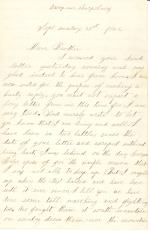
September - October 1862
Thomas William Dick writes two letters to his family describing his experience as a soldier of the Union Army during the Civil War. Dick talks about the battles he has witnessed, religious life in the military camp, and shares his thoughts on the future of the conflict. "I don't know what this war is going to come to I am afraid designing politicians will yet ruin our beloved country," as Dick explains. Transcripts included.
Format: Letters/Correspondence
Location: Mc 2001.10, B1, F5
Subject: Military Affairs and Conflict, Personal and Family Life, Politics and Government, Religion and Spirituality
Time Period: 1860-1879
View Item: Letters from Thomas Dick (Sept. - Oct. 1862)

1862-1866
Two letters from former President James Buchanan to Jessie Magaw regarding his health, Jessie's education, and news regarding their extended family. "Your Cousin Harriet [Lane] was married to Henry E. Johnston" and they are "happily married," as Buchanan notes. Transcripts included.
Format: Letters/Correspondence
Location: MC 1998.10
Subject: Education, Personal and Family Life
Time Period: 1860-1879
View Item: Letters from James Buchanan to Jessie Magaw

December 17, 1862
Former President James Buchanan writes Joseph B. Baker to criticize Kentucky Senator Garrett Davis' resolution. "It is infamous as well as false," as Buchanan explains. Transcript included.
Format: Letters/Correspondence
Location: MC 1998.10, B4, F6
Subject: Politics and Government
Time Period: 1860-1879
View Item: Letter from James Buchanan to Joseph Baker

January - February 1863
John Taylor Cuddy writes four letters to his friends and family describing his experience as a soldier for the Union Army during the Civil War. Cuddy mentions the places that his unit travels to as well as the battles that he is involved in. Cuddy also expresses exhaustion over the war, and a desire to return home. In addition, Cuddy comments on President Abraham Lincoln's Emancipation Proclamation. "Old abe done a bad thing wen he freed all the slaves," as Cuddy observes. Transcripts included.
Format: Letters/Correspondence
Location: MC 2001.9, B1, F7
Subject: Military Affairs and Conflict, Personal and Family Life, Politics and Government
Time Period: 1860-1879
View Item: Letters from John Cuddy (Jan. - Feb. 1863)

January - February 1863
Thomas William Dick writes a five letters to his family describing his experience as a soldier of the Union Army during the Civil War. He describes in detail the battles he has fought in, and discusses the relative strengths of army leaders. "But we did not accomplish anything and never have since little Mac [General George B. McClellan] was taken away from us and in my opinion never will... I think him the only man capable of competition with the rebel Generals..." Transcripts included.
Format: Letters/Correspondence
Location: MC 2001.10, B1, F6
Subject: Military Affairs and Conflict, Personal and Family Life, Politics and Government
Time Period: 1860-1879
View Item: Letters from Thomas Dick (Jan. - Feb. 1863)

January 9, 1863
Supreme Court Chief Justice Roger B. Taney writes to James M. Campbell regarding the whiskey that Campbell sent. Chief Justice Taney also reports on his health ("unable to go to court yesterday or today") as well as that of Elizabeth, Ellen, Sophia, and Roger.
Format: Letters/Correspondence
Location: I-SpahrB-1963-5
Subject: Health and Medicine, Personal and Family Life
Time Period: 1860-1879
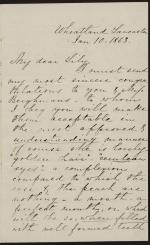
January 10, 1863
Harriet Lane writes to her friend Lily Macalester on the birth of Lily's child. Lane also notes that her uncle, former President James Buchanan, "would no doubt have some messages of love and congratulation if he knew I was writing."
Format: Letters/Correspondence
Location: I-Friends-2007-1
Subject: Personal and Family Life
Time Period: 1860-1879
View Item: Letter from Harriet Lane to Lily Macalester

January - August 1863
Israel Gutelius writes seventeen letters to Eli Slifer, the Secretary of the Commonwealth during the Civil War, in which he discusses compensation for his printing services, logistics of the military draft, and his opinion on candidates for senatorial delegates. Gutelius also comments on several Copperhead candidates. Transcripts included.
Format: Letters/Correspondence
Location: MC 2003.4, B5, F11
Subject: Military Affairs and Conflict, Personal and Family Life, Politics and Government
Time Period: 1860-1879
View Item: Letters from Israel Gutelius to Eli Slifer (Jan. - Aug. 1863)
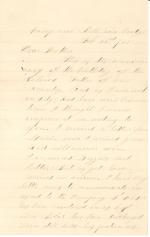
February - March 1863
Thomas William Dick writes four letters to his brother and sister describing his experience as a soldier in the Union Army during the Civil War. Dick mentions having some leisure time due to being off duty for George Washington's birthday, the status of fellow soldiers, and the conditions in his camp. In addition, Dick comments on the likelihood of his family seeing wounded soldiers at home. "I suppose you see [them] almost daily: some with their arms hangings powerless by their sides; and others with their limbs bent in an uncomely shape, and some with an empty coat sleeve," as Dick notes. Transcripts included.
Format: Letters/Correspondence
Location: MC 2001.10, B1, F7
Subject: Health and Medicine, Military Affairs and Conflict, Personal and Family Life
Time Period: 1860-1879
View Item: Letters from Thomas Dick (Feb. - Mar. 1863)

March 1863
John Taylor Cuddy writes six letters to his friends and family describing life as a soldier for the Union Army during the Civil War. Cuddy's letters express disillusionment with the war and a desire to be home with his family in Carlisle. "We are not fighting for what we [were when] we started," as Cuddy notes. Transcripts included.
Format: Letters/Correspondence
Location: MC 2001.9, B1, F7
Subject: Military Affairs and Conflict, Personal and Family Life, Politics and Government
Time Period: 1860-1879
View Item: Letters from John Cuddy (March 1863)
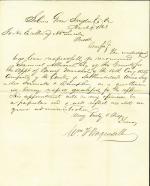
March 9, 1863
William Wagenseller writes President Abraham Lincoln to recommend Samuel Alleman Esq. for the position of Provost Marshal for the 14th Congressional district of Pennsylvania. Transcript included.
Format: Letters/Correspondence
Location: MC 2003.4, B10, F22
Subject: Legal Affairs, Politics and Government
Time Period: 1860-1879
View Item: Letter from William Wagenseller to Abraham Lincoln

March 9, 1863
Supreme Court Chief Justice Roger B. Taney writes to Associate Supreme Court Justice Samuel Nelson regarding the composition of a dissenting opinion in the Prize Cases of 1863. Taney suggests a paragraph to add that "more distinctly asserts the principle that Congress cannot delegate or surrender to the Executive the legislative power which the constitution requires it to exercise." Transcript included.
Format: Letters/Correspondence
Location: I-SpahrB-1958-16
Subject: Legal Affairs, Military Affairs and Conflict, Politics and Government
Time Period: 1860-1879
View Item: Letter from Roger B. Taney to Samuel Nelson

March 23, 1863
Supreme Court Chief Justice Roger Brooke Taney (Class of 1795) replies to Mr. D. Adams' request for Taney's autograph.
Format: Letters/Correspondence
Location: I-Purchase-1954-28
Subject: Politics and Government
Time Period: 1860-1879
View Item: Letter from Roger B. Taney to D. Adams

1863-1866
Alexander McClure writes fourteen letters to Eli Slifer, the Secretary of the Commonwealth under Governor Andrew Gregg Curtin, in which he discusses various Pennsylvania political issues, the potential Confederate invasion of Pennsylvania, possible military strategies during the Civil War, Curtin's political endeavors, and McClure's own political affairs. "The Gov. thinks that they will extend the war to compass my defeat next fall... We shall see about that," as McClure notes. Transcripts included.
Format: Letters/Correspondence
Location: MC 2003.4, B7, F13
Subject: Military Affairs and Conflict, Personal and Family Life, Politics and Government
Time Period: 1860-1879
View Item: Letters from Alexander McClure to Eli Slifer, 1863-66
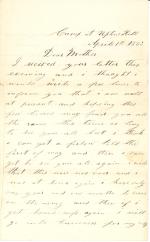
April 1863
John Taylor Cuddy writes three letters to his friends and family describing life as a soldier for the Union Army during the Civil War. Cuddy also comments on the places he has visited, the weather conditions, his unit's future orders, and reflects on his relationship with a girl named Anna. Transcripts included.
Format: Letters/Correspondence
Location: MC 2001.9, B1, F8
Subject: Military Affairs and Conflict, Personal and Family Life, Weather and Climate
Time Period: 1860-1879
View Item: Letters from John Cuddy (April 1863)

April 4, 1863
Former Secretary of the Navy Isaac Toucey writes Nahum Capen to defend a speech that he gave during a rally held in Hartford, Connecticut. "The only remedy for the evils which have fallen upon the country is in the legitimate action of our institution, which will soon transfer political power from the radical abolitionists to the conservative classes," as Toucey explains. Transcript included.
Format: Letters/Correspondence
Location: I-SpahrB-1966-16
Subject: Personal and Family Life, Politics and Government
Time Period: 1860-1879
View Item: Letter from Isaac Toucey to Nahum Capen
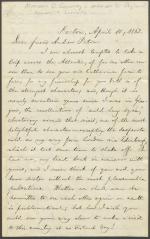
April 10, 1863
Moncure D. Conway carries a letter for abolitionist William L. Garrison, who writes from Boston to his friend, Andrew Paton in Glasgow, Scotland, and introduces Conway in terms of highest commendation. Garrison also explains that Conway is on "an anti-slavery mission to England." Garrison hopes that Paton and Conway will work well together and that Paton, a member of the Glasgow Emancipation Society, will help to boost Conway's presence in the United Kingdom. In addition, Garrison discuses President Abraham Lincoln's "Emancipation Proclamation" and the circumstances of slavery in the American South.
Format: Letters/Correspondence
Location: I-SpahrB-1964-4
Subject: International Affairs, Personal and Family Life, Politics and Government, Social Reform and Advocacy, Travel and Tourism
Time Period: 1860-1879
View Item: Letter from William Lloyd Garrison to Andrew Paton

1863-1865
George Miller writes nine letters to Eli Slifer, Secretary of the Commonwealth, in which he suggests candidates for Notary Public, requests information on Governor Curtin's doctor, discusses military appointments, inquires about free passes issued by railroad companies to members of Congress. Transcripts included.
Format: Letters/Correspondence
Location: MC 2003.4, B8, F4
Subject: Politics and Government
Time Period: 1860-1879
View Item: Letters from George Miller to Eli Slifer
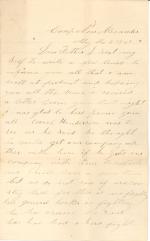
May - June 1863
John Taylor Cuddy writes eight letters to his friends and family describing his experience as a soldier of the Union Army during the Civil War. "Our army has taken Richmond but we do not [know whether] they can hold it [or] not... [General Joseph] Hooker has crossed the river again I think he will nip the rebels this time," as Cuddy explains. Cuddy also requests his father, John H. Cuddy, to write him a recommendation for a furlough. Transcripts included.
Format: Letters/Correspondence
Location: MC 2001.9, B1, F8
Subject: Military Affairs and Conflict, Personal and Family Life
Time Period: 1860-1879
View Item: Letters from John Cuddy (May – Jun. 1863)

May 16, 1863
Former President James Buchanan discusses his administration's policies, his health, and other personal matters in a letter to Reverend Henry Slicer. "I would not, if I could, change any portion of the policy I pursued in view of the then approaching troubles," as Buchanan explains. Buchanan, who is 73, also notes that he is in "excellent health." Transcript included.
Format: Letters/Correspondence
Location: MC 1998.10, B4, F7
Subject: Personal and Family Life, Politics and Government
Time Period: 1860-1879
View Item: Letter from James Buchanan to Henry Slicer
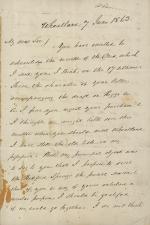
June 7, 1863
Former President James Buchanan writes to Jeremiah Sullivan Black regarding his health and to plan a get together. Buchanan plans "to visit the Bedford Springs the present season." Black served in President Buchanan's administration as the U.S. Attorney General and U.S. Secretary of State.
Format: Letters/Correspondence
Location: I-Friends-2004-2
Subject: Health and Medicine, Personal and Family Life, Travel and Tourism
Time Period: 1860-1879
View Item: Letter from James Buchanan to Jeremiah Black

June 10, 1863
A. C. Mullin responds to John H. Cuddy's request that his son, John Taylor Cuddy, receive a furlough so that he can return home. Mullin, who works as Pennsylvania Governor Andrew Curtin's secretary, notes that "it has been referred to the Commander of the 7th Regt. Pa. Reserves, with a recommendation that [Cuddy's] son be furloughed." Transcript included.
Format: Letters/Correspondence
Location: MC 2001.9, B1, F11
Subject: Military Affairs and Conflict, Personal and Family Life, Politics and Government
Time Period: 1860-1879
View Item: Letter from A. C. Mullin to John H. Cuddy

June 11, 1863
Former President James Buchanan responds to A. T. Goodman's question about his remarks and how he voted as a Senator on the Tariff Bill of 1842. "The opinions I then expressed on the subject of a Tariff, with very little variation, I have continued to hold until the present time," as Buchanan notes. Transcript included.
Format: Letters/Correspondence
Location: MC 1998.10, B4, F7
Subject: Economics and Finance, Politics and Government
Time Period: 1860-1879
View Item: Letter from James Buchanan to A. T. Goodman

June 13, 1863
Israel Gutelius writes James Sellers regarding his political activism in the Pennsylvania Senate and discusses other political issues. Gutelius explains that he plans to "see to it that [Sellers is] elected a delegate to the state convention." Transcript included.
Format: Letters/Correspondence
Location: MC 2003.4, B5, F11
Subject: Military Affairs and Conflict, Politics and Government
Time Period: 1860-1879
View Item: Letter from Israel Gutelius to James Sellers