
About Full-Text Documents
Collections of college and personal papers, as well as a select number of individual documents, have been briefly described in entries available for browsing and searching on this site. All collection and document descriptions contain a representative image and a summary of the contents.
Search Document Descriptions
Browse Document Descriptions
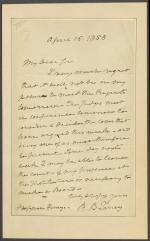
April 16, 1858
Supreme Court Chief Justice Roger Brooke Taney writes Professor Joseph Henry, the first Smithsonian Secretary, to explain that he cannot meet with the Regents of the Smithsonian Institution. As the Supreme Court Justices are meeting to decide cases, Taney explains that "every one of us must therefore be present." Taney notes that there might be an opportunity the following week "to leave the court" for a meeting at the Smithsonian. Transcript included.
Format: Letters/Correspondence
Location: I-SpahrB-1969-7
Subject: Legal Affairs, Politics and Government, Science and Technology
Time Period: 1840-1859
View Item: Letter from Roger B. Taney to Joseph Henry

July 8, 1858
J. Howard Beckwith prepared this oration, entitled “The Triumph of American Genius," for the Junior Prize (Grigg Prize) contest held on July 3, 1858. Twelve members of the Junior class gave speeches on a variety of subjects. Transcript included.
Format: Speeches and Sermons
Location: Orations-1858-B397t
Subject: Education, Politics and Government
Time Period: 1840-1859
View Item: "The Triumph of American Genius," by J. Howard Beckwith

July 8, 1858
Joseph John Stuart receives his Bachelor of Arts Diploma from Dickinson College on July 8, 1858.
Format: Certificates and Diplomas
Location: Diploma Collection
Subject: Education
Time Period: 1840-1859
View Item: Bachelor of Arts Diploma - Joseph Stuart
July 8, 1858
Charles Francis Himes (Class of 1855) receives his Master of Arts Diploma from Dickinson College on July 8, 1858.
Format: Certificates and Diplomas
Location: OC 2000.1, F4
Subject: Education
Time Period: 1840-1859
View Item: Master of Arts Diploma - Charles Himes

July 8, 1858
John Fletcher Hurst (Class of 1854) receives his Master of Arts Diploma from Dickinson College on July 8, 1858.
Format: Certificates and Diplomas
Location: Diploma Collection
Subject: Education
Time Period: 1840-1859
View Item: Master of Arts Diploma - John Hurst
July 8, 1858
Thomas Miller Griffith receives his Bachelor of Arts Diploma from Dickinson College on July 8, 1858.
Format: Certificates and Diplomas
Location: OC 2005.4, F1
Subject: Education
Time Period: 1840-1859
View Item: Bachelor of Arts Diploma - Thomas Griffith

July 8, 1858
Joseph John Stuart, member of the class of 1858, receives this diploma as a member of the Union Philosophical Society on July 8, 1858.
Format: Certificates and Diplomas
Location: Diploma Collection
Subject: Education
Time Period: 1840-1859
View Item: Union Philosophical Society Diploma - Joseph Stuart
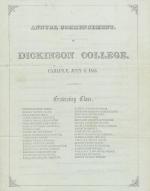
July 8, 1858
This copy of the printed program for the commencement exercises held on July 8, 1858 shows the members of the graduating class and the speeches that they were scheduled to deliver.
Format: Memorabilia and Ephemera
Location: Dickinsoniana Programs
Subject: Dickinson College Events
Time Period: 1840-1859
View Item: 1858 Commencement Program

1858-1859
Andrew Curtin writes fourteen letters to Eli Slifer in which he discusses a number of political issues, including who to nominate as candidates in Congressional elections. Curtin also reflects upon Slifer's potential candidacy for treasurer of Pennsylvania. In addition, Curtin requests a payment from him and asks for advice on whether "to deliver the annual oration before the students faculty &c of the University in your place." Transcripts included.
Format: Letters/Correspondence
Location: MC 2003.4, B3, F10
Subject: Personal and Family Life, Politics and Government
Time Period: 1840-1859
View Item: Letters from Andrew Curtin to Eli Slifer, 1858-59

September 1, 1858
President James Buchanan explains why he cannot grant E. L. Molineux's request that a merchant clerk of New York City receive an appointment to the United States Military Academy at West Point. Transcript included.
Format: Letters/Correspondence
Location: MC 1998.10, B3, F26
Subject: Education, Military Affairs and Conflict, Politics and Government
Time Period: 1840-1859
View Item: Letter from James Buchanan to E. L. Molineux

1858-1859
Horatio Collins King, a member of the Class of 1858, records his thoughts and activities of his daily life in the first year after his graduation from Dickinson College. King's entries include notes on his travels through New England, Canada, and New York. In addition, King discusses social life and studying law with Edwin Stanton in New York City. Several photographs, including two of King and of his wife Emma Stebbins, and a drawing of Stanton are also in the journal.
Format: Diaries and Journals
Location: MC 1999.9, B3, F1
Subject: Education, Legal Affairs, Personal and Family Life, Travel and Tourism
Time Period: 1840-1859
View Item: Journal of Horatio Collins King (Transcript)

November 2, 1858
United States Attorney General Jeremiah Sullivan Black writes to Jacob Thompson, Secretary of the Interior, with a legal opinion on the question of whether widows of officers and soldiers could receive a government pension if they remarry. "Upon the whole it is clear," as Black concludes, that the relevant legislation "[does] not authorize the payment of a pension to a woman while she is married." Transcript included.
Format: Letters/Correspondence
Location: I-BeachW-1974-1
Subject: Legal Affairs, Military Affairs and Conflict, Politics and Government
Time Period: 1840-1859
View Item: Letter from Jeremiah Black to Jacob Thompson

1859
Lily Macalester writes this biographical sketch of President James Buchanan in 1859. Macalester is friends with First Lady Harriet Lane, Buchanan's niece. Transcript included.
Format: Essays and Dissertations
Location: I-BeachW-2001-1
Subject: Genealogy and Family History, Personal and Family Life, Politics and Government
Time Period: 1840-1859
View Item: Biographical Sketch of President James Buchanan by Lily Macalester

January 15, 1859
President James Buchanan writes the Burns Club of the City of New York to decline the club's invitation to a dinner celebrating Robert Burns's centennial birthday. Buchanan also expresses his personal views on the poet's life and work. "[Burns] has ever been a favorite poet of mine," as Buchanan explains. Transcript included.
Format: Letters/Correspondence
Location: I-Friends-2011-3
Subject: Literary Pursuits
Time Period: 1840-1859
View Item: Letter from James Buchanan to New York City Burns Club

April 22, 1859
President James Buchanan writes Charles E. Wentz regarding possible political appointments for Col. Samuel Stambaugh. "I have offered him two good offices; but he will accept neither of them," as Buchanan explains. Transcript included.
Format: Letters/Correspondence
Location: MC 1998.10, B4, F2
Subject: Politics and Government
Time Period: 1840-1859
View Item: Letter from James Buchanan to Charles Wentz
May 4, 1859
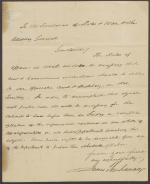
President James Buchanan writes to Secretary of State Lewis Cass, Secretary of War John B. Floyd, and Attorney General Jeremiah S. Black regarding orders that they need to send to federal officials in Utah. "The State of Affairs in Utah renders it necessary that new & harmonious instructions should be sent to our officials, Civil & Military, in that Territory," as Buchanan explains. Transcript included.
Although the letter itself is not dated, it is docketed on the back with the date May 4, 1859, so it was likely authored on that date or just a day or two before.
Format: Letters/Correspondence
Location: MC 1998.10, B4, F2
Subject: Politics and Government
Time Period: 1840-1859
View Item: Letter from James Buchanan to Lewis Cass, John B. Floyd, and Jeremiah S. Black
May 9, 1859
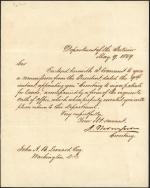
United States Secretary of the Interior Jacob Thompson forwards a commission from President James Buchanan (Class of 1809) to John A. B. Leonard. The commission appoints Mr. Leonard as "Secretary to sign patents for lands."
Format: Letters/Correspondence
Location: I-AsbellY-2002-63
Subject: Land and Real Estate, Politics and Government
Time Period: 1840-1859
View Item: Letter from Jacob Thompson to John Leonard

May 29, 1859
Spencer Fullerton Baird writes to A. Haen & Company about the redrawing of some plates. Dr. John Newberry has left, and Baird has no authority in the matter but will write to Newberry.
Format: Letters/Correspondence
Location: I-BeachW-1983-2
Subject: Science and Technology
Time Period: 1840-1859

June 13, 1859
Governor of Virginia Henry Alexander Wise comments on various national political issues and on the 1860 presidential election. Wise tells his correspondent that "I hope you will deal hardly by the Softs and expose their connection at Cincinnati in 1856 with the fire-eaters." Cincinnati was the location of the 1856 Democratic National Convention. In addition, Wise comments on the viability of President James Buchanan in the 1860 presidential election. "You may well be satisfied [Buchanan] is no candidate, and that he cannot make one of a bobb!," as Wise explains.
Format: Letters/Correspondence
Location: I-SpahrB-1954-9
Subject: Politics and Government
Time Period: 1840-1859
View Item: Letter from Henry Wise to Unknown Recipient

July 9, 1859
Clarence G. Jackson prepared this oration, entitled “Posthumous Glory," for the Junior Prize (Grigg Prize) contest held on July 9, 1859. Transcript included.
Format: Speeches and Sermons
Location: Orations-1859-J12p
Subject: Religion and Spirituality
Time Period: 1840-1859
View Item: "Posthumous Glory," by Clarence G. Jackson

July 9, 1859 - November 13, 1861
Charles F. Thomas' diary includes intermittent entries dating from leaving Dickinson College in July 1859, to attending at Garrett Bible Institute in Evanston, Illinois, and to working as a Methodist circuit rider in Pennsylvania as the Civil War begins. In March 1860, Thomas saw Abraham Lincoln during his visit to the Garrett Bible Institute. Lincoln was "a plain, honest, unassuming man," as Thomas observes. Thomas' entries also include details about the Republican Convention of 1860.
In addition, Thomas comments on the start of the Civil War and describes the divisions in his family. "I received a letter from Father yesterday which leads me to fear in fact to know that all my family are secessionists," as Thomas notes. Transcript included.
Format: Diaries and Journals
Location: I-Friends-1983-17
Subject: Dickinson College Student Life, Education, Military Affairs and Conflict, Personal and Family Life, Politics and Government, Religion and Spirituality
Time Period: 1840-1859, 1860-1879
View Item: Journal of Charles F. Thomas (Transcription)
July 9, 1859
William L. Cannon prepared this oration, entitled “The Central Idea of History," for the Junior Prize (Grigg Prize) contest held on July 9, 1862. Transcript included.
Format: Speeches and Sermons
Location: Orations-1859-C226c
Subject: Education, Politics and Government
Time Period: 1840-1859
View Item: "The Central Idea of History," by William L. Cannon

July 9, 1859
George Baylor prepared this oration, entitled “The Power of Thought," for the Junior Prize (Grigg Prize) contest held on July 9, 1859. Transcript included.
Format: Speeches and Sermons
Location: Orations-1859-B358p
Subject: Education
Time Period: 1840-1859
View Item: "The Power of Thought," by George Baylor

July 14, 1859
Zebulon Dyer prepared this oration, entitled “Manifest Destiny," for the commencement ceremonies held July 14, 1859. Authoring an original speech was among the graduation requirements for Dickinson College seniors at that time. Transcript included.
Format: Speeches and Sermons
Location: Orations-1859-D996m
Subject: Education, Politics and Government
Time Period: 1840-1859
View Item: "Manifest Destiny," by Zebulon Dyer
July 14, 1859
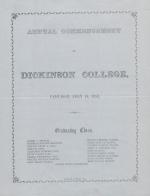
This copy of the printed program for the commencement exercises held on July 14, 1859 shows the members of the graduating class and the speeches that they were scheduled to deliver.
Format: Memorabilia and Ephemera
Location: Dickinsoniana Programs
Subject: Dickinson College Events
Time Period: 1840-1859
View Item: 1859 Commencement Program