
About Full-Text Documents
Collections of college and personal papers, as well as a select number of individual documents, have been briefly described in entries available for browsing and searching on this site. All collection and document descriptions contain a representative image and a summary of the contents.
Search Document Descriptions
Browse Document Descriptions
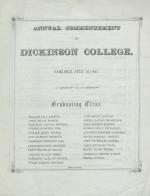
July 12, 1855
This copy of the printed program for the commencement exercises held on July 12, 1855 shows the members of the graduating class and the speeches that they were scheduled to deliver.
Format: Memorabilia and Ephemera
Location: Dickinsoniana Programs
Subject: Dickinson College Events
Time Period: 1840-1859
View Item: 1855 Commencement Program

July 12, 1855
Charles Francis Himes receives his Bachelor of Arts Diploma from Dickinson College on July 12, 1855.
Format: Certificates and Diplomas
Location: OC 2000.1, F4
Subject: Education
Time Period: 1840-1859
View Item: Bachelor of Arts Diploma - Charles Himes

July 12, 1855
Josiah F. Kennedy prepared this oration, entitled “Philanthropy" for the commencement ceremonies held July 12, 1855. Authoring an original speech was among the graduation requirements for Dickinson College seniors at that time. Transcript included.
Format: Speeches and Sermons
Location: Orations-1855-K35p
Subject: Education, Social Reform and Advocacy
Time Period: 1840-1859
View Item: "Philanthropy," by Josiah F. Kennedy

July 12, 1855
J. Douglas Wade prepared this oration, entitled “Cuban Liberty" for the commencement ceremonies held July 12, 1855. Authoring an original speech was among the graduation requirements for Dickinson College seniors at that time. Transcript included.
Format: Speeches and Sermons
Location: Orations-1855-W119c
Subject: International Affairs, Politics and Government
Time Period: 1840-1859
View Item: "Cuban Liberty," by J. Douglas Wade

July 13, 1855
Andrew Hemphill Dill receives his Bachelor of Arts Diploma from Dickinson College on July 13, 1855.
Format: Certificates and Diplomas
Location: Diploma Collection
Subject: Education
Time Period: 1840-1859
View Item: Bachelor of Arts Diploma - Andrew Dill

August 18, 1855
Supreme Court Chief Justice Roger Brooke Taney writes his grandson, [Roger Brooke] Taney Campbell, and notes that he is glad to have heard so much from the Campbell family this summer. As Taney explains, he and his wife just this morning received letters from Taney Campbell's father and sister Alice. In addition, Taney also comments on the outbreak of yellow fever in Norfolk and Portsmouth.
"We hear now scarcely anything talked about but sickness and death from the fever," as Taney explains. Yet, as he is in Old Point, Taney believes that "we are far enough off to feel no fear about it." Officials have also taken steps to protect the large number of soldiers stationed near Old Point. "The commanding officer has forbidden any person landing from Norfolk or Portsmouth," as Taney notes. Taney also reports that "your Aunt Lizzie left us on Wednesday" and "little Roger improves daily." Transcript included.
Format: Letters/Correspondence
Location: I-SpahrB-1965-7
Subject: Health and Medicine, Military Affairs and Conflict, Personal and Family Life
Time Period: 1840-1859
View Item: Letter from Roger B. Taney to Taney Campbell

August 25, 1855
Supreme Court Chief Justice Roger Brooke Taney writes to J. Mason Campbell about the summer at Old Point with regard to the nearby outbreak of yellow fever and the construction of a new wharf. While his family is safe from the outbreak, Taney finds sadness in the illness and death as well as the unchristian behavior of some in forbidding those in the infected areas from taking refuge in other cities. Taney notes that he knows some of those who have died, including Mrs. Barron and one of her daughters. In addition, Taney comments that "the Loyalls (Mrs. Faragut's family) have been in the midst of it, and one of them ill."
Aside from news related to the outbreak, Taney is fascinated by the process of building piers to support a new wharf and wishes his grandson could see it. Taney describes "the operations of a man with a marine armor who is engaged in building the Piers" and who "remains under water five hours at a depth of 18 or 20 feet." Transcript included.
Format: Letters/Correspondence
Location: I-SpahrB-1965-18
Subject: Business and Industry, Health and Medicine, Personal and Family Life, Weather and Climate
Time Period: 1840-1859

September - December 1855
Horatio Collins King's diary during the fall of his second year at Dickinson College. King is a member of the class of 1858. Transcript included.
Format: Diaries and Journals
Location: MC 1999.9, B2, F6
Subject: Carlisle and Cumberland County, Dickinson College Student Life, Education
Time Period: 1840-1859
View Item: Editor's Note -- Diary of Horatio Collins King , Diary of Horatio Collins King, Fall 1855 (Transcript)
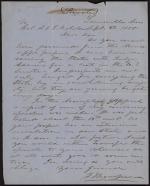
September 22, 1855
Jacob Thompson writes to Colonel A. O. P. Nicholson and discusses how he expects to win the US Senate seat in Mississippi. Thompson also notes that his speeches have been published in the Memphis Appeal. As Nicholson is also a newspaper editor, Thompson asks Nicholson to include the speeches in his paper. Thompson does not win a Senate seat.
Format: Letters/Correspondence
Location: I-BeachW-1986-7
Subject: Politics and Government
Time Period: 1840-1859

September 28, 1855
Supreme Court Chief Justice Roger Brooke Taney writes to J. Mason Campbell and discusses Mrs. Taney's ill health. "Maria -- who was sleeping the bed with her -- discovered that she was making an effort to raise herself in bed -- and was unable to do so," as Taney explains. Taney also asks Campbell to "implore [their family doctor?] to come in the next boat."
Format: Letters/Correspondence
Location: I-SpahrB-1964-8
Subject: Health and Medicine, Personal and Family Life
Time Period: 1840-1859

September 29, 1855
Supreme Court Chief Justice Roger Brooke Taney sends a telegram to J. Mason Campbell: "Mrs Taney is dying. Charter a Boat from Mr Falls and send it for us as soon as possible."
Format: Letters/Correspondence
Location: I-SpahrB-1964-8
Subject: Health and Medicine, Personal and Family Life
Time Period: 1840-1859
View Item: Telegram from Roger B. Taney to J. Mason Campbell

December 14, 1855
James Buchanan, the United States Minister to the United Kingdom, writes to W. Hunter and encloses a communication of "an important religious subject" from Edward Ellice, a member of the House of Commons, to C. A. Davis of New York. Transcript included.
Format: Letters/Correspondence
Location: MC 1998.10, B3, F20
Subject: Politics and Government, Religion and Spirituality
Time Period: 1840-1859
View Item: Letter from James Buchanan to W. Hunter

December 28, 1855
James Buchanan, the United States Minister to the United Kingdom, writes to Miss Eliza Watterston and offers condolences regarding the death of her father and a Mrs. Baker. Buchanan also explains that he is ready to return home. "I long to return to my own country which is the happiest land beneath the sun," as Buchanan observes. Transcript included.
Format: Letters/Correspondence
Location: MC 1998.10, B3, F20
Subject: International Affairs, Personal and Family Life, Politics and Government, Travel and Tourism
Time Period: 1840-1859

January - July 1856
Horatio Collins King's diary during the spring of his second year at Dickinson College. King is a member of the class of 1858. Transcript included.
Format: Diaries and Journals
Location: MC 1999.9, B2, F6
Subject: Carlisle and Cumberland County, Dickinson College Student Life, Education
Time Period: 1840-1859
View Item: Editor's Note -- Diary of Horatio Collins King , Diary of Horatio Collins King, Spring 1856 (Transcript)

January 25, 1856
Supreme Court Chief Justice Roger Brooke Taney writes to Joel Barlow Sutherland and discusses the legal distinction between letters being "in the mail" and "in the post office." Taney notes that he cannot conduct further research on the question due to his ill health. Transcript included.
Format: Letters/Correspondence
Location: I-SpahrB-1962-5
Subject: Health and Medicine, Legal Affairs
Time Period: 1840-1859

February 4, 1856
Albert Slape writes to James Munroe with news of the dismissal of four students on the charge of tarring Professor Henry Otis Tiffany's blackboard. Slape mentions that the dismissal of the students resulted in a "rebellion of the students." Slape is a member of the Class of 1858 while Munroe is Class of 1855. Transcript included.
Format: Letters/Correspondence
Location: I-CowdreyM-1955-1
Subject: Dickinson College Administration, Dickinson College History, Dickinson College Student Life, Education
Time Period: 1840-1859
View Item: Letter from Albert Slape to James Munroe

February 15, 1856
James Buchanan, the United States Minister to the United Kingdom, writes to Mr. Tyler regarding his plans to leave London as soon as George Dallas, his successor, arrives. Buchanan is not looking forward to the trip back home. " I am a very very bad sailor and suffer dreadfully from sea sickness," as Buchanan explains. Transcript included.
Format: Letters/Correspondence
Location: MC 1998.10, B3, F21
Subject: Politics and Government, Travel and Tourism
Time Period: 1840-1859
View Item: Letter from James Buchanan to Mr. Tyler
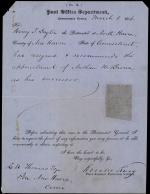
March 1, 1856
Postmaster General Horatio Collins King writes to L.A. Thomas, Postmaster of New Haven, CT, about a recent position vacancy. Collins states that Hervey T. Dayton resigned from the job and recommends Nathan U. Brown as a replacement.
Format: Letters/Correspondence
Location: I-BeachW-1976-1
Subject: Politics and Government
Time Period: 1840-1859

March 17, 1856
Supreme Court Chief Justice Roger Brooke Taney thanks his daughter, Alice Taney Campbell, for sending a letter that arrives on his 79th birthday. Campbell's "affectionate remembrance," as Taney explains, reminds him of her "affectionate & constant attention to [her] dear grandmother." Justice Taney also discusses the weather in Washington, his health, and his family, including Alice's aunts [Elizabeth] Stevenson, Ellen, Sophia, and Maria and her cousin "little Roger."
Format: Letters/Correspondence
Location: I-SpahrB-1964-7
Subject: Health and Medicine, Personal and Family Life, Weather and Climate
Time Period: 1840-1859
View Item: Letter from Roger B. Taney to Alice Campbell

June 1856
John Calhoun Gilmore writes to "Lib" prior to the Dickinson College Commencement exercises about his class rank in the Class of 1856. Gilmore lists the full ranking of the class of 1856 in his letter. "You will see that my standing is high - I am the first one next to the honor men," as Gilmore explains. Gilmore writes his letter on the reverse side of a commencement program. Transcript included.
Format: Letters/Correspondence
Location: I-Original-1856-1
Subject: Dickinson College Academic Affairs, Dickinson College Student Life, Education, Personal and Family Life
Time Period: 1840-1859
View Item: Letter from John Gilmore to "Lib"
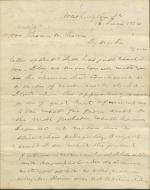
June 16, 1856
Representative Alexander Hamilton Stephens writes to Thomas W. Thomas and discusses the 1856 presidential election. Stephens, a Democrat, supports James Buchanan and describes the reasons why the convention made the decisions they did with regard to President Franklin Pierce, Senator Stephen Douglas, and Senator William H. Seward. Stephens also compares it to the 1852 nomination of General Winfield Scott. While not sure that Buchanan will win the election, Stephens notes that "I do verily believe if in the approaching contest we shall succeed there will never be another sectional or slavery struggle in the United States at least[?] in our day." In addition, Stephens also discusses other important political issues of the day, including Kansas, free soil party, and abolition of slavery. Transcript included.
Format: Letters/Correspondence
Location: I-SpahrB-1959-10
Subject: Politics and Government
Time Period: 1840-1859
View Item: Letter from Alexander H. Stephens to Thomas W. Thomas
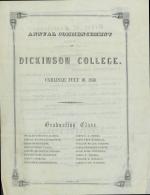
July 10, 1856
This copy of the printed program for the commencement exercises held on July 10, 1856 shows the members of the graduating class and the speeches that they were scheduled to deliver.
Format: Memorabilia and Ephemera
Location: Dickinsoniana Programs
Subject: Dickinson College Events
Time Period: 1840-1859
View Item: 1856 Commencement Program

July 10, 1856
Marvin E. Clark prepared this oration, entitled “Authority" for the commencement ceremonies held July 10, 1856. Authoring an original speech was among the graduation requirements for Dickinson College seniors at that time. Transcript included.
Format: Speeches and Sermons
Location: Orations-1856-C594a
Subject: Education, Religion and Spirituality, Social Reform and Advocacy
Time Period: 1840-1859
View Item: "Authority," by Marvin E. Clark
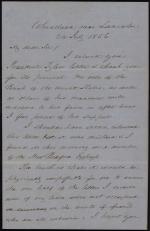
July 24, 1856
Democratic Presidential candidate James Buchanan (Class of 1803) writes John S. Cunningham about various political issues, including his support of President John Tyler's veto of the Bank of the United States in 1841. Buchanan also returns President Tyler's letter to Cunningham and notes that he "feels proud of his support."
Format: Letters/Correspondence
Location: I-Friends-2003-3
Subject: Economics and Finance, Politics and Government
Time Period: 1840-1859

August 1856
President Charles Collins writes this short history of Dickinson College in 1856.
Charles Collins, "Dickinson College," The Ladies' Repository 16 (August 1856): 449-453.
Format: Newspapers and Magazines
Location: Special Collections Periodicals
Subject: Dickinson College Academic Affairs, Dickinson College Administration, Dickinson College History, Education
Time Period: 1840-1859
View Item: "Dickinson College," by Charles Collins