
About Full-Text Documents
Collections of college and personal papers, as well as a select number of individual documents, have been briefly described in entries available for browsing and searching on this site. All collection and document descriptions contain a representative image and a summary of the contents.
Search Document Descriptions
Browse Document Descriptions

November 19, 1841
Senator James Buchanan writes to Ross Wilkins a letter reflecting upon Michigan's establishment of the "Wild cat" banking system, which "was one great cause of its prostration." Buchanan also comments on the possibility of a conflict with the United Kingdom if " the States repudiate [their] debts & England interpose[s] to protect her subjects from the effects of this swindling operation." Transcript included.
Format: Letters/Correspondence
Location: MC 1998.10, B1, F27
Subject: Economics and Finance, International Affairs, Military Affairs and Conflict, Politics and Government
Time Period: 1840-1859
View Item: Letter from James Buchanan to Ross Wilkins

November 29, 1841
Senator James Buchanan defends his position as a candidate for President and discusses Pennsylvania's important role in national politics. "I have never yet deemed myself a candidate for the highest office, nor have I considered it," as Buchanan tells M. S. Blackman. Transcript included.
Format: Letters/Correspondence
Location: MC 1998.10, B1, F27
Subject: Politics and Government
Time Period: 1840-1859
View Item: Letter from James Buchanan to M. S. Blackman
1842
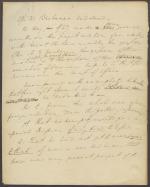
This report by an unknown author discusses and provides a summary of the key points in Senator Henry Clay's speech on the Webster-Ashburton Treaty. This report notes how "[Clay] believed in the sincerity of the professions of the British Govt" and that "nothing but the greatest evil could result to either country from a war." Senator James Buchanan (Class of 1809) had delivered a speech on the same topic right before Clay's speech. Transcript included.
Format: Reports
Location: I-SpahrB-1950-2
Subject: International Affairs, Military Affairs and Conflict, Politics and Government
Time Period: 1840-1859
View Item: Report of Henry Clay’s speech on the Webster-Ashburton Treaty by Unknown Author
1842-1864
Charles Collins records his thoughts and activities from his time at Emory and Henry College in Emory, Virginia, to his years as president of Dickinson College in Carlisle, Pennsylvania, and then as the head of State Female College in Memphis, Tennessee. The entries from the 1860s refer to the effects that the Civil War had upon the family and the State Female College. "A mighty revolution has swept & is still sweeping over this once peaceful & happy people," as Collins observes in August 1861. Collins' journal also includes information on the genealogies of both his and his wife’s families as well as accounts of all of the marriages that Collins performed throughout his career. Transcript included.
Format: Diaries and Journals
Location: MC 2003.6, B1, F6
Subject: Dickinson College Administration, Education, Genealogy and Family History, Personal and Family Life, Politics and Government, Religion and Spirituality
Time Period: 1840-1859, 1860-1879
View Item: Journal of Charles Collins (Transcript)
January 27, 1842
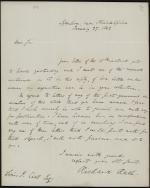
Richard Rush responds to a request for his autograph as well as any letters he may have from past governors or senators from Pennsylvania for possible publication. "In regard to letters of any of the past governors or senators of [Pennsylvania], I fear that I shall scarcely be able to furnish you with any for publication," as Rush explains to Lewis J. Cist.
Format: Letters/Correspondence
Location: I-BeachW-1983-6
Subject: Politics and Government
Time Period: 1840-1859
View Item: Letter from Richard Rush to Lewis Cist

February 26, 1842
Senator James Buchanan writes to Thomas Brice regarding how society values "mechanicks" and argues against cutting the salaries of members of Congress. Buchanan explains that Brice "underrates the estimation in which our mechanicks are held." "I know no man who now holds a more influential position in society than a respectable mechanick," as Buchanan notes.
While "reform in the expenditures of our Government" is necessary, Buchanan argues that Congressional salaries should not be reduced. "The pay of members of Congress ought not to be reduced so low that a poor man could not afford to live here and maintain his family at home," as Buchanan notes. If salaries were cut, Buchanan explains that "the powers of Legislation would thus be placed in the hands of those who could afford to serve for nothing." Transcript included.
Format: Letters/Correspondence
Location: MC 1998.10, B2, F1
Subject: Business and Industry, Politics and Government
Time Period: 1840-1859
View Item: Letter from James Buchanan to Thomas Brice
February 27, 1842
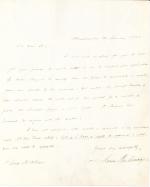
Senator James Buchanan responds to Dr. George McClellan's request for his son to receive an appointment as a cadet, possibly to West Point. "I have not interfered either directly or indirectly, in any appointment since Mr. Van Buren retired; but if I have a right to nominate a cadet, your son shall be appointed," as Buchanan explains. Transcript included.
Format: Letters/Correspondence
Location: MC 1998.10, B2, F1
Subject: Military Affairs and Conflict, Politics and Government
Time Period: 1840-1859

April 1, 1842
Postmaster General James Campbell writes to Reah Frazer, an attorney in Lancaster County, Pennsylvania, about various political issues and James Buchanan as a possible candidate for a future Presidential election. "I should like very much to go up to Lancaster and see Mr. Buchanan" and "have a talk with him," as Campbell notes. "I have always entertained the highest respect and have had for years my eye steadily fixed upon [Buchanan] as the master spirit who was to redeem the reputation of Pennsylvania" through, as Campbell explains, "his elevation to the Presidency."
Format: Letters/Correspondence
Location: I-SpahrB-1958-3
Subject: Politics and Government
Time Period: 1840-1859
View Item: Letter from James Campbell to Reah Frazer
April 1, 1842
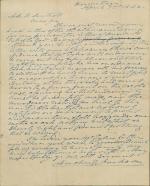
Former President Andrew Jackson writes J. Southall to discus a letter that President John Tyler wrote to a "Govr. Branch" and explain what he believes the United States policy should be towards Great Britain. "It behoves [President Tyler] to meet now the arrogant pretensions of Great Britain at the threshold," as Jackson explains. Transcript included.
Format: Letters/Correspondence
Location: I-SpahrB-1953-12
Subject: International Affairs, Politics and Government
Time Period: 1840-1859
View Item: Letter from Andrew Jackson to J. Southall

April 1, 1842
Rev. George Washington Bethune asks Isaac Waldron to also "come and see me" when he visits his mother. Bethune, a member of the Class of 1823, lives in Brooklyn, New York.
Format: Letters/Correspondence
Location: I-Purchase-1955-1
Subject: Personal and Family Life
Time Period: 1840-1859
View Item: Letter from George Bethune to Isaac Waldron
April 4, 1842
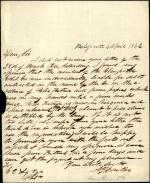
Attorney Andrew Gregg Curtin (Class of 1837) writes to an unspecified C. E. Lex, offering his opinion on a legal matter concerning liability for certain debts.
Format: Letters/Correspondence
Location: I-BeachW-1982-3
Subject: Legal Affairs
Time Period: 1840-1859
View Item: Letter from Andrew Gregg Curtin to C. E. Lex

June 22, 1842
Senator James Buchanan writes to James X. McLanahan, a member of the Pennsylvania State Senate, regarding how postmasters are appointed and removed, Pennsylvania politics, and the apportionment bill. "Now the power of removal rests with the President alone; and this he has already exercised," as Buchanan explains. Transcript included.
Format: Letters/Correspondence
Location: MC 1998.10, B2, F1
Subject: Politics and Government
Time Period: 1840-1859

July 14, 1842
John Richard Pattison prepared this oration, entitled “National Ingratitude," for the commencement ceremonies held July 14, 1842. Authoring an original speech was among the graduation requirements for Dickinson College seniors at that time. Transcript included.
Format: Speeches and Sermons
Location: Orations-1842-P321n
Subject: Politics and Government
Time Period: 1840-1859
View Item: "National Ingratitude," by John R. Pattison

July 14, 1842
Perry Green Buckingham receives his Bachelor of Arts Diploma from Dickinson College on July 14, 1842.
Format: Certificates and Diplomas
Location: Diploma Collection
Subject: Education
Time Period: 1840-1859
View Item: Bachelor of Arts Diploma - Perry Buckingham

July 14, 1842
Daniel Elzey Moore Bates (Class of 1839) receives his Master of Arts Diploma from Dickinson College on July 14, 1842.
Format: Certificates and Diplomas
Location: Diploma Collection
Subject: Education
Time Period: 1840-1859
View Item: Master of Arts Diploma - Daniel Bates

July 21, 1842
Senator James Buchanan asks Dickinson College Professor John McClintock to thank the Board of Trustees for granting him an honorary Doctor of Laws. "I feel conscious that I do not deserve so distinguished a literary honor," Buchanan notes. Transcript included.
Format: Letters/Correspondence
Location: MC 1998.10, B2, F1
Subject: Dickinson College Administration, Dickinson College Alumni Affairs, Dickinson College Events, Dickinson College History, Personal and Family Life
Time Period: 1840-1859

August 23, 1842
Chief Justice of the Supreme Court Roger Brooke Taney writes to Henry Baldwin about the delay in payment for Baldwin's books. As Taney explains, "I have written to [the individual responsible for forwarding the money] requesting his immediate attention to the matter, if he has not already made the remittance." Justice Taney also offers an explanation for his delayed response to Baldwin's earlier letter, writing: "I have, since my spring circuit was over, been very much from home." In addition, Taney notes that one of his daughters "has been severely indisposed."
Format: Letters/Correspondence
Location: I-SpahrB-1951-4
Subject: Economics and Finance, Personal and Family Life
Time Period: 1840-1859
View Item: Letter from Roger B. Taney to Henry Baldwin

October 1842 - January 1846
Alfred Brunson McCalmont, a member of the Class of 1844, writes daily entries about classes, social life at Dickinson College, and his life after graduation. McCalmont's entries start in October 1842 and conclude in January 1846. Transcript included.
Format: Diaries and Journals
Location: I-Friends-2012-3
Subject: Carlisle and Cumberland County, Dickinson College Student Life, Education, Personal and Family Life
Time Period: 1840-1859
View Item: Journal of Alfred B. McCalmont (Transcript)
October 14, 1842
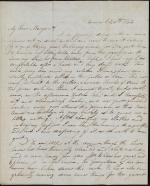
John Zug (Class of 1837) writes to his wife, Margaret Hood, updating her on the farmhouse and the lives of their friends. Transcript included.
Format: Letters/Correspondence
Location: I-Friends-2013-8
Subject: Carlisle and Cumberland County, Personal and Family Life
Time Period: 1840-1859
View Item: Letter from John Zug to Margaret Hood

October 18, 1842
Senator James Buchanan responds to P. G. Washington's request for a recommendation for a political appointment. "I have recommended no friend for office," as Buchanan explains, "since the present administration came into power." Transcript included.
Format: Letters/Correspondence
Location: MC 1998.10, B2, F2
Subject: Politics and Government
Time Period: 1840-1859

November 8, 1842
US Senator James Buchanan writes Mrs. James I. Roosevelt (Cornelia Van Ness Roosevelt) to express his regrets that he "could not enjoy the pleasure of meeting you on my late visit to New York." Buchanan notes that he hopes to see her "at Washington in good health & spirits." Transcript included.
Format: Letters/Correspondence
Location: MC 1998.10, B2, F3
Subject: Personal and Family Life
Time Period: 1840-1859
View Item: Letter from James Buchanan to Mrs. James I. Roosevelt
January 13, 1843
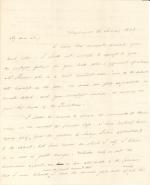
Senator James Buchanan writes Benjamin Champneys, a Pennsylvania State Senator, to thank him for his help "in rescuing me from the hands of the Philistines" and to discuss several political issues. "I never believed until the present moment that I had the personal good will of nearly all the members of all parties to such an extent," as Buchanan observes. Transcription included.
Format: Letters/Correspondence
Location: MC 1998.10, B2, F4
Subject: Politics and Government
Time Period: 1840-1859

March 13, 1843
Senator James Buchanan writes to Harrison Wright regarding President William Henry Harrison's administration and the appointment of a postmaster in Wilkes Barre, Pennsylvania. Buchanan also comments on Vice President John Tyler's ambitions. "Tyler has determined to be the next President if he can; and he will use the patronage of the Government to accomplish this object," as Buchanan explains. Transcript included.
Format: Letters/Correspondence
Location: MC 1998.10, B2, F4
Subject: Politics and Government
Time Period: 1840-1859

June 13, 1843
Senator James Buchanan writes to Samuel C. Humes and explains that he "cannot interefere in any appointment under Mr. Tyler's administration." Buchanan claims that President John Tyler is "a well disposed & well informed man; but he is more egregiously humbugged than any man [he has] ever known." Transcript included.
Format: Letters/Correspondence
Location: MC 1998.10, B2, F5
Subject: Politics and Government
Time Period: 1840-1859

July 13, 1843
William L. Whitney prepared this oration, entitled “Colonial Prosperity," for the commencement ceremonies held July 13, 1843. Authoring an original speech was among the graduation requirements for Dickinson College seniors at that time. Transcript included.
Format: Speeches and Sermons
Location: Orations-1843-W623c
Subject: Education, Politics and Government
Time Period: 1840-1859
View Item: "Colonial Prosperity," by William L. Whitney