
About Full-Text Documents
Collections of college and personal papers, as well as a select number of individual documents, have been briefly described in entries available for browsing and searching on this site. All collection and document descriptions contain a representative image and a summary of the contents.
Search Document Descriptions
Browse Document Descriptions
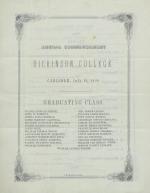
July 11, 1850
This copy of the printed program for the commencement exercises held on July 11, 1850 shows the members of the graduating class and the speeches that they were scheduled to deliver.
Format: Memorabilia and Ephemera
Location: Dickinsoniana Programs
Subject: Dickinson College Events
Time Period: 1840-1859
View Item: 1850 Commencement Program

July 11, 1850
Alexander M. Hamilton prepared this oration, entitled “Robert Burns," for the commencement ceremonies held July 11, 1850. Authoring an original speech was among the graduation requirements for Dickinson College seniors at that time. Transcript included.
Format: Speeches and Sermons
Location: Orations-1850-H217r
Subject: Literary Pursuits
Time Period: 1840-1859
View Item: "Robert Burns," by Alexander M. Hamilton

July 11, 1850
Phil M. Leakin prepared this oration, entitled “Bigotry," for the commencement ceremonies held July 11, 1850. Authoring an original speech was among the graduation requirements for Dickinson College seniors at that time. Transcript included.
Format: Speeches and Sermons
Location: Orations-1850-L435b
Subject: Politics and Government, Religion and Spirituality
Time Period: 1840-1859
View Item: "Bigotry," by Phil M. Leakin
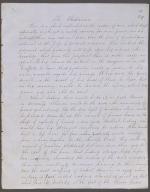
July 11, 1850
Flavel C. Barber prepared this oration, entitled “The Historian," for the commencement ceremonies held July 11, 1850. Authoring an original speech was among the graduation requirements for Dickinson College seniors at that time. Transcript included.
Format: Speeches and Sermons
Location: Orations-1850-B234h
Subject: Education, Literary Pursuits
Time Period: 1840-1859
View Item: "The Historian," by Flavel C. Barber
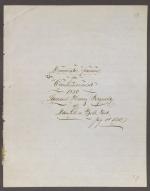
July 11, 1850
Samuel Henry Reynolds prepared this oration, entitled “Democratic Passion," for the commencement ceremonies held July 11, 1850. Authoring an original speech was among the graduation requirements for Dickinson College seniors at that time. Transcript included.
Format: Speeches and Sermons
Location: Orations-1850-R465d
Subject: Politics and Government
Time Period: 1840-1859
View Item: "Democratic Passion," by Samuel H. Reynolds

1850-1852
Alexander McClure writes sixteen letters to Eli Slifer, a member of the Pennsylvania House of Representatives, on a number of different topics, including the senatorial and representative delegate elections, reports on "Abolishing Capital Punishment," the abolition of slavery, and other developments in local politics. "The Locofocos have not even had a dream lately of defeating you... You will get a solid Whig vote, and a little more," as McClure notes. Transcripts included.
Format: Letters/Correspondence
Location: MC 2003.4, B7, F10
Subject: Personal and Family Life, Politics and Government, Social Reform and Advocacy
Time Period: 1840-1859
View Item: Letters from Alexander McClure to Eli Slifer, 1850-52

September 2, 1850
James Buchanan writes David Myerle to congratulate him and to remissness on how Myerle helped provide a "domestic supply of water rolled hemp" for the United States Navy. While "the object would doubtless have been eventually accomplished," Buchanan observes that "[Myerle's ] efforts have hastened the time & thus greatly benefited the Country." Buchanan also explains that he has "retired from public life, probably forever." Transcript included.
Format: Letters/Correspondence
Location: MC 1998.10, B2, F25
Subject: Military Affairs and Conflict, Politics and Government
Time Period: 1840-1859
View Item: Letter from James Buchanan to David Myerle

December 4, 1850
Chief Justice of the Supreme Court Roger Brooke Taney writes to his wife, Anne Key Taney, and informs her of his safe arrival in Washington, DC. Even the Supreme Court has already started hearing cases, Taney asks his wife to "tell James his case will not come on this week." Taney also notes that he misses her and reports that "it is a sad and lonely looking evening."
Format: Letters/Correspondence
Location: I-SpahrB-1965-4
Subject: Legal Affairs, Personal and Family Life
Time Period: 1840-1859
View Item: Letter from Roger B. Taney to Anne Taney

December 26, 1850
James Buchanan responds to John G. Brenner's invitation to a dinner in honor of Captain Mathews of the Steamer City of Glasgow as well as discusses Philadelphia's economic status in the United States. "I rejoice to percieve that Philadelphia is about to make a serious effort to obtain her just share of the foreign commerce of the Country," as Buchanan notes. Transcript included.
Format: Letters/Correspondence
Location: MC 1998.10, B2, F25
Subject: Business and Industry, Politics and Government
Time Period: 1840-1859

1851
William Charles Ford Reed, a member of the Class of 1851, receives this diploma as a member of the Belles Lettres Society in 1851.
Format: Certificates and Diplomas
Location: Diploma Collection
Subject: Education
Time Period: 1840-1859

1851-1853
Moncure Daniel Conway, a 1849 graduate of Dickinson College, records a critical time in his personal development as he moves from life as a Methodist preacher to Harvard Divinity School, Unitarianism, and freethought, meeting and befriending Ralph Waldo Emerson and Henry David Thoreau along the way. Transcript included.
Format: Diaries and Journals
Location: MC 1999.6, B2, F8
Subject: Personal and Family Life, Religion and Spirituality, Social Reform and Advocacy
Time Period: 1840-1859
View Item: Journal of Moncure D. Conway (Transcript)

1851-1857
James Buchanan writes a total of six letters to Robert Tyler expressing his opinions on various contemporary political developments. Topics include the campaign of Judge Campbell, Simon Cameron as a political opponent, Colonel William King as Vice President nominee, Buchanan's "onerous" duties as the United States Minister to the United Kingdom, Pennsylvania state politics, increasing sectional tensions, and the question of slavery. Transcripts included.
Format: Letters/Correspondence
Location: MC 1998.10
Subject: International Affairs, Politics and Government, Social Reform and Advocacy
Time Period: 1840-1859
View Item: Letters from James Buchanan to Robert Tyler
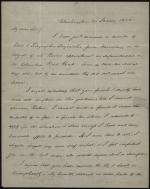
January 30, 1851
Pennsylvania politician James Buchanan congratulates James Campbell on his recent political victory and discusses W. Baker's appointment as superintendent of the Columbia Rail Road. While one of Campbell's friends opposes Baker's selection, Buchanan argues that "I cannot desert a friend to secure the neutrality of a foe." Buchanan also discusses national politics, including the 1852 Presidential election. "The time has arrived... when Pennsylvania may furnish the Democratic Candidate for the Union," as Buchanan explains.
Format: Letters/Correspondence
Location: I-Friends-2003-5
Subject: Business and Industry, Personal and Family Life, Politics and Government
Time Period: 1840-1859
View Item: Letter from James Buchanan to James Campbell

May 5, 1851
James Buchanan writes to former Senator Robert J. Walker regarding the potential secession of South Carolina. "Heaven alone can foresee all the evils to our Country and to herself which may follow her secession," as Buchanan notes. Transcript included.
Format: Letters/Correspondence
Location: MC 1998.10, B3, F3
Subject: Politics and Government
Time Period: 1840-1859

March 14, 1851
James Sellers writes Colonel William F. Wagenseller regarding two recent court cases and payments that are due. Transcript included.
Format: Letters/Correspondence
Location: MC 2003.4, B9, F20
Subject: Legal Affairs
Time Period: 1840-1859
March 18 ; May 22, 1851
James Buchanan writes two letters to John Hastings that focus on Pennsylvania politics, including divisions in the state Democratic party, the Jefferson resolution, Reading convention, and the possibility of Democrats selecting Buchanan as their candidate in the next Presidential election. Transcripts included.
Format: Letters/Correspondence
Location: MC 1998.10
Subject: Politics and Government
Time Period: 1840-1859
View Item: Letters from James Buchanan to John Hasting
1851-1854
Israel Gutelius writes eight letters to Eli Slifer regarding issues related to the publication of Gutelius' German language newspaper, including laws that would allow "reasonable compensation" for the work in translating and publishing county news. Gutelius' paper is the Der Demokrat, which is also known as the Union Demokrat. Transcripts included.
Format: Letters/Correspondence
Location: MC 2003.4, B5, F7
Subject: Business and Industry, Legal Affairs, Literary Pursuits, Politics and Government
Time Period: 1840-1859
View Item: Letters from Israel Gutelius to Eli Slifer, 1851-54
1851-1861
William Wagenseller writes ten letters to Eli Slifer on a number of different topics, including funding a monument for his late brother and recommending his nephew for a position as a doctor in the Union army. In addition, Wagenseller provides information regarding a soldier who left military service without permission. This individual "was entirely ignorant of the punishment and it seems thought that his leaving would amount to but little as there were so many more men than could be accepted," as Wagenseller explains. Transcripts included.
Format: Letters/Correspondence
Location: MC 2003.4, B10, F21
Subject: Health and Medicine, Military Affairs and Conflict, Personal and Family Life, Politics and Government
May 3, 1851
James Buchanan writes his nephew and legal ward, James Buchanan Henry, to discuss a recent school report. "In Scholarship you are 93.9; not so high as formerly," as Buchanan notes. In addition, Buchanan comments on his niece, Harriet Lane, and mentions the recent death of a Mrs. Pleasanton. Transcript included.
Format: Letters/Correspondence
Location: I-Friends-2010-2
Subject: Education, Personal and Family Life
Time Period: 1840-1859
View Item: Letter from James Buchanan to James Henry
May 5, 1851
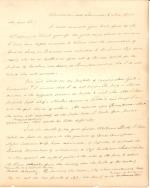
James Buchanan writes Robert P. Flenniken to discuss a number of political issues, including the 1852 Presidential election, the implications of General Lane's nomination in Indiana, and the intentions of Mr. Cameron to "admit the Frazer delegates from this county over the heads of the regularly elected delegates & claim this as a triumph over [Buchanan]." Transcript included.
Format: Letters/Correspondence
Location: MC 1998.10, B3, F3
Subject: Politics and Government
Time Period: 1840-1859
May 7, 1851
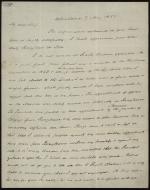
James Buchanan writes Robert Tyler, son of President John Tyler, about Buchanan's tenure as secretary of state under President James Polk and the Mexican War. "The appointments of officers in the Mexican war nearly ruined me politically in Pennsylvania" and, as Buchanan explains, "I solemnly protested against any more military appointments being made from Pennsylvania without my knowledge and against my will." Buchanan notes that this issue explains why Frank Clinton "has good reason to be offended with me." In addition, Buchanan argues that an "article noticing the Penn. Statesman was produced, either directly or indirectly, by the machinations of [Simon] Cameron." Transcript included.
Format: Letters/Correspondence
Location: I-Friends-2003-4
Subject: Military Affairs and Conflict, Politics and Government
Time Period: 1840-1859
View Item: Letter from James Buchanan to Robert Tyler
June 11, 1851
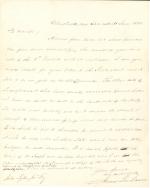
James Buchanan writes John Tyler Jr. and explains how sectional tensions will increase after the Whig party nominates General Winfield Scott as their candidate for the 1852 Presidential election. "The result most probably will be to increase the strength & bitterness of those sectional feelings which now threaten the Union," as Buchanan observes. Tyler's father was the tenth President of the United States. Transcript included.
Format: Letters/Correspondence
Location: MC 1998.10, B3, F4
Subject: Politics and Government
Time Period: 1840-1859
View Item: Letter from James Buchanan to John Tyler Jr.
June 26, 1851
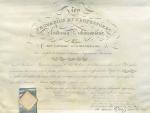
William Charles Ford Reed receives his Bachelor of Arts Diploma from Dickinson College on June 26, 1851.
Format: Certificates and Diplomas
Location: Diploma Collection
Subject: Education
Time Period: 1840-1859
View Item: Bachelor of Arts Diploma - William Reed

June 26, 1851
This copy of the printed program for the commencement exercises held on June 26, 1851 shows the members of the graduating class and the speeches that they were scheduled to deliver.
Format: Memorabilia and Ephemera
Location: Dickinsoniana Programs
Subject: Dickinson College Events
Time Period: 1840-1859
View Item: 1851 Commencement Program

June 26, 1851
James Monroe Kimberlin prepared this oration, entitled “The Destiny of America," for the commencement ceremonies held June 26, 1851. Authoring an original speech was among the graduation requirements for Dickinson College seniors at that time. In discussing the future of the United States, Kimberlin noted that "our existence as a nation been endangered by [slavery]." "By some inglorious providence of God, slavery exists among us," Kimberlin explained. Transcript included.
Format: Speeches and Sermons
Location: Orations-1851-K49d
Subject: Military Affairs and Conflict, Politics and Government, Religion and Spirituality, Social Reform and Advocacy
Time Period: 1840-1859